Category: Christian Social Thought

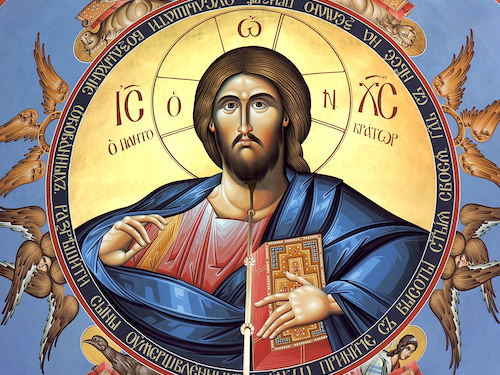
Arabic icon of St. John of Damascus

Today (Dec. 4) is commemorated an important, though sometimes little-known, saint: St. John of Damascus. Not only is he important to Church history as a theologian, hymnographer, liturgist, and defender of Orthodoxy, but he is also important, I believe, to the history of liberty.

In a series of decrees from 726-729, the Roman (Byzantine) emperor Leo III the Isaurian declared that the making and veneration of religious icons, such as the one to the right, be banned as idolatrous and that all icons be removed from churches and destroyed. The Christian practice of making icons dates back to decorations of the catacombs in the early Church as well as illuminations in manuscripts of the Scriptures; indeed, many icons can be found in manuscripts of the Greek version of the Hebrew Scriptures and several icons have even been uncovered in the ruins of synagogues.

Naturally, most Christians of the time protested. Patriarch Germanos I of Constantinople was forced to resign and was replaced by Anastasios, who supported the emperor’s program. This began what is known as the iconoclastic controversy. It spanned over 100 years, and the iconoclasts in the Roman (Byzantine) empire martyred literally thousands of the Orthodox who peacefully resisted and destroyed countless works of sacred art that would be priceless today. Whatever one’s understanding of the place of icons in the Church today, this controversy was a clear abuse of government power that resulted in great tragedy. Read more on St. John of Damascus in the History of Liberty…

Pin not actual size.

I commented last week on the “textbook bubble” (here) and have commented in the past on the “higher-ed bubble” and the character of American education more generally (see here, here, and here). To briefly summarize, over the last few decades the quality of higher education has diminished while the cost and the number of people receiving college degrees has increased. The cost is being paid for, in large part, through government subsidized loans. But with the drop in quality and increase in quantity, a college degree is not as impressive as it used to be; in many cases it no longer signals to employers what it used to. When a critical mass of those loans goes into default, we will have another housing-bubble-esque crisis on our hands. At the same time, government loans, which are largely indiscriminate with regard to the risk of the applicant and guaranteed on the backs of taxpayers, have incentivized colleges and universities to raise the costs to students for the sake of increased expenditures, inflating the bubble even more. Now, Alex Williams of The New Times reports last Friday,

The idea that a college diploma is an all-but-mandatory ticket to a successful career is showing fissures. Feeling squeezed by a sagging job market and mounting student debt, a groundswell of university-age heretics are pledging allegiance to new groups like UnCollege, dedicated to “hacking” higher education. Inspired by billionaire role models, and empowered by online college courses, they consider themselves a D.I.Y. vanguard, committed to changing the perception of dropping out from a personal failure to a sensible option, at least for a certain breed of risk-embracing maverick.

An increasing number of students are realizing that they, to quote Good Will Hunting, do not want to be $150,000 in debt for an education that they could have gotten “for a $1.50 in late charges at the public library.” Read more on The Pin that Might Pop the Higher-Ed Bubble…

John Couretas
posted by on Friday, November 30, 2012

Visiting San Francisco’s Haight-Ashbury district in 1968, Tom Wolfe was struck by the way hippies there “sought nothing less than to sweep aside all codes and restraints of the past and start out from zero.” In his essay “The Great Relearning,” Wolfe connects this to Ken Kesey’s pilgrimage to Stonehenge, inspired by “the idea of returning to civilization’s point zero” and trying to start all over from scratch and do it better. Wolfe predicted that history will record that Haight-Ashbury period as “one of the most extraordinary religious experiments of all time.”

Read more on Back to Civilization’s Point Zero?…

Dylan Pahman
posted by on Thursday, November 29, 2012

According to AEI author Mark Perry, there is another education-related “bubble” to worry about: the textbook bubble. He writes that this textbook bubble “continues to inflate at rates that make the U.S. housing bubble seem relatively inconsequential by comparison.” He continues, “The cost of college textbooks has been rising at almost twice the rate of general CPI inflation for at least the last thirty years.” Given that many students use loan money to purchase books as well as pay for classes, we might think of this as one of the many sources pumping air into the student debt bubble. But what choice do students (or professors, for that matter) have than to surrender to the textbook “cartel,” as Perry characterizes it? This bubble popping, while a bad thing for the textbook bubble-boys committed to the old, cartel-style model, could be a small relief and contribute to slowing the growth rate of the student debt bubble. Read more on Textbook Bubble-Boys…

Ann Schneible, who interviewed Rev. Robert A. Sirico for Vatican Radio today (see PowerBlog post for audio) also published an interview with the Acton Institute president and co-founder on the Catholic news site, Zenit. Excerpt:

Read more on Interview: Rev. Sirico on ‘A Moral Case for a Free Economy’…

On Vatican Radio, Acton President and co-founder Rev. Robert A. Sirico discusses his new book Defending the Free Market: The Moral Case for the Free Market Economy with reporter Ann Schneible.

Read more on Audio: Rev. Sirico on the ‘moral dimension of economic activity’…

Review of Silent Spring at 50: The False Crises of Rachel Carson. Edited by Roger Meiners, Pierre Desrochers, and Andrew Morriss (Cato, 2012)

During the 50 years following the publication of Rachel Carson’s Silent Spring, much has been written to discredit the science of her landmark book. Little, however, has been written on the environmentalist cult it helped spawn.

Until Silent Spring at 50, that is.

Subtitled “The False Crises of Rachel Carson,” Silent Spring at 50 is a collection of essays specially commissioned by the Cato Institute and edited by Roger Meiners, Pierre Desrochers and Andrew Morriss. Much like Roger Scruton’s recent How to Think Seriously About the Planet: The Case for Environmental Conservatism, the essays present a unified indictment not necessarily of Carson per se but of the disastrous results wrought by the policies she inspired.

In “The Lady Who Started All This,” environmentalist William Kaufman presents an admiring portrait of Carson as a scientist who unfortunately took a left-turn from her previous works — based on objective, empirical research — when she endeavored to write Silent Spring shortly after her cancer diagnosis. For this ill-conceived approach, Kaufman blames Wallace Shawn, the New Yorker editor who prompted Carson to abandon her “disinterested scientist” voice in favor of a more “adversarial” tone. Since the famous editor signed Carson’s check, the author readily complied. Read more on Rachel Carson’s Environmental Religion…

Pravmir.com, a Russian site, has published an English translation of an interview given by Archpriest Nikolai Chernyshev, who is identified as “the spiritual father of the Solzhenitsyn family during the final years of the writer’s life.” The interview touches on Aleksandr Solzenitsyn’s upbringing in a deeply religious Russian Orthodox family, his encounter with militant atheism ( … he joined neither the Young Pioneers nor the Komsomol [All-Union Leninist Young Communist League]. The Pioneers would tear off his baptismal cross, but he would put it back on every time). Fr. Chernyshev describes the writer’s later “period of torturous doubt, of rejection of his childhood faith, and of pain.” The priest talks of Solzhenitzyn’s return to the faith after his experience in the Gulag and how “he suffered and fretted about the Church being in a repressed state. For him this was open, obvious, naked, and painful.” Excerpt from the interview:

Read more on Solzhenitsyn: ‘There’s Plenty of Freedom, But Little Truth’…

Anthony Esolen has written a rollicking piece in Crisis bemoaning the misrepresentation, misuse and mangling of Catholic Social Teaching. In a phrase, he’s sick of it.

I’m sick of hearing that Catholic teaching regarding sex and marriage is one thing, in that old-fashioned trinket box over there, while Catholic teaching regarding stewardship and our duties to the poor is another thing, on that marble pedestal over here.  I’m sick of hearing that Catholic teaching regarding the Church and her authority is one thing, the embarrassing Latinate red-edged tome tucked away in that closet, while Catholic teaching regarding the laity is another, and pass that bread this way!  No, it is all of a piece.  What the Church says about divorce is inextricable from what she says about the poor.  What she says about the presence of Christ in the Eucharist is inextricable from what she says about the respects in which all men are created equal—and the many respects in which she insists upon a salutary inequality.  When we fail to see the integrity of the faith, not only do certain truths escape our notice; the rest, the truths we think we see, grow monstrous, like cancers, and work to destroy the flesh they once seemed to replace.

This is the first in a series of articles on Catholic Social Thought. Esolen addresses the issue of “imposing our morality” on our neighbors, what Pope Leo XIII really had in mind when discussing socialism, and why asking Michelangelo to promote porn isn’t a justifiable idea. If the rest of the series is anything like this article, it’ll be a real treat.

Read more on Misrepresenting Catholic Social Teaching: ‘I’m Sick of It’…

R.J. Moeller
posted by on Thursday, November 22, 2012

I just finished re-reading through C.S. Lewis’ “Space Trilogy” and have a Holiday book recommendation for you: the third title in this series, That Hideous Strength.

Certainly all three are fantastic and important reads that incorporate thematic elements relating to theology, philosophy, history, politics, economics and astronomy. It’s “Science Fiction,” but only in the same way that the Bible is “just a bunch of God’s rules.” These three books are bigger than any one genre and the Sci-fi label should not deter a single one of you from digging in.

Read more on Recommended: ‘That Hideous Strength’…

Acton PowerBlog RSS

Google Plus

Twitter Feed

Facebook Fan Page

Support the Acton Institute

The Acton Institute is funded through the generous contributions of individuals such as yourself. Learn more about how you can advance the cause of freedom and virtue.