Category: Christian Social Thought

Elise Hilton
posted by on Tuesday, July 3, 2012

Ismael Hernandez, founder and executive director of the Freedom & Virtue Institute and Acton University lecturer, has written a piece in Crisis Magazine detailing why the Church should cut purse strings with the federal government. Noting that we cannot be both religious ministers to the poor and government-paid social workers, Hernandez bolsters his view by looking to the very foundation of America:

Read more on Telling Pharaoh To Keep His Money…

Most Rev. Joseph F. Naumann, D.D., Archbishop of Kansas City, Kansas

On Catholic World Report, Carl E. Olson interviews Rev. Joseph F. Naumann, the Archbishop of Kansas City, Kansas, about the HHS mandate, the Ryan budget, and what the Supreme Court ruling means for the religious freedom fight.

Read more on ‘We didn’t pick the time, nor did we pick the fight’…

Anytime I can get a progressive/dissenting Catholic magazine/blog like the Jesuit-run America simultaneously to quote papal documents, defend the Magisterium of the Catholic Church, embrace the Natural Law and even yearn for a theological investigation “by those charged with oversight for the Church’s doctrine” of a writer suspected of heresy, I consider that I have had a good day.

And to think that all this was prompted by two sentences of mine quoted in a New York Times story on an attempt by adjunct professors at Pittsburgh’s Duquesne University to form a union! Times reporter Mark Oppenheimer asked how I made sense of the resistance on the part of Duquesne, a Catholic University, to unionizing efforts by adjunct professors in light of the Church’s teaching about unions. We had a pleasant half hour talk on the subject in which I first explained that the Church generally looked favorably on unions – certainly not all of them, at all times or in all places, and not at all they do, and not as an end in themselves, but rather for the well-being of those workers and their families (i.e., that the Church’s support for unions is contingent). This favorable bias does not mean that workers are obligated to join a union, nor that management is obligated to accept the terms of a union. The right to join a union, in Church teaching, is rooted in the natural right of association, which of course also means that people have the right not to associate. It all boils down to the details of the specific case, meaning that Duquesne was probably considering the ever-rising costs of education and its impact on the lives of students and their families.

It was in this context that I uttered what the America magazine/blog writer Vincent Miller deemed offensive when I observed that Pope Leo XIII wrote Rerum Novarum, “In the industrial revolution, [when] the church was concerned about communism, and not just capitalism but savage capitalism . . . People were being brutalized. That’s just not the case in Pittsburgh today.” Read more on Rev. Robert Sirico: Reply to America Magazine…

Brian Brenberg, a teacher of business and economics at The King’s College, explains why the work of “table servers” has eternal significance:

Who is the “public” for your work—who is it for, and how does it affect the lives of those who engage with it?

Read more on How Table Servers Advance God’s Kingdom…

Joe Gorra of the Evangelical Philosophical Society concludes his excellent series of interviews with Acton University speakers by discussing entrepreneurship, poverty, and Abraham Kuyper with Peter Heslam:

Gorra: The role of faith in building social capital is fascinating.
Social scientists increasingly agree that social capital is fundamental to business success, economic development and wellbeing and that Christianity is one of its key contributors.

Read more on Entrepreneurship, Poverty, and Abraham Kuyper…

The New York Times interviewed Rev. Robert A. Sirico about a movement by professors at Duquesne University, a Catholic school in Pittsburgh, to organize a union. The Times writes that, “Duquesne is arguing that its affiliation with the Spiritans, a Roman Catholic order, affords it a special exemption from the jurisdiction of the National Labor Relations Board. It’s a conflict between church and state, the school’s lawyer argues, to allow workers to file for a union election.” Rev. Sirico, Acton’s president and co-founder, responded to the question of whether or not “the importance of unions in Catholic teaching is historically contingent.”

Read more on Rev. Sirico on the Duquesne Unionization Drive…

Mindy Hirst
posted by on Monday, June 25, 2012

Raleigh Gresham is senior pastor at Fellowship Bible Church in Colorado Springs. His passion is to help people understand that church is more than what we do on Sundays but reaches into all areas of our lives. He has begun a new way of interacting with the congregation through a concept called “Gathered & Scattered.” Join us as we listen to his hopes and dreams for the church today and a powerful example of a small win he saw while leading FBC on this journey toward becoming a church that “just loves people.”

Read more on A Church on Mission…

What would Diedrich Bonhoeffer have to say about the HHS mandate? Eric Metaxas–best selling author of the biographies on William Wilberforce and Bonhoeffer:Pastor, Martyr, Prophet, Spy gives us some insight in this 2 minute video that explains the real issue behind the HHS Mandate: Religious liberty

Read more on New Video: HHS Mandate and Religious Liberty…

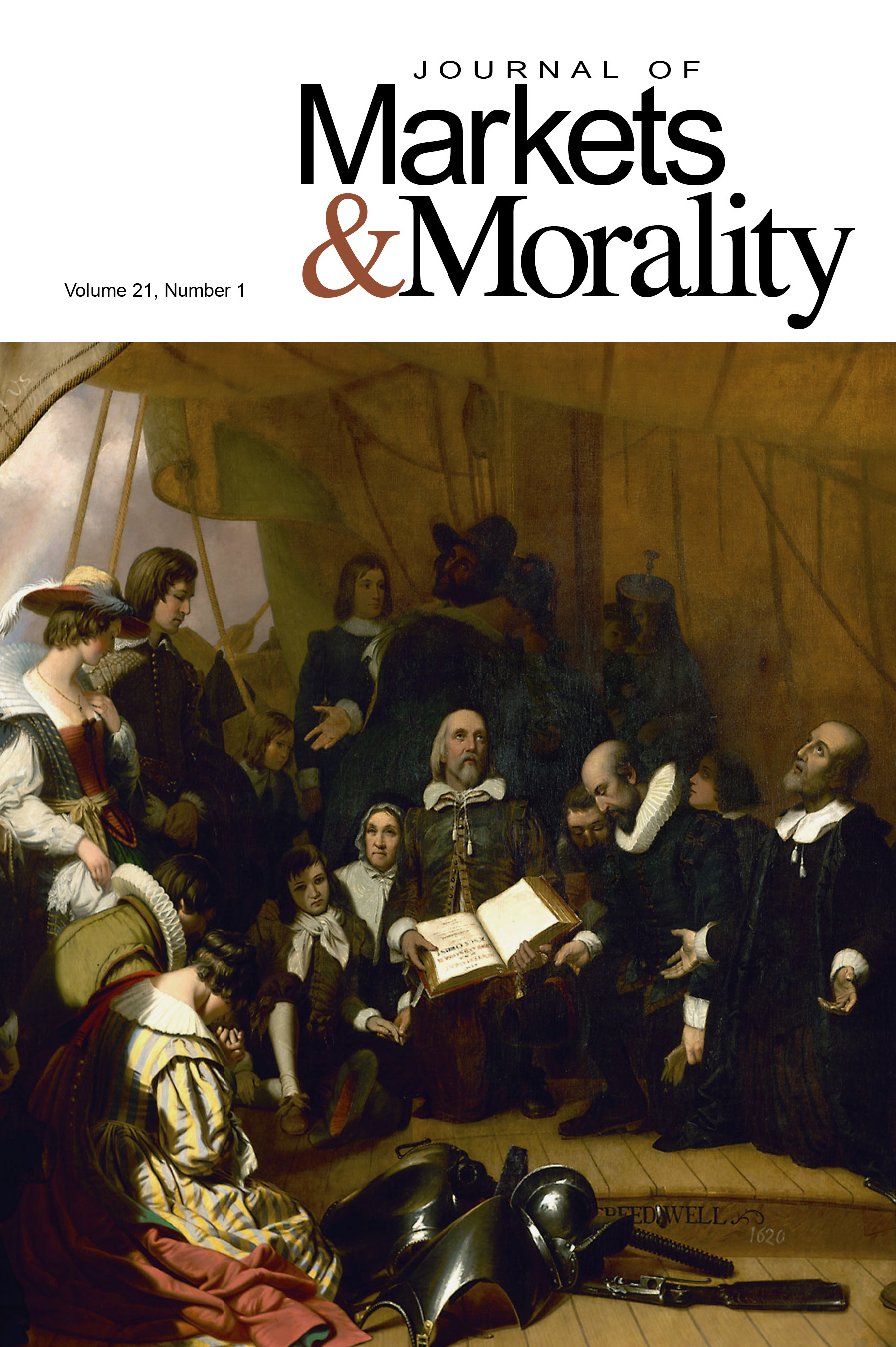
The new issue of the Journal of Markets & Morality

The Spring 2012 issue of the Journal of Markets & Morality (15.1) has been posted at www.marketsandmorality.com and should be arriving in print to our subscribers sometime soon in the coming weeks.

Read more on New Issue of the ‘Journal of Markets & Morality’…

In a follow up interview to “Is Capitalism Immoral?,” Joseph E. Gorra on the Patheos Evangelical channel talks with Rev. Robert A. Sirico, Acton Institute president and co-founder, about the publication of his new book, Defending the Free Market: The Moral Case for a Free Economy. Gorra begins the interview by observing that “within Western societies today there appears to be a kind of fact/value dichotomy that operates as an assumption in much of our discourse, where questions of ‘economics’ (and the sciences in general) are in the category of knowledge and facts and therefore tend to trump questions of theology.”

Read more on Interview: Rev. Sirico responds to ‘Does Capitalism Promote Greed?’…

Acton PowerBlog RSS

Google Plus

Twitter Feed

Facebook Fan Page

Support the Acton Institute

The Acton Institute is funded through the generous contributions of individuals such as yourself. Learn more about how you can advance the cause of freedom and virtue.