Category: Public Policy

It often comes to light over matters of disagreement that one side attempts to shut down the debate by emulating Ring Lardner’s father in The Young Immigrants: “’Shut up,’ he explained.” Of course, this isn’t at all a real explanation, but it sure does slam the door on any further discussion.

This disingenuous tactic is witnessed again and again in the climate-change debate. Most notably it appears in the tactics of those who believe the science is settled, a scientific consensus exists and global warming indeed poses a serious catastrophic threat to our planet – as evidenced by a March 7, 2013, webinar conducted by As You Sow for proxy shareholder resolutions.

As You Sow – which says 18 percent of its members are faith-based organizations – seeks to prompt corporate boards in which it owns stock to adopt its view of climate change. One method to achieve this goal is shutting down the debate completely. As noted in its 2013 “Proxy Preview,” AYS and a “very broad coalition of investors is continuing a vigorous initiative to make companies be more transparent about how they spend corporate treasury money on political campaigns and lobbying.” Read more on As You Sow Shuts Up Climate-Change Debate…

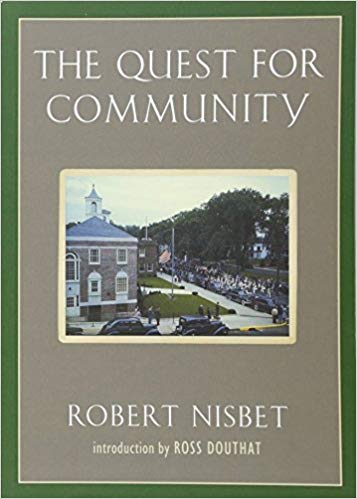
If we assume that the institutions of civil society, like churches, recreation centers, fantasy football leagues, and book clubs are essential for a flourishing society, it becomes very important to determine how such institutions are developed, maintained, and promoted.

For thinkers as varied as Alexis de Tocqueville, Abraham Kuyper, and Pope Paul VI, the realm of civil society provides an indispensable area of connection and protection between the individual person and the political order. In Quadragesimo anno, Paul VI writes of the need for “the reform of institutions,” necessary in part because of “the evil of what we have termed ‘individualism’ that, following upon the overthrow and near extinction of that rich social life which was once highly developed through associations of various kinds, there remain virtually only individuals and the State.”

It is at this point that Paul VI invokes the principle of subsidiarity, which is dependent upon and recognizes the rich variegation of human social life, which consists in human identity not only in terms of the individual citizen and the political order, but also in the human person as friend, co-worshiper, family member, co-worker, neighbor, and so on. One of the things most pressing for Paul VI was the idea that these institutions of civil society needed to be strengthened, not only for their own good but also for that of the political order itself and even more broadly for the common good: “for, with a structure of social governance lost, and with the taking over of all the burdens which the wrecked associations once bore, the State has been overwhelmed and crushed by almost infinite tasks and duties.”

How do we reinvigorate civil society once it has declined? How do we help build up what has atrophied? These are questions that are vital for moving beyond a false dichotomy of market and state or individual and state, not only conceptually but practically. As Matthew Kaemingk writes, “Their importance is often ignored by politicians, but sociologists tell us that a flourishing array of non-profits and free organizations consistently leads to measurable declines divorce, poverty, violence, obesity, depression, chronic illness, illiteracy, dependency, homelessness, and political apathy.” But if associations of civil society help lead to these outcomes, what helps lead to associations of civil society?

Melissa Steffan reports at Christianity Today this week on some research that bears on aspects of the necessary answers to these questions. Steffan writes, “Parents considering whether or not to send their children to private school can now weigh more than just tuition and curriculum. According to a new study from professors at Calvin College, the affiliation of a high school student’s school significantly impacts his or her sense of civic duty.”

She is referring to a new article from Jonathan Hill and Kevin den Dulk, “Religion, Volunteering, and Educational Setting: The Effect of Youth Schooling Type on Civic Engagement,” which appears in the Journal for the Scientific Study of Religion.
Read more on Education by and for Civil Society…

When it comes to proving support for those in poverty, a significant number of economists, politicians, and pundits support direct transfer of money—just giving the poor cash.

ford fiestaThere are many moral and practical reasons I think that option is a suboptimal means of aiding the poorest of our neighbors. But it does have one substantial benefit: It’d be much cheaper and efficient than current welfare programs.

As Daniel Halper at The Weekly Standard points out, the Senate Budget Committee finds that the amount of money spent on welfare programs equals, when converted to cash payments, about “$168 per day for every household in poverty.”

According to the Senate Budget Committee:
Read more on Welfare Spending Equals $47,000 and a Ford Fiesta Per Family…

mass_design_groupIn a recent issue of Metropolis Magazine, Thomas de Monchaux tells the story of an amazing lesson about innovation that Americans can learn from Rwandans. This is no surprise, but readers will learn that burdensome government regulations stifle innovation and undermine human flourishing.

De Monchaux recounts the story of Michael Murphy, executive director and co-founder of the Boston-based MASS Design Group, and Alan Ricks, MASS cofounder and COO, attempting to take what they learned from building health care facilitates and hospitals in Rwanda, with minimal building code regulations, and bringing that knowledge to building in the United States. He describes the project in Butaro, Rwanda this way:
Read more on Architecture, Human Flourishing, and Health Care…

Joe Carter
posted by on Tuesday, March 5, 2013

“Want a job at the Pig?” asked my best friend Steve.

By my reaction, you would have thought he’d asked if I wanted a date with Kathy Ireland rather than inquiring about a job as a grocery sacker at the Piggly Wiggly. But I was living at Steve’s parent’s house rent-free, and needed to earn some money. And in Clarksville, Texas in 1985, the prospects of an inexperienced teen finding a good job were only slightly better than chances of dating a supermodel.

piggly-wigglyThe elation was short-lived, though, and lasted only until I saw my first paycheck. As a full-time student working for a job that qualified for tips (I never, ever got tips) my employer was allowed to pay me the subminimum wage of $2.85 a hour (the equivalent of $5.87 in 2012). After FICA and Social Security took their cut, there wasn’t much left for me.

So if Ronald Reagan had announced in his State of the Union address that he was raising the minimum wage to $4.37 an hour (the equivalent in 1986 of Obama’s $9 minimum wage) I would have been ecstatic. Like all my fellow proletarian coworkers I was disdainful of Reagan’s economic policies, particularly his refusal to raise the minimum wage. Reagan’s was the only administration not to have raised the minimum wage since it was introduced nationally in 1938—a fact we often repeated in the breakroom as we looked at our paystubs and cussed the president.

Twenty-seven years later, though, I see the situation differently. I realize that I have not only my friend Steve but also President Reagan to thank for my getting hired at the Piggly Wiggly. Had the minimum wage been raised, the store owner could have never afforded to hire me. Since my labor was barely worth $2.85 an hour, having a government imposed price increase on wages of 52% would have priced me out of the market.

As William Graham Sumner explained in 1883, by attempting to do me a favor—by artificially raising the minimum wage I must be paid—the politicians were hurting both me and my potential employer:
Read more on The Forgotten Man at the Piggly Wiggly…

Should Catholics be concerned about the looming budget cuts? The National Catholic Register asked several Catholic leaders and thinkers, including Acton’s Samuel Gregg, for their response to the sequester:

NCRlogo_tagRe-establishing fiscal discipline and welfare reform are necessary components to securing the common good, a key principle in Catholic social teaching, said Samuel Gregg, author of the new book Becoming Europe: Economic Decline, Culture and How America Can Avoid a European Future.

Read more on Samuel Gregg on Catholics, Welfare, and the Sequester…

Anthony Bradley
posted by on Friday, March 1, 2013

I have yet to read a moral argument for why the taxes collected from working men and women should be redistributed to businesses. It’s called “corporate welfare.” This is the odd state of affairs where, business owners compete for government funding rather than exclusively competing for customers in the marketplace. In fact, many of the biggest recipients of corporate welfare are the same businesses that hire high-priced lobbyists to help write laws in Congress that protect them from competition. Why, then, do voters turn a blind eye to corporate welfare?

Bloomberg.com reports that:
Read more on Corporate Welfare: Why?…

I have recently accepted the honor of becoming a contributing editor at Ethika Politika, and I begin my contribution in that role today by launching a new channel (=magazine section): Via Vitae, “the way of life.” In my introductory article, “What Hath Athos to Do With New Jersey?” I summarize the goal of Via Vitae as follows:

Read more on Seeking the Meeting Point Between the Kingdom of God and the Common Good…

The February issue of Sojourners magazine presents various perspectives on the surge in evangelicalism’s interest in exploring new national and international peace initiatives. For example, The World Evangelical Alliance’s Peacebuilding and Reconciliation Initiative acknowledges “that in our zeal for evangelism, we have often overlooked the biblical mandate to pursue peace. We commit ourselves anew to this mandate within our homes, churches, communities, and among the nations.” Evangelicals for Social Action (ESA) promotes itself as an evangelical organization that “consistently campaigns at the grassroots and policy level for a world that is pro-life and pro-poor, pro-family and pro-racial justice, pro-sexual integrity and pro-creation care.” “We want Christians to look deeply, act justly, and love radically,” says ESA.

Justice and peace are, of course, themes we can all support. What Christians are there in the world who are pro-war and pro-injustice? Even with these themes, however, is it possible that those who are oppressed and suffering need more than a society that is merely peaceful and where people are acting justly? Because “peace” and “justice” are normally situated in light of negative realities, more often than not, the discourse tends to focus on what we should not do in society instead what allows people to be free to live out their vocation to be human. The solutions offered tend to narrowly focus on lofty hoped for visions that deny trade-offs necessary in a broken world.

Additionally, we find the surprising promotion of a ruling class of elites in government having concentrated decision-making power over those with less money and less political power, rather than considering ways to allow people to make decisions that empower them to seek their own solutions to meeting their needs. We need to do more than “end slavery” or “end poverty.” We need to think more deeply about what it means to be human and how we can put people in positions, in accordance with their design by their Creator, to live well. In other words, we need to focus our attention on human flourishing.

In a 2003 article on human flourishing,” Dr. Edward W. Younkins helps us get a sense of the advantages of focusing on human flourishing: Read more on Human Flourishing: Seeking More For The Oppressed…

Has there ever, in the history of America, been a presidential administration as dismissive of religious liberties as the Obama Administration?

contraceptive-mandateThe Administration seems to truly believe that when religious beliefs come into conflict with one of the President’s pet policies—such as employers being forced to pay for contraceptives and abortifacients—that religious liberties must be set aside. A prime example is the Administration’s idea that by forming a business entity intended to limit liability, a person loses their First Amendment right to the free exercise of religion.

As CNSNews reports, during an oral argument in the U.S. District Court for the District of Columbia last fall, a lawyer for the U.S. Justice Department told a federal judge that the Obama administration believed it could force the judge’s own wife—a physician—to act against her religious faith in the conduct of her medical practice.

Here is the exchange, from the official court transcript, between this Obama administration lawyer and Judge Walton:
Read more on Obama Administration to Federal Judge: We Can Force Your Wife to Violate Her Religion…

Acton PowerBlog RSS

Google Plus

Twitter Feed

Facebook Fan Page

Support the Acton Institute

The Acton Institute is funded through the generous contributions of individuals such as yourself. Learn more about how you can advance the cause of freedom and virtue.