Archived Posts 2010 » Page 4 of 47 | Acton PowerBlog

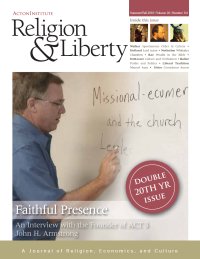
Over the years Religion & Liberty has compiled a lot of interview gems and first class content for our readers. The new issue, now available online, highlights some of that content, with new material as well. This double issue is an Acton 20th Anniversary tribute with an interview with John Armstrong as well as a collection from some of our best interviews. Regarding the compiled collection, the responses selected represent a range of timeless truths of the Gospel, the importance of human liberty, and the importance of religion and moral formation in society.

Read more on Religion & Liberty: Acton 20th Year Issue with John Armstrong…

Madeleine L’Engle, in a 1986 essay, “What May I Expect from My Church?”

And that is what I want my church to speak out about: the Gospel, the Good News. Then I will be given criteria to use in thinking about such issues as abortion, euthanasia, genetic manipulation. It is impossible to listen tot he Gospel week after week and turn my back on the social issues confronting me today. But what I hope for is guidance, not legislation.

L’Engle wrote these words referring to the Episcopal Church, but I echo precisely these sentiments in my critique of the ecumenical movement’s social witness in Ecumenical Babel. What we need is moral guidance and formation from the church, not, as I put it, attempts “to make arbitrary conclusions morally binding.”

Read more on ‘What May I Expect from My Church?’…

Marc Vander Maas
posted by on Wednesday, December 8, 2010

Acton On The AirDr. Samuel Gregg, Director of Research at the Acton Institute, joined host Al Kresta on Kresta in the Afternoon to discuss his recent Acton Commentary and Pope Benedict XVI’s book Light of the World. You can listen by using the audio player below.

Read more on Audio: Benedict XVI, Christian Radical…

Jordan J. Ballor
posted by on Wednesday, December 8, 2010

My friend John Armstrong examines “How Market Economies Really Work.” Armstrong concludes, “The gospel makes people free and teaches them to be virtuous. This is what is inherently Christian and no economic system can thrive long-term without them.”

Read more on Market Economies and the Gospel…

The Seven Fund has announced a new Breakthrough Innovation Grant competition.

The Breakthrough Innovation Grant (BIG) of up to USD $20,000 will be given to the most innovative business ideas that will have an impact on poverty alleviation in the Philippines.

Read more on Seven Fund Announces New Competition…

Hunter Baker
posted by on Tuesday, December 7, 2010

John Couretas reminded me that I put up a short note about Jeremy Lott’s life of William F. Buckley, but never returned to give the overall review. Please forgive the oversight! I have combined elements of the first post with additional thoughts to create a whole and to prevent the need to look back to the original post.

Read more on Lott on Buckley, Revisited…

Jordan J. Ballor
posted by on Tuesday, December 7, 2010

In an edition of the Philosophy Bites podcast last month, “Nicholas Phillipson, his acclaimed biographer, discusses Adam Smith’s view of human beings.” Phillipson argues of Smith that “even his economic thinking is perhaps best understood as part of a broader philosophical project of a science of human beings.”

Read more on Adamic Anthropology…

Last Thursday at Rome’s (but technically part of Vatican City) Pontifical Lateran University, Istituto Acton held a day-long conference on “Ethics, Aging and the Coming Healthcare Challenge.”

It was a successful event, if a bit unusual compared to some of our other Roman gatherings. It’s not often that an Acton conference is so focused on the finality of death, after all; we often stick to the other “inevitability” of life, i.e. taxes. Yet in both spiritual and economic terms, there’s no sense in denying it.

Read more on Acton Rome event on Ethics, Aging and Health Care…

Last night a band of hearty travelers braved the first snow of the season here in Grand Rapids (and the attendant slick and dangerous roads) to hear Dr. John H. Armstrong speak at the November/December Acton on Tap, “Ecumenism and the Threat of Ideology.” Dr. Armstrong is founder of ACT 3 and adjunct professor of evangelism at Wheaton College.

Read more on Acton on Tap: Ecumenism and the Threat of Ideology…

John Couretas
posted by on Wednesday, December 1, 2010

This week’s Acton commentary from Research Director Samuel Gregg. Sign up for the free, weekly newsletter from Acton for the latest news and analysis.

Benedict XVI: Christian Radical

By Samuel Gregg

As the condom-wars ignited by Benedict XVI’s Light of the World abate, some attention might finally be paid to the book’s broader themes and what they indicate about Benedict’s pontificate. In this regard, perhaps the interview’s most revealing aspect is the picture that emerges of Pope Benedict as nothing more and nothing less than a Christian radical.

Those accustomed to cartoon-like depictions of Joseph Ratzinger as a “reactionary” might be surprised by this description. But by “radical,” I don’t mean the type of priest or minister who only wears clerical garb when attending left-wing rallies or publically disputing particular church doctrines.

The word “radical” comes from the Latin radix, meaning “root.” It’s in this sense Benedict is radical. His pontificate is about going back to Christianity’s roots to make, as Benedict says, “visible again the center of Christian life” and then shining that light upon the world so that we might see the truth about ourselves.

At Christianity’s center, Benedict states, is the person of Jesus Christ. But this person, the pope insists, is not whoever we want him to be. Christ is not the self-help guru proclaimed by the charlatans of the Prosperity Gospel. Nor is he the proto-Marxist beloved by devotees of the now-defunct liberation theologies. Still less is Christ a “compassionate, super-intelligent gay man”, as once opined by that noted biblical scholar, Elton John.

According to Benedict, Christ is who Christ says he is: the Son of God. Hence, there is no contradiction between what some call “the Christ of faith” and “the Christ of history.” In Light of the World, Benedict confirms that underscoring this point was why he wrote his best-selling Jesus of Nazareth (2007). “The Jesus in whom we believe,” Benedict claims, “is really also the historical Jesus.” Read more on Benedict XVI: Christian Radical…

Acton PowerBlog RSS

Google Plus

Twitter Feed

Facebook Fan Page

Support the Acton Institute

The Acton Institute is funded through the generous contributions of individuals such as yourself. Learn more about how you can advance the cause of freedom and virtue.