Archived Posts February 2011 » Page 4 of 5 | Acton PowerBlog

Anthony Bradley
posted by on Wednesday, February 9, 2011

My latest for Acton Commentary. I’m also adding a couple of videos from Hotep and the Institute for Justice.

Let the Hustlers Hustle

By Anthony Bradley

If necessity is the mother of invention, then there is nothing worse than quenching the entrepreneurial spirit of people seeking to improve their situation by imposing arbitrary third-party constraints. America’s unemployment problems linger because hustlers cannot hustle.

Read more on Let the Hustlers Hustle…

Hunter Baker
posted by on Wednesday, February 9, 2011

Michael Kinsley has a column up at The Politico in which he claims to debunk a series of Reagan myths. The one that annoys me the most is the one that is obviously and clearly incorrect and at the same time gets the least explanation from Kinsley. Here it is:

Read more on Don’t Knock the Laffer Curve…

Wrapping up our recap of last year’s Acton Lecture Series, today we present two additional lectures for your enjoyment.

The first was delivered in April of 2010 by Acton President Rev. Robert A. Sirico, and was entitled “Does Social Justice Require Socialism?” In this lecture, Sirico examined the increasing calls for government intervention in financial market regulation, health care, education reform, and economic stimulus in the name of “social justice”.

Read more on Acton Lecture Series 2010: Sirico & Ballor…

God and Money passes along a news story about a church in Nebraska raising money “to buy motorcycles (probably not Harleys) for pastors in the African country of Tanzania. Pastors there serving multiple congregations cannot simulcast their sermons–they have to walk upwards of 60 miles to be with their flock.”

Read more on The New Circuit Riders and the Bicycle Economy…

Ray Nothstine
posted by on Friday, February 4, 2011

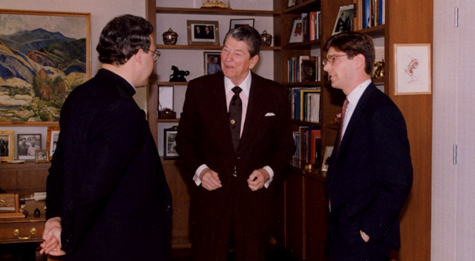
Rev. Robert Sirico, president and co-founder of the Acton Institute called Ronald Reagan a “sunny warrior for freedom” with “a clear sense of moral priority.” The commentary was written a day after the former president’s death in 2004. If you walk into the Acton office you might notice a photo of Rev. Sirico and Acton executive director and co-founder Kris Mauren with Reagan at his former office in Century City, California. He holds a visible imprint at Acton.

Read more on Reagan Centennial Roundup…

Today is the 105th anniversary of the birth of the German pastor and theologian Dietrich Bonhoeffer. From the R&L archives:

Bonhoeffer’s resistance to the Nazi regime included his support for and pastoral participation in the Confessing Church along with other prominent Protestant theologians like Karl Barth and Martin Niemöller, as well as his intricate association with the broader ecumenical movement. When the effectiveness of the Confessing Church’s opposition to Hitler was blunted and his efforts to bring the moral authority of the ecumenical movement to bear failed, Bonhoeffer became involved with the so-called Abwehr conspiracy, which intended to assassinate Hitler, overthrow the Nazi regime, and end the war.

Read more on Dietrich Bonhoeffer’s 105th Birthday…

Stephen Grabill and I follow up on the Lausanne Congress in this week’s Acton Commentary:

After Cape Town: Still Learning to Talk About Business and Ministry

By Brett Elder and Stephen Grabill

The Cape Town Commitment — a document that flows out of the Third Lausanne Congress on Global Evangelization held in Cape Town, South Africa, this past October — has generated a great deal of discussion since its release last week. Prior documents and declarations proceeding from the previous two Lausanne Congress gatherings (such as the 1974 Lausanne Covenant, and the 1989 Manila Manifesto) have been embraced as a sort of social encyclical and common rallying point for the evangelical church — broadly defined — around the world.

Last fall, we sat with rapt attention in the multiplex session on “Workplace Ministry” in Cape Town. It was during this insightful session that we were humbly reminded that one of the shortcomings of the Manila Manifesto was the glaring omission of the business community in the cause for global evangelization. Here we were apprised of the secular-sacred divide that has plagued the Christian church for centuries. Mark Greene, of the London Institute for Contemporary Christianity, and other distinguished speakers and panelists described eloquently the main reasons why, historically speaking, “ministry” and “business” have frequently operated in hermetically sealed compartments. The bottom line is that the evangelical church has yet to integrate ministry and business or harness its potential synergy in significant ways for the cause of global evangelization.

The sad reality for far too many in the church is that “ministry” is sacred and “business” is secular. You do not have to be a theologian to grasp the logical conclusions that follow and that perpetuate these bifurcated realms. Christian discipleship is reduced to one form or another of ministry effort and all ministry is done through the institution of the local church or a nationally or globally oriented parachurch organization. Therefore, all those serious about ministry will be drawn to spend as much time as possible in the “ministry” world. Perhaps one can even take some of that ministry into the “secular” workplace and redeem it? Perhaps Bible studies or personal evangelism efforts will help redeem that space?

When we relegate work (which God ordained before the fall) to the “secular” realm we cede territory that is squarely a part of God’s kingdom design. This separation has profound consequences. In fact, from a biblical vantage point, what we commonly refer to as “ministry” is no more sacred than “business” — God is the author and designer of all of life. That means that reflecting God’s image in our business activity is indeed a sacred calling and one worthy of a lifetime of intentional effort. It is most certainly not a necessary evil. We commend the framers of the Cape Town Commitment for very clear language that charts a fuller, more robust trajectory for evangelism and discipleship; thereby inviting the remaining 98 percent of the Christian community who do not serve in formal ecclesiastical roles to understand their vocation as “ministry.” We all must reflect God’s image as we employ our unique areas of giftedness in service to our neighbor, the kingdom, and the world around us. Read more on After Cape Town: Still Learning to Talk About Business and Ministry…

The following is my latest article for Acton Commentary:

Stewardship and the Human Vocation to Work

By Rev. Gregory Jensen

Paying the bills and contributing to the collection basket are laudable. But Christian stewardship is significantly more than these; like prayer, fasting, and the sacraments, it is an essential part of our Christian life. More than what we say, the way we use our time, talent and treasure, reveals what we value, how we understand ourselves as men and women of faith, and what we believe it means to be human.

Read more on Stewardship and the Human Vocation to Work…

There’s still time to register for tomorrow’s opening lecture of the 2011 Acton Lecture Series (click here to reserve your seat for Rev. Robert A. Sirico’s “Christian Poverty in the Age of Prosperity”), and while we’re anticipating the start of the 2011 series we’ll continue our blog recap of the 2010 series. Today, we highlight one of my favorite lectures from last year: Joseph Morris’ “Alinsky for Dummies: His Persistent Influence and Its Meaning for American Society and Politics.”

Read more on Acton Lecture Series 2010: Joseph Morris on Saul Alinsky…

Jordan J. Ballor
posted by on Wednesday, February 2, 2011

Yesterday I noted some items related to the question of punishment and restorative justice in the American criminal justice system. And in the past we’ve looked here at the PowerBlog of the issues surrounding political and social activism on prison rape.

Read more on Humor and Prison Rape Culture…

Acton PowerBlog RSS

Google Plus

Twitter Feed

Facebook Fan Page

Support the Acton Institute

The Acton Institute is funded through the generous contributions of individuals such as yourself. Learn more about how you can advance the cause of freedom and virtue.