Posts tagged with: abraham kuyper

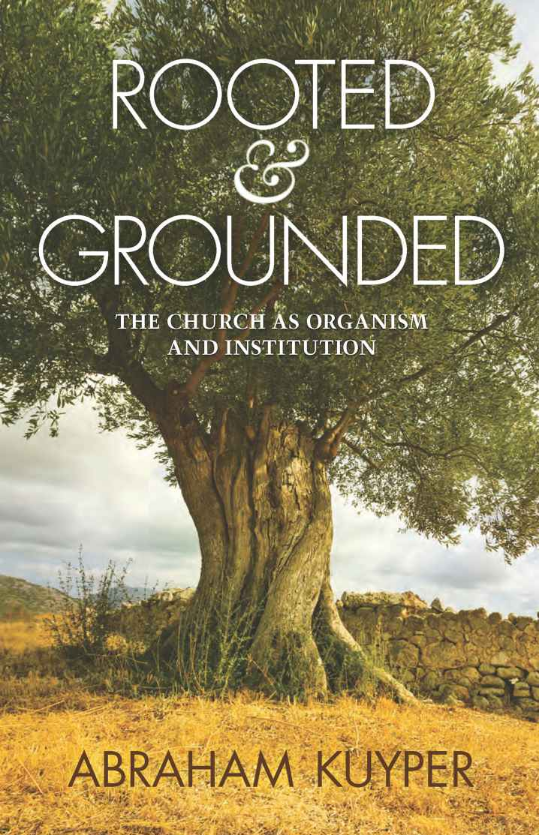
I’m pleased to announce that the first fruits of the Kuyper Common Grace Translation project are forthcoming, in the form of Wisdom & Wonder: Common Grace in Science & Art. This is the first selection out of the larger three-volume set that will appear in complete translation in English.

Read more on Announcing Wisdom & Wonder: Common Grace in Science & Art

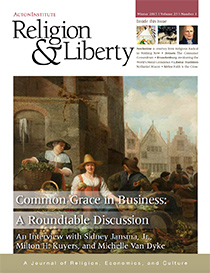
Religion & Liberty’s summer issue featuring an interview with Metropolitan Jonah (Orthodox Church in America) is now available online. Metropolitan Jonah talks asceticism and consumerism and says about secularism, “Faith cannot be dismissed as a compartmentalized influence on either our lives or on society.”

Mark Summers, a historian in Virginia, offers a superb analysis of religion during the American Civil War in his focus on the revival in the Confederate Army. 2011 marks the 150th anniversary of America’s bloodiest conflict. With all the added attention the conflict is receiving, a piece focusing on faith is especially poignant. “The Great Harvest” by Summers notes that the revival was “homespun,” meaning one that was organic in nature and spread among the common soldier.

I offer a review of Darren Dochuk’s new book From Bible Belt to Sunbelt. Dochuk tells the tale of the great migration from the American South to Southern California. This development ultimately transformed evangelicalism and national politics. It also helped in wedding many religious conservatives to economic conservatism.

“The Separation of Church and Art” is an excerpt from the forthcoming book, Wisdom & Wonder: Common Grace in Science & Art by Abraham Kuyper. Available for the first time in English, Christian’s Library Press will publish Kuyper’s work in November. The Acton Institute has played a tremendous role in the translation project. You can find out more about that role here.

The “In The Liberal Tradition” figure is American Founder Oliver Ellsworth. Ellsworth, a strong proponent of federalism was instrumental in the shaping of our Republic. American President John Adams called Ellsworth “the firmest pillar” of the federal government during its earliest years. In a new biography about Ellworth, author Michael C. Toth argues that Ellsworth’s Reformed faith not only shaped his personal life but the model of federalism he supported also had deeply religious roots within Connecticut.

There is more content in this issue. Past issues of Religion & Liberty are also available online.

Jordan J. Ballor
posted by on Thursday, August 18, 2011

As part of our ongoing engagement with the Protestant world, the Acton Institute has taken on the translation of Abraham Kuyper’s Common Grace, under the general editorship of Stephen Grabill and in partnership with Kuyper College. We’re convinced that renewed interest in the thought of Abraham Kuyper (1837-1920), and in fact rediscovering aspects of his thought that have been lost or misconstrued in the intervening decades, is critically important for the reconstruction of Protestant social thought.

Read more on New Amsterdam Redivivus…

Jordan J. Ballor
posted by on Wednesday, June 29, 2011

Richard Mouw, president of Fuller Theological Seminary and a member of the editorial advisory board for the Journal of Markets & Morality, has written a memoir reflecting on his introduction to and engagement with the thought of Abraham Kuyper. His book is titled, Abraham Kuyper: A Short and Personal Introduction, and in an essay appearing at the Comment site, Mouw writes about the significance of Kuyper for the evangelical world today.

Read more on Mouw on Kuyper and Culture…

Abraham KuyperRecently, the Acton Institute announced a partnership with Kuyper College to translate Abraham Kuyper’s Common Grace. Understanding the importance of reaching out to the evangelical community, Kuyper’s work is essential in developing evangelical principles and social thought. The Common Grace translation project is summarized by the Acton Institute:

Read more on Evangelicals, Common Grace, and Abraham Kuyper…

In today’s edition of Capital Commentary, HBU assistant professor of literature Micah Mattix explores the question, “How Might the Arts Be Funded?” He ably and briefly surveys the recent history of politics surrounding the NEA.

Read more on Subsidiarity, Funding, and the Arts…

Earlier this month, prize-winning novelist Marilynne Robinson delivered the 2011 Kuyper Prize Lecture at the Kuyper Center conference, “Calvinism and Culture.”

In this lecture, Robinson explores and reframes our historical understanding of the Reformed tradition and its relationship to “Christian liberalism.” She says,

Read more on Marilynne Robinson on Christian Liberalism…

The Acton Institute and Kuyper College are partnering to produce a first-ever English translation of Abraham Kuyper’s seminal work Common Grace (De gemeene gratie). The three-volume project will be published through Acton’s recently acquired imprint, Christian’s Library Press, and the first volume is slated to appear in the fall of 2012.

Read more on Acton Institute and Kuyper College launch ‘Common Grace,’ a major Abraham Kuyper translation project…

In today’s Grand Rapids Press I respond to a previous piece by religion columnist Charley Honey, “Religious voices have a place in the state’s budget cut discussions.”

I Hope I Die Before I Get OldI argue in “Christ’s kingdom is bigger than the federal government” that there is a basic confusion from many religious voices in the budget debate about the primary role of the federal government, and make the point that Abraham Kuyper’s “famous quotation attributes the claims of lordship over ‘every square inch’ of the world to Christ, not to the government. To miss this critical distinction is to undermine the very basis of Kuyper’s comprehensive and variegated social thought. For Kuyper, there are important differences among the responsibilities of the government, the church, the family, schools and a host of other social realities.”

Read more on Christ’s Kingdom and the Federal Government…

Jordan J. Ballor
posted by on Wednesday, March 9, 2011

In this week’s Acton Commentary, “Back to Budget Basics,” I argue that the public debt crisis facing the federal government is such that “All government spending, including entitlements, defense, and other programs, must be subjected to rigorous and principled analysis.” This piece summarizes much of my analysis of various Christian budget campaigns over the last week (here, here, and here).

Read more on Back to Budget Basics…

Acton PowerBlog RSS

Google Plus

Twitter Feed

Facebook Fan Page

Support the Acton Institute

The Acton Institute is funded through the generous contributions of individuals such as yourself. Learn more about how you can advance the cause of freedom and virtue.