Posts tagged with: adam smith

Earlier this week on the Acton Institute Facebook page, Rev. Sirico’s archived article “What is Capitalism?” was posted and sparked a lively discussion between two people (click here to see our Facebook page and the discussion). This blog post is to serve as my response.

Read more on Defending Free Markets and Private Property…

Jordan J. Ballor
posted by on Tuesday, December 7, 2010

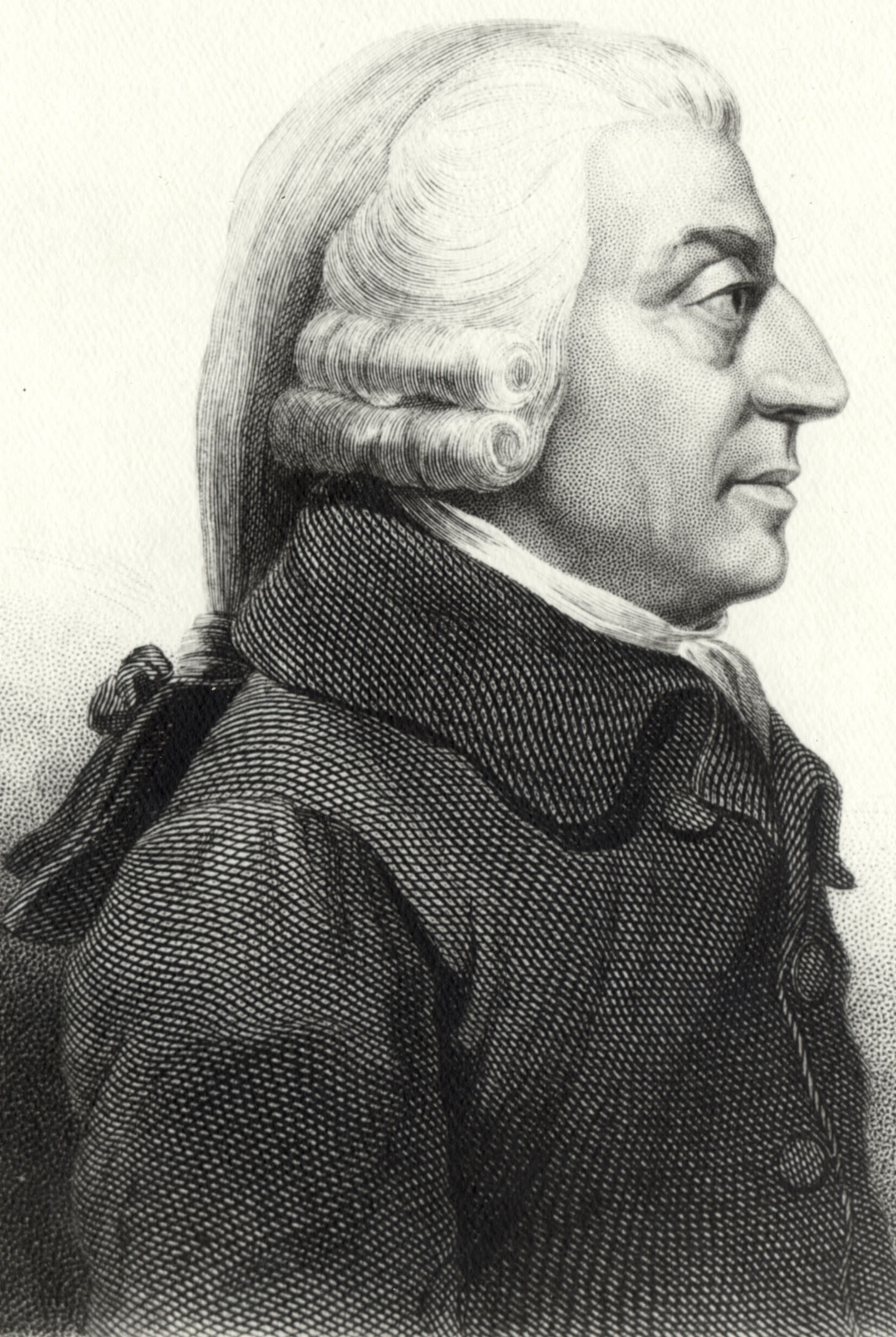
In an edition of the Philosophy Bites podcast last month, “Nicholas Phillipson, his acclaimed biographer, discusses Adam Smith’s view of human beings.” Phillipson argues of Smith that “even his economic thinking is perhaps best understood as part of a broader philosophical project of a science of human beings.”

Read more on Adamic Anthropology…

John Couretas
posted by on Friday, September 10, 2010

On Public Discourse, Acton Research Director Samuel Gregg looks at fiat money and how today it “represents the end of a long process of development whereby governments have used their power of legal tender to use money to pursue various policy goals.”

Read more on Samuel Gregg: Fiat Money and Public Debt…

Jordan J. Ballor
posted by on Monday, July 12, 2010

Some of the assumptions built into the mainstream international aid and development movement are puzzling. Among them is the faulty assumption that the comparison that matters most is how the developing world is doing in relation to the developed. Not surprisingly, this kind of comparison tends to make the gains in developing countries seem small, inscrutable, or nonexistent, and end up reinforcing the myth that progress is never achieved.

Read more on Walk, Pedal, Drive…

In the most recent edition of the Harvard Journal of Law and Public Policy, Acton’s Research Director Samuel Gregg has an article in which he argues that the ongoing financial and economic crisis has raised serious questions about the credibility and usefulness of much mainstream contemporary economics. Drawing partly on his recent book, Wilhelm Röpke’s Political Economy (2010), Gregg suggests that much mainstream economics after Keynes became gradually dominated by a fixation upon econometrics that has threatened at times to reduce economics to a poor cousin of mathematics. As Gregg writes:

Read more on Adam Smith versus John Maynard Keynes…

Over at Public Discourse, Acton’s Samuel Gregg has just published a piece about the future of money. The issuance of money, he writes, is often associated with issues of national sovereignty, despite the fact that governments have long abused their monopoly of the money supply. Gregg argues, however, that the role played by mismanaged monetary policy in the 2008 financial crisis may well open up the opportunity to consider some truly radical options for how we supply money to the economy.

Read more on Beyond Sovereignty: Money and its Future…

Kevin noted earlier this week that the UK has issued a paper bill featuring Adam Smith. I also received notice this week that the Adam Smith Review is planning a conference in January of 2009, celebrating the semiquincentennial (250th) anniversary of the publication of Smith’s Theory of Moral Sentiments.

Read more on Adam Smith’s Theory of Moral Sentiments

The title of this post is not intended to imply anything by way of comparison between Smith and the American gentlemen. It is only to report that the United Kingdom has launched a new 20£ note sporting the visage of the Father of Economics.

Read more on Adam Smith, the British Grant (or Jackson)…

The Journal of Markets & Morality, Volume 9, Number 2.

The newest edition of the Journal of Markets & Morality is now available online and in print. You can pick up a single copy of the print version at the Acton Bookshoppe, or you can subscribe to the Journal.

Read more on Journal of Markets & Morality, Volume 9, Issue 2…

Stephen Grabill
posted by on Wednesday, January 17, 2007

Duncan Foley’s new book, Adam’s Fallacy, is the latest installment among the critics of free-market economics to spin economic history according to the received wisdom of today’s Center-Left intelligentsia. Lest this statement be too harsh, let it be shown that Foley himself reports that his intention in writing the book is not to get bogged down in historical and textual analysis of the key economic texts of the last three-hundred years but to tell his own “imaginatively reconstructed” account of the broad sweep of modern economic history.

Read more on The Fallacy of Adam’s Fallacy…

Acton PowerBlog RSS

Google Plus

Twitter Feed

Facebook Fan Page

Support the Acton Institute

The Acton Institute is funded through the generous contributions of individuals such as yourself. Learn more about how you can advance the cause of freedom and virtue.