Posts tagged with: catholic church

Michael Matheson Miller
posted by on Monday, March 11, 2013

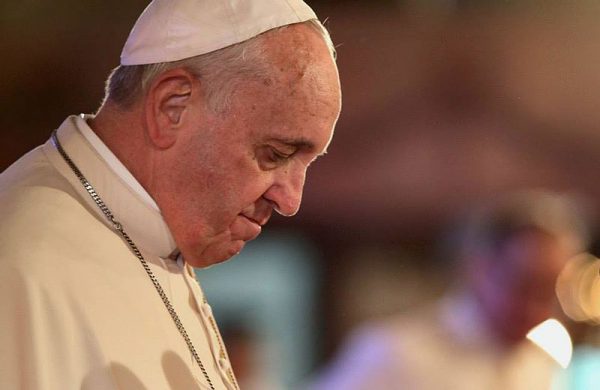
The conclave to elect the new pope is scheduled to begin tomorrow afternoon after the public Missa pro Eligendo Pontifice (Mass for the Election of the Roman Pontiff) which is scheduled at 10am Rome time.   It was at this mass in 2005 after the death of John Paul II that the then Cardinal Ratizinger famously spoke of the “dictatorship of relativism.”   At 4:30 pm Rome time, the cardinals wearing full choir dress will enter the Sistine Chapel singing the hymn Veni Creator Spiritus (Come Holy Spirit).  Cardinals will enter into conclave (from the Latin cum clave, meaning “with key”) and they will be locked away from the world with no access to television, newspapers, or mobile phones until they have elected the new pope.

As the Conclave gets underway and the world waits to see who will be the next pope, here are some helpful hints for making your way through the media storm that is already underway.

1. The papal election is not a U.S.- or European-style political event.

In our hyper politicized world where almost everything is reduced to politics it is hard for our imagination to process a public event like the election of a new pope outside of the structures of politics.  That’s not to say there’s no politics in the Church.  There’s too much of it.  Way too much. And it’s always a factor.  Nevertheless trying to understand the papal election if the light of the American political system or interest and lobbying groups will not be of much help. Read more on A Guide to the Conclave…

Acton president and co-founder, Rev. Robert Sirico, and Director of Research, Samuel Gregg, are currently in Rome for the upcoming papal conclave. Here’s a roundup of their observations, including thoughts on the legacy of Pope emeritus Benedict XVI.

Read more on Audio Roundup: Acton Vatican Experts on the Conclave…

Update: Video Interview with Kishore from Rome.

Cardinal Malcolm Ranjith

Cardinal Malcolm Ranjith

As the world awaits the beginning of the conclave, many are looking at non European Cardinals as potentials for the next pope.  Channel News Asia points out that “68 per cent of the world’s Catholics currently from Latin America, Africa and Asia, there are increased calls for the next pope to be a non-European.”

Read more on Jayabalan: Possibility of a Non European Pope…

Elise Hilton
posted by on Monday, February 25, 2013

The historic resignation of Pope Benedict XVI continues to hold the world’s attention. The pope used yesterday’s Angelus address to say good-bye to throngs of well-wishers, while the Vatican announced today that the conclave to choose Benedict’s successor can begin as soon as March 15.

Read more on Chaput: The Next Pope and a Re-Formation…

Since Benedict’s resignation we’ve been treated to almost two weeks of conspiracy mongering about the “real” reasons behind Pope Benedict XVI’s decision to step down. It’s been everything from Piers Morgan’s ceaseless yammering about his “doubts” to theories about the pope hiding out in the Vatican in fear of an arrest warrant issued by “unknown European” entities concerning clergy sexual misconduct, and still lingering hope among some that this time it really was the butler who did it.

Yet, if scandal were the reason, Benedict could have resigned well before this. He was asked about the matter point blank in 2010 by Peter Seewald in Light of the World. Here was his response:

When the danger is great one must not run away. For that reason, now is certainly not the time to resign. Precisely at a time like this one must stand fast and endure the difficult situation. That is my view. One can resign at a peaceful moment or when one simply cannot go on. But one must not run away from the danger and say that someone else should do it.

Perhaps I am naïve but I think the reasons he resigned are actually the reasons he gave us. We live in a world where leaders, Christian or otherwise, are resistant to giving up the reins, where people tend to hold on to power much too long, and where everyone is jockeying for influence. Pope Benedict’s willingness to let go is a refreshing contrast to all this.

And as for the claim that Benedict may try to influence the conclave and the next pope, there is no more influential person in the Catholic Church than Benedict XVI. If maximizing his influence were his goal he wouldn’t have resigned.

I think his resignation can be boiled down to three things: magnanimity, humility, and prudence. I’d like to take a moment to consider each of these qualities in turn. Read more on Benedict XVI: Magnanimity in an Age of Self-Promotion…

Joe Carter
posted by on Wednesday, February 20, 2013

While most Catholics are likely to already be familiar with the process, my fellow Protestants will likely find this video on how the pope is selected to be helpful and informative.

Read more on How to Become Pope…

Benedict XVI has resigned, effective February 28, 2013.On April 19, 2005, Joseph Ratzinger was elected to become the next Pope after John Paul II. Several Acton Institute analysts wrote articles looking ahead to what kind of papacy the world could expect from Benedict XVI. Take a look and let us know how we did. (We’ve added links where they are still available).

Read more on Looking Back: Acton Experts on Benedict XVI’s Election…

Joe Carter
posted by on Tuesday, January 15, 2013

Of all the documents that came out of the Catholic Church’s Second Vatican Council, Dignitatis Humanae (Declaration on Religious Liberty) was, says Omar F.A. Gutierrez, the most revised, debated, and controversial. But as Gutierrez argues, it also represented a development, rather than a reversal of Catholic teaching:

Read more on Vatican II and Religious Liberty…

The Michigan legislature passed right-to-work legislation today, a landmark event that promises to accelerate the state’s rebound from the near-collapse it suffered in the deep recession of 2008. The bills are now headed to Gov. Rick Snyder’s desk. The right-to-work passage was a stunning reversal for unions in a very blue state — the home of the United Auto Workers. Following setbacks for organized labor in Wisconsin last year, the unions next turned to Michigan in an attempt to enshrine prerogatives for their organizing efforts in the state constitution. A union-backed ballot proposal was handily defeated by voters in the Nov. 6 election.

Read more on Big Gains for the Union Liberation Movement…

Here is the comment posted this this morning on the National Catholic Reporter article titled, “Statement on economy denounced by archbishop fails to pass.”

Full statement follows:

An important clarification.

Archbishop Fiorenza’s assertion that the Acton Institute views Rerum Novarum as “no longer applicable today” is incorrect. The archbishop is most likely basing this claim on a June 2012 America Magazine blog post by Vincent Miller titled, “Sirico Completely Wrong on Church’s Social Teaching.”

Read more on Acton Institute responds to National Catholic Reporter article on bishops’ economic statement…

Acton PowerBlog RSS

Google Plus

Twitter Feed

Facebook Fan Page

Support the Acton Institute

The Acton Institute is funded through the generous contributions of individuals such as yourself. Learn more about how you can advance the cause of freedom and virtue.