Posts tagged with: declaration of independence

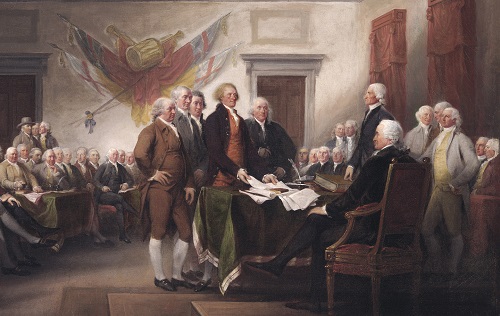
Last week’s Wall Street Journal features a column from Michael Meyerson detailing the religious perspective of the Declaration of Independence. With questions of religious liberty occupying a sizable space in the public square, the article is especially timely. According to Meyerson, the Declaration’s brilliance lies in the “theologically bilingual” language of the Framers. Phrases like “endowed by their Creator with certain inalienable rights” employ what he calls a nondenominational inclusivism, a show of rhetoric that neither endorses nor rejects any particular religious ideology. The underlying implication of this statement, which captures the broader thrust of Meyerson’s article, is that the Framers recognized religion’s intrinsic value in a democratic state. He goes on to argue that the Framers’ understood religious expression as not only permissible, but desirable, for a budding nation. This is especially evident in two oft-forgotten but explicitly religious passages of the Declaration. First, the Framers’ acknowledged their own  “appealing to the Supreme Judge of the world for the rectitude of our intentions.” They also professed a “firm reliance on the protection of divine Providence.” Such phraseology, Meyerson argues, testifies to the value that the Framers’–among them some staunch supporters of church-state separation–placed on religious freedom:

Read more on The Declaration of Independence and the Necessity of Religion…

Jordan J. Ballor
posted by on Monday, July 9, 2012

Last week, in a reflection about American freedom and Christianity, I contended that the shift from emphasis on the pursuit of “property” to the pursuit of “happiness” illustrated the spiritual insight of the American founders. And today, Joe passed along a piece related to the economic climate in America at the end of the eighteenth century, which suggests that as “America had a thriving middle class,” the United States might have been designed especially to institutionalize, protect, and promote the materially-acquisitive ethos of the time.

That, at least, is the suggestion made by Brad Gregory in his book, The Unintended Reformation. In a chapter on “Manufacturing the Goods Life,” Gregory contends that the Declaration of Independence, the Constitution, and the broader vision of social life articulated by the founders was uniquely oriented toward merely material prosperity:

The substantive emptiness of the nation’s founding documents was possible not only because Americans were strongly shaped by Christian moral assumptions, but also because so many of them had simultaneously departed in practice from the traditional Christian condemnation of avarice.

A corollary of this is that America is uniquely anti-Christian:

If Christianity is among other things a discipline of selflessness in charitable service to others, then the United States’ legally protected ethos of self-regarding acquisitiveness, culturally reinforced at every turn, would seem to be its antithesis.

You might guess what this means for our evaluation of Europe, however, which ends up looking rather more Christ-like by comparison:

But, ironically, more than is true of federal or state institutions in the church-going United States, secularized Europeans’ welfare states since World War II have more in common with the social concerns and the moral commitments of the Christianity that made the Continent and Britain, because they at least seek to meet the most basic needs of every citizen.

It’s true, admits Gregory, that American freedom includes the ability to be spiritually responsible. But even the value of this is doubtful:

So too, it is obvious that he advent of modern capitalism and market-governed societies has facilitated the potential for human flourishing and the possibility of living meaningful human lives for hundreds of millions of people, which considered as such is also a very good thing. But those who are devoted to their families, demonstrate care for others, make charitable donations, and practice self-restraint do so within a world dominated by wall-to-Walmart capitalism and consumerism, with all that this implies.

What all this has to do with the Reformation is something that has to be explored within the larger argument of the book. I’m currently drafting a review of it, but it has already been reviewed and engaged in a number of significant places, like Books & Culture, the Wall Street Journal, and First Things. At this point I can recommend Gregory’s book if you want to see what the Reformation and global climate change have to do with one another (hint: the main link is the American “ethos of self-regarding acquisitiveness” outlined above).

Charles Kaupke
posted by on Tuesday, July 3, 2012

Florida Governor Rick Scott

Florida Governor Rick Scott recently declared that his state would not comply with President Obama’s Patient Protection and Affordable Care Act. In blatant defiance of the federal government, Florida will not expand its Medicare program or implement any of the other changes that “Obamacare” requires. While a flat-out refusal to comply with federal law on the part of a lower authority is relatively uncommon, it is by no means unprecedented. The history of the United States is filled with individuals and groups who have decided to obey their consciences in the face of laws that they believed to be illegal or immoral, or both. In fact, our country’s very founding began with an act of civil disobedience against the unjust and illegal actions of England’s King George III.

Even before our nation was formally established, adherence to true justice and the natural law, rather than to the whims of tyrants, was a hallmark of the American spirit. Witness the turmoil that took place in the American colonies in the 1760s and 1770s over the actions of England, including the famous Boston Tea Party of 1773. Thomas Jefferson wrote in the Declaration of Independence that, “when a long train of abuses and usurpations, pursuing invariably the same Object evinces a design to reduce them under absolute Despotism, it is their right, it is their duty, to throw off such Government, and to provide new Guards for their future security.” Read more on Obamacare and Civil Disobedience…

In this week’s commentary, I take a look at Calvin Coolidge and his views on government. Coolidge is important today for many reasons. Chiefly, he’s a striking contrast to our current culture of government and the bloated state.

Read more on Acton Commentary: Calvin Coolidge and the foundational truths of government…

Below is an excerpt from an early speech given by Calvin Coolidge to the Algonquin Club in Boston, Mass. in 1915. These remarks are included in a series of speeches Coolidge published in the book, Have Faith in Massachusetts. The speeches primarily deal with his philosophy of government, which because of his emphasis on foundational beliefs, remained consistent.

Read more on Coolidge and His Foundational Views on Government…

Coolidge

If we are to maintain the great heritage which has been bequeathed to us, we must be like-minded as the fathers who created it. — Calvin Coolidge.

Read more on Coolidge and ‘the best ideas of democracy’…

A brilliant assessment of where we are. (HT: American Orthodox Institute Observer).

Subject to the governor of the universe: The American experience and global religious liberty

March 1, 2011 – Most Rev. Charles J. Chaput, O.F.M. Cap., Archbishop of Denver, addressed the Berkley Center for Religion, Peace and World Affairs at Georgetown University.


A friend once said – I think shrewdly — that if people want to understand the United States, they need to read two documents.  Neither one is the Declaration of Independence.  Neither one is the Constitution.  In fact, neither one has anything obviously to do with politics.  The first document is John Bunyan’s The Pilgrim’s Progress.  The second is Nathaniel Hawthorne’s The Celestial Railroad

John Bunyan

Bunyan’s book is one of history’s great religious allegories.  It’s also deeply Christian.  It embodies the Puritan, Protestant hunger for God that drove America’s first colonists and shaped the roots of our country. 

Hawthorne’s short story, of course, is a very different piece.  It’s one of the great satires of American literature.  A descendant of Puritans himself, Hawthorne takes Bunyan’s allegory – man’s difficult journey toward heaven – and retells it through the lens of American hypocrisy: our appetite for comfort, easy answers, quick fixes, material success and phony religious piety.

Bunyan and Hawthorne lived on different continents 200 years apart.  But the two men did share one thing.  Both men – the believer and the skeptic — lived in a world profoundly shaped by Christian thought, faith and language; the same moral space that incubated the United States.  And that has implications for our discussion today.

In his World Day of Peace message earlier this year, Pope Benedict XVI voiced his concern over the worldwide prevalence of “persecution, discrimination, terrible acts of violence and religious intolerance.”i   In reality, we now face a global crisis in religious liberty. As a Catholic bishop, I have a natural concern that Christian minorities in Africa and Asia bear the brunt of today’s religious discrimination and violence.  Benedict noted this same fact in his own remarks.

Read more on Archbishop Chaput: The American experience and global religious liberty…

Ray Nothstine
posted by on Wednesday, June 30, 2010

My commentary this week is a simple message about the importance of returning to our founding principles and embracing the liberty granted to all of us as Americans. Independence Day should always serve as a significant reminder of the freedom narrative of this country that has provided so many people with opportunities to flourish and live out their dreams:

Read more on America’s Destiny Must Be Freedom…

The Birth of Freedom opens and closes with Martin Luther King, Jr.’s iconic “I Have a Dream” speech. King appealed to Americans to live out the true meaning of this nation’s creed that all men are created equal. The documentary sets that appeal within the broader context of the Christian West’s slow but ultimately triumphant march to freedom.

Read more on Celebrate Martin Luther King Day With The Birth of Freedom Film…

August 28 at Denver’s Mile High Stadium, the son of a black African delivered a rousing acceptance speech for the Democratic presidential nomination. It occurred 45 years to the day after Martin Luther King, Jr. stood on the steps of the Lincoln memorial and told America “I have a dream.”

Even Americans unconvinced that the Democratic nominee is the right choice for America should take heart from the fact that half a century after King struggled against vicious, institutionalized racism, the United States has become a place that can fairly consider an African-American for the highest political office in the land.

But if as King urged, we are careful to judge a person not by the color of his skin but by the content of his character, the convergence stretching across 45 years begs a question: Has Barack Obama’s political career embodied Martin Luther King’s dream of justice for all?

King dreamed of a day when his nation would “live out the true meaning” of a creed inscribed in the Declaration of Independence: “all men are created equal” and “are endowed by their Creator with certain unalienable Rights, that among these are Life, Liberty and the pursuit of Happiness.” The reality is, Barack Obama supports policies that aggressively, even violently undermine that dream.

Read more on Obama’s Dream not for All God’s Children…

Acton PowerBlog RSS

Google Plus

Twitter Feed

Facebook Fan Page

Support the Acton Institute

The Acton Institute is funded through the generous contributions of individuals such as yourself. Learn more about how you can advance the cause of freedom and virtue.