Posts tagged with: economic crisis

Sojourners’ Jim Wallis has been at the Davos gathering in Switzerland and is urging us to be guided by a new Davos “covenant.” If you’ve never heard of Davos, Michael Miller’s RealClear Politics piece “Davos Capitalism” describes the gathering and its unassailable hubris this way:

Davos capitalism, a managerial capitalism run by an enlightened elite–politicians, business leaders, technology gurus, bureaucrats, academics, and celebrities–all gathered together trying to make the economic world smarter or more humane…. And we looked up to Davos Man. Who wouldn’t be impressed by the gatherings at the annual meeting of the World Economic Forum at Davos, a Swiss ski resort? Sharply dressed, eloquent, rich, famous, Republican, Democrat, Tory, Labour, Conservative, Socialist, highly connected, powerful and ever so bright.

Then, when the whole managerial economy collapsed, the managers and technocrats lost faith in markets. But they did not lose faith in themselves, and now they want us to entrust even more of the economy to them.

As if on cue, Jim Wallis writes in a recent public letter:

This week at the World Economic Forum in Davos, Switzerland, we are looking to the future and asking “what now?” At a Saturday session — “The Moral Economy: From Social Contract to Social Covenant” — a document will kick off a year-long global conversation about a new “social covenant” between citizens, governments, and businesses.

Why dispense with the yeomen-like “contract” language in favor of a new “social covenant”? Wallis explains that “in the past 20 years, the world has witnessed the death of social contracts. We have seen a massive breakdown in trust between citizens, their economies, and their governments…. Former assumptions and shared notions about fairness, agreements, reciprocity, mutual benefits, social values, and expected futures have all but disappeared. The collapse of financial systems and the resulting economic crisis not only have caused instability, insecurity, and human pain; they have also generated a growing disbelief and fundamental distrust in the way things operate and how decisions are made.” Read more on Jim Wallis, Davos Capitalism, Cronyism, and the ‘New Social Covenant’…

Samuel Gregg, Acton’s Director of Research and author of the book “Becoming Europe“, says one of America’s real debt dangers is our increasing sense of entitlement from the government. In today’s Investor’s Business Daily editorial, Gregg states our “insatiable appetites” are getting us into the very deep economic trouble that no one, least of all politicians, seems to want to face:

Read more on Samuel Gregg: Americans’ ‘Absurd Expectations’ and the Economic Crisis…

Rome contributor to ZENIT, Stefanie DeAngelo, recently interviewed the Acton Institute’s 2012 Novak Award winner, Professor Giovanni Patriarca. During the interview Prof. Patriarca speaks candidly about some of his academic influences, including Michael Novak and Benedict XVI. He also offers his reasons for hope in overcoming the prolonged global economic crisis.

Some Contemporary Reflections: An Itinerary from Novak to Benedict XVI

by Stefanie DeAngelo

2012 Novak Award Winner Prof. Giovanni Patriarca

ZENIT: You have recently received the Novak Award. What are some of the major contributions of the American philosopher and theologian to our thinking about the current state of the world?

Patriarca: The work of Dr. Michael Novak is so rich that it is not easy to summarize it in a few thoughts. In addition to his famous works on economics, a number of his articles published in the last few years, especially in the journal First Things, explores some of modernity’s contradictions regarding individual and social responsibility and the demise of traditional values that were held by previous generations. As Alexis de Tocqueville also warned, the loss of a metaphysical perspective, leads to materialism and the absurdity of nihilism. Read more on Novak Award Winner reflects on influences of Benedict, Michael Novak…

Rev. Robert Sirico, author of “Defending the Free Market: The Moral Case for a Free Economy,” appears at a Rome press conference for his book.

The Catholic News Agency recently interviewed Acton’s president Rev. Robert Sirico during a press conference held last week in Rome for Vatican journalists. The local media were introduced to his new book, “Defending the Free Market: the Moral Case for a Free Economy.”

Read more on Interview: Rev. Sirico on the Market Economy and the Moral Life…

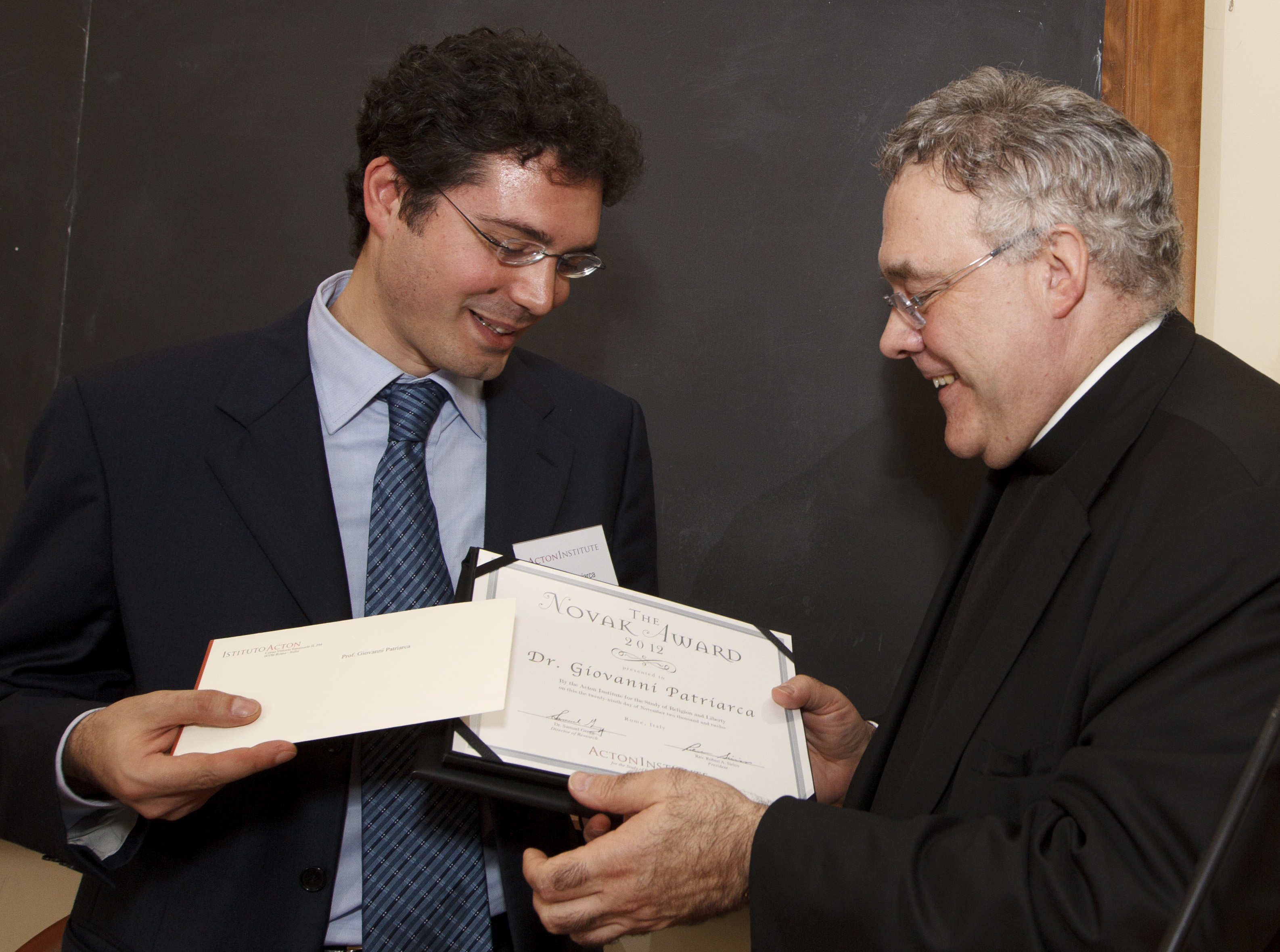
Acton President Rev. Robert Sirico presents the 2012 Novak Award to Prof. Giovanni Patriarca

An overflow crowd, which included two current and one former rector of Rome’s pontifical universities, enthusiastically turned out on November 29 to support the winner of the Acton Institute’s Novak Award.  Students, professors, journalists, entrepreneurs and politicians alike packed the Aula delle Tesi auditorium at the Pontifical University of Thomas Aquinas to hear Prof. Giovanni Patriarca deliver his lecture  “Against Apathy: Reconstruction of a Cultural Identity”.

The Novak Award, a $10,000 prize named after the American theologian and social philosopher Michael Novak, is given annually to a young international professor whose distinguished research advances a deeper understanding of theology’s connection to human dignity, the importance of limited government, religious liberty, and economic freedom. The recipient delivers a formal presentation at the award ceremony known as the Calihan Lecture. Read more on Novak Award Winner Assesses Spiritual, Vocational Crisis of Economy…

On his flight to World Youth Day in Madrid this morning, Pope Benedict XVI responded to a question about the current economic crisis. Not sure what the question was, but the well-respected Italian Vatican analyst Andrea Tornielli captured the reply. Here’s my quick translation of the Pope’s answer:

Read more on World Youth Day: Pope talks profits and people…

“The Deal Professor,” Steven M. Davidoff, has a good piece at The New York Times website about the indispensability of finance to our economy. It briefly rebuts the view popularized in the Oliver Stone movie Wall Street, in which financiers are portrayed as greedy parasites. I left a comment at the web page, noting that our documentary The Call of the Entrepreneur makes a similar case. I include the comment below, since it may not pass muster with the page’s comment moderator:

Read more on The Inevitability of Finance And The Call of the Entrepreneur…

Jonathan Witt
posted by on Wednesday, September 16, 2009

Memo to documentary filmmaker Michael Moore: Free markets didn’t cause the financial crisis. The biggest culprits were government planners meddling with the market. That’s the message of Acton’s newest video short.

Read more on Government-Managed Capitalism: A Love Story…

Joan Lewis, EWTN’s Rome bureau chief, covered Pope Benedict XVI’s general audience address on Wednesday, July 8 , during which the pontiff publicly commented on his landmark social encyclical “Caritas in Veritate” the day after it was officially released by the Vatican. Below is a summary of Benedict’s address to visitors in Rome, including Lewis’s own translation.

Yesterday, the Vatican released Pope Benedict’s third encyclical, “Caritas in veritate,” along with an official summary of the 144-page document that has six chapters and a conclusion. In addition, there was a very worthwhile two-hour press conference with summaries of the document’s salient points, as well as a Q&A session between reporters and Cardinals Martino and Cordes, Archbishop Crepaldi and Prof. Stefano Zampagni.

But surely the best summary of Pope Benedict’s just-released encyclical is the one he himself gave at today’s general audience, held in the Paul VI Hall and highlighting the moral criteria that must underpin economic choices.

In only 1,300 words (the encyclical has 30,466), the Pope explained the document’s contents and his intention in writing it. He began by explaining that Caritas in veritate was inspired by a passage from Paul’s Letter to the Ephesians where “the Apostle speaks of acting according to the truth in love: ‘Rather, living the truth in love, we should grow in every way into him who is the head, Christ’.” Thus, said Benedict, “charity in truth is the principal driving force behind the authentic development of every person and of all humanity. For this reason, the entire social doctrine of the Church revolves around the principle ‘Caritas in veritate’. Only with charity, illuminated by reason and by faith, is it possible to pursue development goals that possess more human and humanizing values.”

Read more on Benedict Reflects on Caritas in Veritate…

Louie Glinzak
posted by on Tuesday, June 30, 2009

Over at World Magazine, Lee Wishing cites a speech by Rev. Robert A. Sirico, president and co-founder of the Acton Institute, on the subject of putting our faith in God and our own abilities instead of the government to manage economies. He quotes Rev. Sirico: “Many thinkers throughout the ages have noted that we face a choice between holding a robust faith in God or putting faith in man and institutions such as the state.”  In such tough economic times, we are reminded that we need to put our faith and trust in God first.

Read more on Rev. Sirico on Faith-Based Budgeting…

Acton PowerBlog RSS

Google Plus

Twitter Feed

Facebook Fan Page

Support the Acton Institute

The Acton Institute is funded through the generous contributions of individuals such as yourself. Learn more about how you can advance the cause of freedom and virtue.