Posts tagged with: economics

The Affordable Care Act, more commonly known as “Obamacare”, is a strange law from the perspective of economic theories of insurance markets. Still, one can see where its designers were starting from. The individual mandate may be onerous from a liberty standpoint, but it makes sense if you understand that insurance markets are vulnerable to a phenomenon known as the “death spiral.”

The idea behind the death spiral is based on the recognition that insurance is a risk management scheme. Insurance companies, despite their best efforts, are less knowledgeable about its customers’ health than are their customers. As such, the prices an insurance company charges are based on the average risk that a customer will need care. Read more on The Tortured Logic of the Obamacare Law…

One of the most basic forms of entertainment that friends and families share together is playing board games, such as Monopoly or Risk. While we may not realize is how much these games are teach us about economic ideas such as trade or scarcity.

I must confess I’m a bit of a board game snob. I don’t really care for common games like Monopoly as I prefer so-called “designer” games such as the Settlers of Catan or Power Grid. In an article for the Washington Post, Blake Eskin calls Settlers the “board game of our time.”

Eskin explains that Monopoly had an appeal in the depression-era because it allowed poor kids the opportunity to feel rich and successful for a day. He also mentions several of the reasons I do not care for Monopoly: It takes several hours to play; the outcome is too dependent on luck; it can often become clear who is going to win far before the game actually ends, etc. It is also an elimination game, meaning that an early loser can be stuck with nothing to do for hours while their friends finish the game.

Read more on What Board Games Can and Cannot Teach Us About Economics…

Jordan J. Ballor
posted by on Thursday, July 19, 2012

I belong to the Christian Reformed Church, and our synod this year decided to formally adopt a report and statements related to creation care and specifically to climate change. I noted this at the time, and that one of the delegates admitted, “I’m a skeptic on much of this.”

Read more on Churches and Climate Change…

Andrew Knot
posted by on Wednesday, July 18, 2012

That’s the question asked at the “Economics for Everybody” blog. The answer? A resounding yes:

Work is important to God. It’s so important that He put Adam in the garden “to work it and keep it.” God took His creation and assigned it to Adam “to fill and subdue.” That sounds like work to me.

Read more on ‘Does God Like Economics?’…

Jordan J. Ballor
posted by on Friday, July 13, 2012

Conference: “Free Markets with Solidarity and Sustainability: Facing the Challenge”

Ethical human agency is only possible with freedom. Freely turning to the good, which the Creator has given us, is the highest sign of human dignity. The proper exercise of freedom requires “specific conditions of an economic, social, juridic, political and cultural order”. (Compendium of the Social Doctrine of the Church, n. 137) The free market is one of these institutions. The free market is the most efficient instrument to guarantee the distribution of goods and services in society. Beyond efficiency, however, markets need sound ethical and cultural foundations. Only free markets can be ethical markets, and only ethical markets can function in freedom. One of these primary and universally recognized ethical principles is charity.

Call for Papers: “The State of the Consecrated Life in Contemporary Canada”

Read more on ResearchLinks – 07.13.12…

Michelle Hornak
posted by on Friday, July 6, 2012

If you, or someone you know, are searching for last-minute scholarship opportunities, I invite you to please take the time to learn more about the scholarship programs offered through the Acton Institute.

Read more on Upcoming Scholarship Deadline…

Charles Kaupke
posted by on Friday, June 29, 2012

Frédéric Bastiat (1801-1850)

This Saturday, June 30, is the 211th birthday of Frédéric Bastiat, one of the greatest political philosophers of the modern era. Considered among the founding fathers of classical liberalism, Bastiat is known for his simple and direct explanations of political and economic realities, his arguments against oppressive economic regulations and his clear and concise vision of a government of limited, enumerated powers, operating under the rule of law and unencumbered by favoritism or distributionist policies.

Bastiat drew on his Catholic faith and the writings of Adam Smith and John Locke to articulate a vision of limited, efficient government that respects each citizen’s God-given dignity, strictly adheres to the rule of law, and allows for a largely un-regulated economy in which individuals are free to pursue their interests through peaceable exchange with each other. His best-known works, and those most central to his ideas, are The Law and The Seen and the Unseen, articulating his central political and economic ideas, respectively. Read more on Bastiat’s Vision…

In response to the Supreme Court ruling on Obamacare’a individual mandate, National Review Online launched a symposium — a roundup of commentary — which posed the following question: “What’s next for both conservatives and the Republican party on health-care reform?” Acton Research Director Samuel Gregg contributed this analysis:

Read more on Samuel Gregg on the Supreme Court and the Individual Mandate…

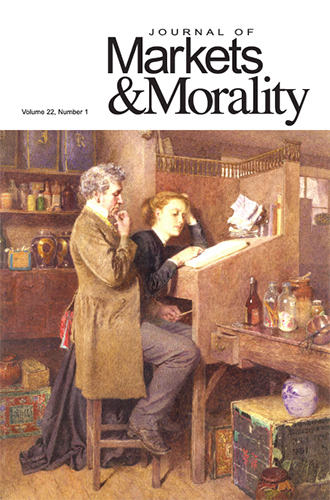
The new issue of the Journal of Markets & Morality

The Spring 2012 issue of the Journal of Markets & Morality (15.1) has been posted at www.marketsandmorality.com and should be arriving in print to our subscribers sometime soon in the coming weeks.

Read more on New Issue of the ‘Journal of Markets & Morality’…

One of the most worrisome economic troubles coming down-the-pipe is the “student debt bubble” which many argue is caused by too many students seeking degrees in higher education as the costs of tuition increase. Because we understand that poverty and economic misfortune are serious barriers to human flourishing, it is very important to try and understand the economics involved in the education market. Dylan Pahman gave a good explanation earlier today about how administrative costs are rising to promote a myriad of diversity-advocacy programs, a process which is clearly affecting  the supply-side of the issue. What about the demand side where students are making the decision to go to college?

Read more on The Demand Side of College Education…

Acton PowerBlog RSS

Google Plus

Twitter Feed

Facebook Fan Page

Support the Acton Institute

The Acton Institute is funded through the generous contributions of individuals such as yourself. Learn more about how you can advance the cause of freedom and virtue.