Posts tagged with: ecumenical babel

Acton on Tap

Carl TruemanDr. Carl Trueman is our guest for Acton on Tap tonight at Derby Station in East Grand Rapids. Be sure to join us and bring a friend if you are within hailing distance of this fine establishment (arrival at 6pm, discussion at 6:30pm).

Read more on Acton on Tap Tonight: Dr. Carl Trueman…

Wrapping up our recap of last year’s Acton Lecture Series, today we present two additional lectures for your enjoyment.

The first was delivered in April of 2010 by Acton President Rev. Robert A. Sirico, and was entitled “Does Social Justice Require Socialism?” In this lecture, Sirico examined the increasing calls for government intervention in financial market regulation, health care, education reform, and economic stimulus in the name of “social justice”.

Read more on Acton Lecture Series 2010: Sirico & Ballor…

John Couretas
posted by on Wednesday, January 26, 2011

Two more thoughtful reviews of Jordan Ballor’s Ecumenical Babel: Confusing Economic Ideology and the Church’s Social Witness are in. Ross Emmett says that, “those concerned about the role of the church in the world today can learn a lot by reading and reflecting on Ballor’s excellent critique of the ecumenical movement’s political economy.” And in the new issue of the Journal of Markets & Morality, Thomas Sieger Derr agrees with Jordan that the ecumenical movement should be “appropriately circumspect in its ethical pronouncements on specific matters of public policy.”

Read more on Talking About Babel…

Jordan J. Ballor
posted by on Tuesday, January 11, 2011

It is sometimes remarked in response to my treatment of the Accra Confession of the World Alliance of Reformed Churches (WARC) and now World Communion of Reformed Churches (WCRC) in my book Ecumenical Babel that the Accra document is not really a confession at all. It says itself, after all, that it is a confession, but “not meaning a classical doctrinal confession, because the World Alliance of Reformed Churches cannot make such a confession, but to show the necessity and urgency of an active response to the challenges of our time and the call of Debrecen.”

Read more on Accra: Confession or Conversation?…

Jordan J. Ballor
posted by on Tuesday, December 21, 2010

Rev. Daniel Meeter, pastor in the Reformed Church of America (RCA), writing in the Reformed journal Perspectives, “Observations on the World Communion of Reformed Churches”:

My participation at Johannesburg is the reason I was an observer at the General Council, and why I was assigned to the General Council’s committee on Accra (though there were many other committees and a host of workshops that interested me, from worship to theology to inter-faith dialogue). Our committee was huge: sixty people or so. We eventually divided into table groups, and I was a pinchhit table leader. My table included Taiwanese, Chinese, Filipinos, and Indonesians. Our tables were charged to come up with a variety of responses to Accra, such as actions and outcomes or further work on its content and theology. Our responses were recorded and two delegates were appointed to consolidate them into a report to the plenary. I had to leave before the report was made, so I look forward to reading the minutes of when they come out.

Read more on The WCRC and Social Justice…

Jordan J. Ballor
posted by on Monday, December 20, 2010

I assert the existence of the “ecumenical-industrial complex” in my book Ecumenical Babel.

On that point, this bears watching: “Ecumenical news agency suspended, editors removed.”

From the piece:

Earlier this year the WCC, which has been ENI’s main funder and in whose headquarters the agency was based, said it was reducing its financial support for 2011 by over 50 percent.

The WCC is an umbrella body linking Protestant and Orthodox churches around the globe. An acting spokesman for the organisation told Reuters on Monday that the funding decision was “part of a broad redeployment of WCC resources” and had been a “key element in decisions related to the re-shaping of ENI.”

The cash cut came in the wake of complaints by the WCC’s former Kenyan general secretary Samuel Kobia of “inaccuracy” and “sensationalism” in coverage of the body by ENI — which had run reports from an authoritative German religious news service that he had falsely claimed an academic degree.

That doesn’t make for a very merry Christmas for all the ENI staff affected by the cuts.

The full official ENI story related to the “restructuring” after the break. Read more on Ecumenical-Industrial Complex at Work?…

Jordan J. Ballor
posted by on Thursday, December 16, 2010

In this week’s commentary I say that part of the reason less money is being given to local churches is that it is reflective of a broader trend of distrust towards institutions.

Read more on Loss of Institutional Faith…

Madeleine L’Engle, in a 1986 essay, “What May I Expect from My Church?”

And that is what I want my church to speak out about: the Gospel, the Good News. Then I will be given criteria to use in thinking about such issues as abortion, euthanasia, genetic manipulation. It is impossible to listen tot he Gospel week after week and turn my back on the social issues confronting me today. But what I hope for is guidance, not legislation.

L’Engle wrote these words referring to the Episcopal Church, but I echo precisely these sentiments in my critique of the ecumenical movement’s social witness in Ecumenical Babel. What we need is moral guidance and formation from the church, not, as I put it, attempts “to make arbitrary conclusions morally binding.”

Read more on ‘What May I Expect from My Church?’…

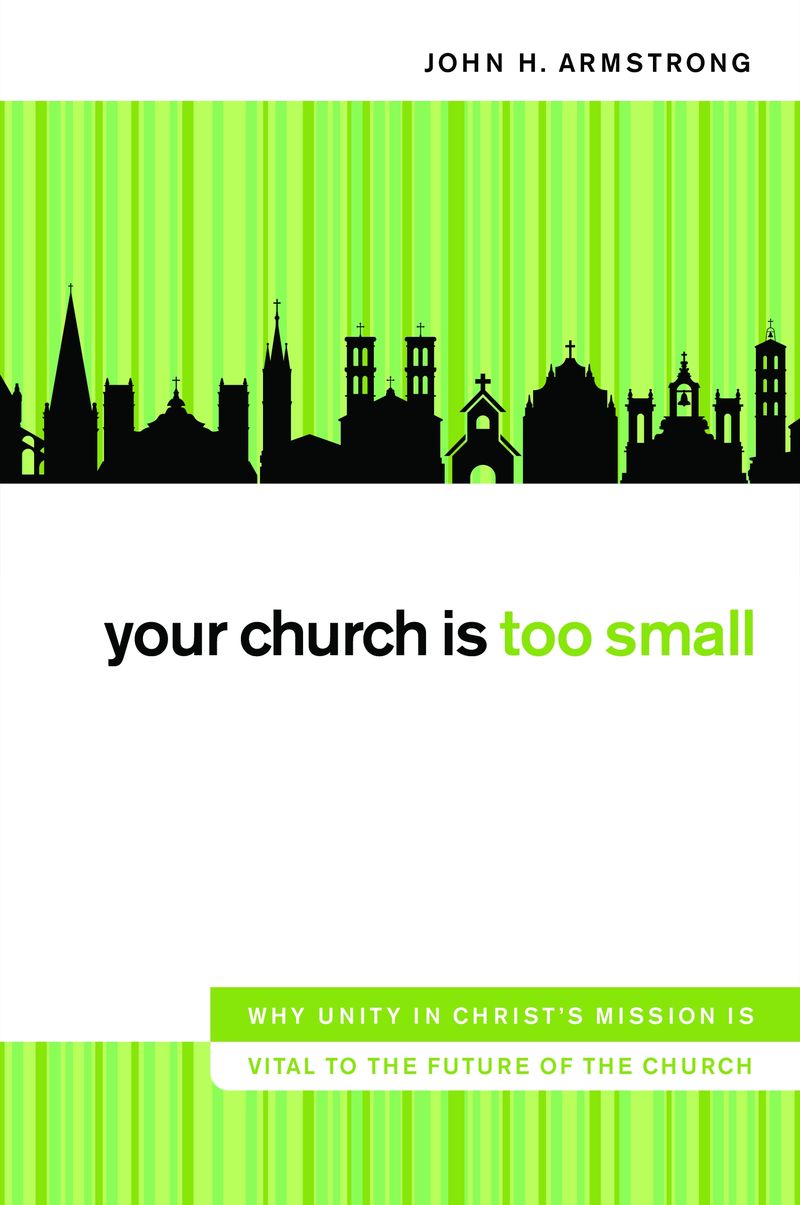
Last night a band of hearty travelers braved the first snow of the season here in Grand Rapids (and the attendant slick and dangerous roads) to hear Dr. John H. Armstrong speak at the November/December Acton on Tap, “Ecumenism and the Threat of Ideology.” Dr. Armstrong is founder of ACT 3 and adjunct professor of evangelism at Wheaton College.

Read more on Acton on Tap: Ecumenism and the Threat of Ideology…

Jordan J. Ballor
posted by on Friday, November 19, 2010

Today is my last day at the Evangelical Theological Society (ETS) meeting in Atlanta. I plan to make my purchases from the various book sellers this morning, having already reconnoitered the exhibits and mapped out my plan of attack.

One thing that has struck me is that there are a number of new books discussing ecumenism and Christian unity from host of different perspectives. On the one hand this shouldn’t be surprising. The unity of the church is a constant theme, one that is confessed in the Nicene Creed (“We believe…in one holy catholic and apostolic Church.”).

But for a period of time it seemed that ecumenism was in decline. After all, it used to be its own area of theological specialization; there have been (and still are some) professors of ecumenics. On the broader level one thing that breathed life into the ecumenical movement in the last half-century was the founding of what is now known as the Pontifical Council for Promoting Christian Unity (I had the pleasure of meeting the pope’s representative, Fr. Gregory Fairbanks, at the WCRC Uniting General Council earlier this year in Grand Rapids).

An ENI story notes a recent address from Pope Benedict XVI regarding ecumenism: “Today, some people believe that this journey has lost its impetus, especially in the West,” the Vatican Information Service quoted Pope Benedict XVI as saying. “Thus do we see the urgent need to revive ecumenical interest and give a fresh incisiveness to dialogue.”

Now this story is in the context of Roman Catholic, Orthodox, and Anglican dialogue. But “new energy” needs to be found in the mainline ecumenical movement as well. I outline some of the reasons for the decline of groups like the WCC, LWF, and WCRC in my book, Ecumenical Babel. And as the Vatican celebrates fifty years of institutional ecumenical efforts, we have seen a corresponding decline in vigor in the mainline Protestant groups. Some evidence of this is the consistent outreach and emphasis on engaging “evangelicals” from the WCC, whose new president expressed such sentiments at both the WCRC Uniting General Council and the recently concluded Cape Town 2010 meeting of the Lausanne Movement.

So says Mark Tooley of IRD. “Sadly, over the last 50 years, it (the ecumenical movement) has faded into the sidelines and is now largely ignored,” he said. In the 1980s Ernest Lefever, founder of the Ethics and Public Policy Center, observed that “the ecumenical movement’s social witness has become obsolescent, marginal, irrelevant, or worse.”

I outline some of the things needed to reinvigorate the mainline ecumenical movement in my book. I outline correctives on three main levels: the ecclesiastical, the social ethical, and the economic. But I conclude too that

Without pursuing correctives along these general lines, the answer to Gustafson’s challenging question, “Who listens to the moral teachings of Protestant churches?” will continue to be indeterminate, and deservedly so. Without doing the hard work of serious ethical deliberation that engages a variety of conflicting perspectives, the ecumenical movement has little claim to possess authentic moral authority in the public square or among the churches.

After the break you can read the full ENI story on the fiftieth anniversary of the Vatican secretariat (now council) for promoting Christian unity. Read more on The Ecumenical Future…

Acton PowerBlog RSS

Google Plus

Twitter Feed

Facebook Fan Page

Support the Acton Institute

The Acton Institute is funded through the generous contributions of individuals such as yourself. Learn more about how you can advance the cause of freedom and virtue.