Posts tagged with: entrepreneurship

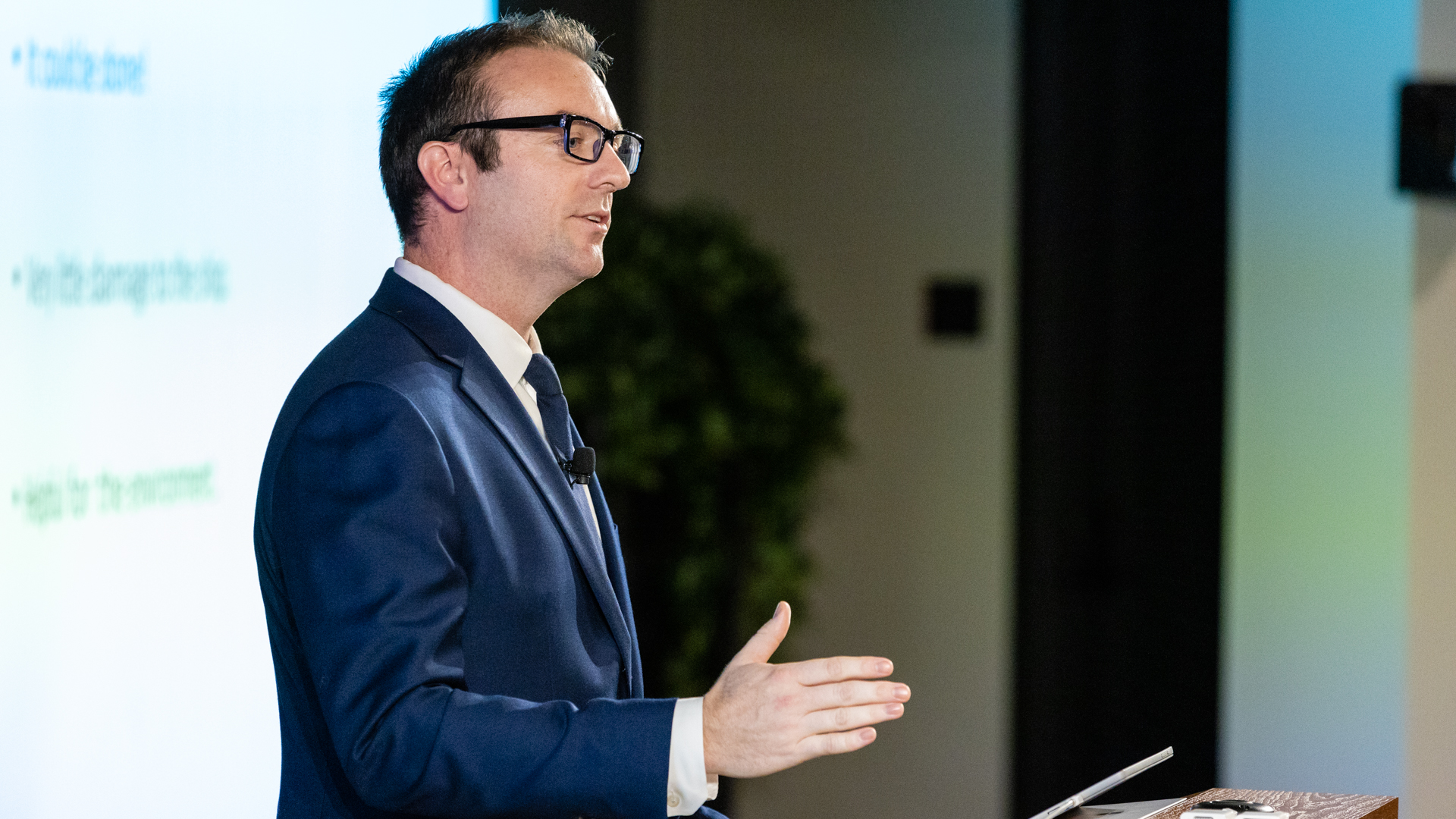
Alexandre Havard leading a recent “Virtuous Leadership” seminar with CEOs and entrepreneurs in Latvia, one of the most industrialized and wealthy republics of the former Soviet Union

The Acton Institute’s Rome office led its recent Campus Martius Seminar with Alexandre Havard, the Russian-French author of Virtuous Leadership (2007),  Created for Greatness: The Power of Magnanimity (2011) and founder of the Moscow- and Washington, D.C.-based Harvard Virtuous Leadership Institute.

Havard, speaking with Zenit’s Ed Pentin in an article following the seminar, said that during today’s economic crisis aspiring and veteran entrepreneurs alike are suffering from an improper understanding of the intimate union between humility and magnanimity, even the most religious and virtuous of them:

It’s much easier to say to God: ‘Do the work in me and I just do nothing. But God very often tells us: ‘I will not do it because I have already given you talents through nature; you have to discover those things and do it …Humility is to say: ‘I have gifts, I have talents, and they come from God.’ You recognize that you have not produced those talents, that they are a gift from him to you. Then magnanimity is to say: ‘I have them but I have to make them fructify, I must develop them and multiply them, and put them at the service of the community and the common good.  So you see these two things come together. [Talents] are not mine. I have been given them and this is my humility; my magnanimity tells me to multiply them and use them.

Havard agreed to sit down with me recently and talk about the moral and character pitfalls in both the East and the West as well as the inspiration for his virtuous leadership training program. Read more on Magnanimity and Humility Make for Good Entrepreneurs…

Our world desperately needs heroic people—people who shape events, who act rather than watch, who are creative and brave. Such people are needed in every field, in every realm of life—not only in law enforcement and disaster response but also in science, education, business and finance, health care, the arts, journalism, agriculture, and—not least—in the home.

Rev. Robert Sirico and Jeff Sandefer, in their about-to-be-released book, have written a “blueprint” to the heroic life. The two joined Acton last week to talk about their endeavor (listen to the podcast here), and discuss some of the themes of this book. Both stressed the need for people of all ages to strive for living not just a good life, but a heroic one:

Read more on ‘The Field Guide to the Hero’s Journey’: Newest Acton Book…

Over at Christianity Today, HOPE International’s Chris Horst, whose article on a Christian manufacturer was recently highlighted at the PowerBlog, focuses on yet another Christian business, this time dealing in mattresses:

“This is one of the sleaziest industries in the world,” says business owner Ethan Rietema. “Customers are treated so poorly. Stores beat you up, trying to get as much money as they can, but they couldn’t care less if you get the right bed.”

Rietema and Steve Van Diest, both former campus ministers, are bringing rest—and integrity—back to a business largely devoid of it. Four years ago, a Christian entrepreneur invited the Colorado natives to begin deploying their relational abilities in strip malls rather than on college campuses. They now co-own three Urban Mattress stores in Denver and have franchised four more. And, they argue, their current work is just as important as their former ministry….

…”I don’t have to do mental gymnastics with the product I sell,” Van Diest says. “It’s not a frivolous item. It’s not an image-conscious product. People come here after being worn down by horrible sleep, replete with aches and pain. If we can provide them with a small glimpse of grace for a third of their lives, that’s kingdom work. That matters to God.”

Every entrepreneur begins by identifying a need. For Rietema and Van Diest, it was better customer service and consumer information. Urban Mattress has grown its business by directly countering a status-quo industry environment of price misinformation, offering “consistent and fair prices that promote transparency and honesty.” No faux “blowout sales,” no shady product labeling, no overly hasty, overly pushy customer interactions.

Read more on Bringing Spirituality to ‘One of the Sleaziest Industries in the World’…

Rev. Robert Sirico, President of the Acton Institute and Jeff Sandefer, entrepreneur, teacher and educational innovator, have co-authored the new book, “The Field Guide to the Hero’s Journey: inspirational classics and practical advice from a serial entrepreneur and an entrepreneurial priest”. The book is set to be released in early December.

Read more on Radio Free Acton: New Book from Rev. Sirico and Jeff Sandefer…

The Goldwater Institute has released a new study showing that states with a larger share of entrepreneurs do a better job at reducing poverty than states with fewer entrepreneurs.

There is a strong connection between a state’s rate of entrepreneurship and declines in poverty. Statistical analysis of all 50 states indicates that states with a larger share of entrepreneurs had bigger declines in poverty. In fact, comparing states during the last economic boom—from 2001 to 2007—data show that for every 1 percentage point increase in the rate of entrepreneurship in a state, there is a 2 percent decline in the poverty rate.

Read more on Want to Lower Poverty Rates? Increase Entrepreneurship…

Ray Nothstine
posted by on Thursday, October 25, 2012

Fr. Z’s Blog has a great post highlighting the Benedictine Monks at Norcia and their new brew.

Here is the motto from the Birra Nursia site. Wonderful stuff, really:

In complete harmony with the centuries old tradition, the monks of Norcia have sought to share with the world a product which came about in the very heart of the monastic life, one which reminds us of the goodness of creation and the potential that it contains. For the monks of Norcia, beer has always been a beverage reserved for special occasions, such as Sundays and Feast days. The project of the monastic brewery was conceived with the hope of sharing with others the joy arising from the labor of our own hands, so that in all things the Lord and Creator of all may be sanctified. In one word, “ut laetificet cor”.

Read more on Monks, Beer, and the Labor of their Hands…

At some point in tonight’s foreign policy debate between the two presidential candidates, Governor Mitt Romney should send his very capable inner wonk on a long coffee break and press a big-picture truth that otherwise will go begging: America’s strength on the international stage requires economic strength, and our economic strength cannot long endure under the weight of a government so swollen in size that it stifles human enterprise.

The connection between economic freedom and economic growth is well-established. The connection between the relative strength of a nation’s economy and its strength on the international stage is also well established.

There are a lot of reasons for this, but it’s maybe easiest to grasp by thinking about technology. Our strength rests partly on our position as a technology leader, which allows our military to do more with less. But we’re unlikely to maintain that position of leadership if our government habitually suffocates our high-tech entrepreneurs under high taxes and hyper-regulation.
Read more on Tonight’s Foreign Policy Debate: ‘It’s the Economy, Stupid’…

At an Acton Institute event on Oct. 3 in Grand Rapids, Mich., Amway President Doug DeVos delivered a talk on ‘Free Enterprise and the Entrepreneurial Spirit’ to an audience of 200 people. He was introduced by the Rev. Robert A. Sirico, president and co-founder of the Acton Institute.

Read more on Video: Amway’s Doug DeVos on ‘Free Enterprise and the Entrepreneurial Spirit’…

I recently wrote about Hobby Lobby’s billionaire CEO, who, in a recent Forbes profile, made it clear how deeply his Christian faith informs his economic decision-making.

This week, in Christianity Today, HOPE International’s Chris Horst profiles another Christian business, Blender Products, whose owners Steve Hill and Jim Howey actively work to elevate the practices of the metal fabrication business and, above all, operate their business “unto the Lord.”

Their company’s foundational verse? Colossians 3:17: “And whatever you do, in word or deed, do everything in the name of the Lord Jesus, giving thanks to God the Father through him.”

“The metal fabrication business is extremely cutthroat,” says Hill. “Workers are given a singular task, and maximum output is demanded. They’re simply a factor of production. As a general rule, they have no access to management. There is very little crossover between guys on the floor and guys in the offices.”

Hill and Howey aim to subvert the us-versus-them mentality. Many days they walk the shop floor, engaging their workers as peers. Employees on the floor are treated as importantly as the managers, undermining the adversarial culture simmering in many manufacturing businesses.

“The company has tried to abide by a simple philosophy concerning our employees,” Steve said. “Pay them well, provide great benefits, and invest in lives…The guys in our shop… know that I’m a human too. I have many of the same struggles they do. Showing humanness to people is key to disarming those stereotypes.”

And the employees aren’t the only ones who benefit:

The very work that Blender employees accomplish benefits a broader community. On the shop floor, talented metal artisans convert stacks of sheet metal—what looks like an oversized stack of paper—into massive fans that improve the efficiency of machinery by mixing airstreams. Their proprietary mixing designs decrease pollution, reduce machinery fire risks, and improve ventilation wherever they’re installed. Fastened in hospitals, schools, office buildings, and factories, they silently make buildings and machines work better and safer.

But although Hill and Howey’s Christian values inform the way they conduct their business and treat their employees, the approach has impacted far more than employee paychecks, customer satisfaction, and environmental stewardship:
Read more on Christian Manufacturer Strives Toward Productivity and Grace…

Forbes recently ran a profile of Christian billionaire and Hobby Lobby CEO David Green. According to Forbes, Green is “the largest evangelical benefactor in the world,” giving “at upwards of $500 million” over the course of his life, primarily to Christian ministries.

Yet, for Green, his strong Christian beliefs don’t just apply to how he spends his wealth; they’re integral to how it’s createdin the first place:

Hobby Lobby remains a Christian company in every sense. It runs ads on Christmas and Easter in the local paper of each town where there’s a store, often asserting the religious foundation of America. Stores are closed on Sundays, forgoing revenue to give employees time to worship. The company keeps four chaplains on the payroll and offers a free health clinic for staff at the headquarters–although not for everything; it’s suing the federal government to stop the mandate to cover emergency contraception through health insurance. Green has raised the minimum wage for full-time employees a dollar each year since 2009–bringing it up to $13 an hour–and doesn’t expect to slow down. From his perspective, it’s only natural: “God tells us to go forth into the world and teach the Gospel to every creature. He doesn’t say skim from your employees to do that.”

Economists have increasingly recognized the ways in which healthy stewardship and property rights are linked—how increased ownership leads individuals to weigh costs and benefits more thoughtfully and effectively. Green’s comments add a slight twist to this approach, calling Christians in particular to reconsider who the “owner” actually is and how we might weigh particular costs/benefits and subsequent action accordingly:
Read more on Hobby Lobby’s Billionaire CEO Says ‘God Owns It’…

Acton PowerBlog RSS

Google Plus

Twitter Feed

Facebook Fan Page

Support the Acton Institute

The Acton Institute is funded through the generous contributions of individuals such as yourself. Learn more about how you can advance the cause of freedom and virtue.