Posts tagged with: global poverty

Bono, foreign aid, development, capitalismBono, lead singer of U2 and co-founder of charity-group ONE, recently offered some positive words about the role of markets in reducing global poverty and spurring economic development (HT):

The Irish singer and co-founder of ONE, a campaigning group that fights poverty and disease in Africa, said it had been “a humbling thing for me” to realize the importance of capitalism and entrepreneurialism in philanthropy, particularly as someone who “got into this as a righteous anger activist with all the cliches.”

“Job creators and innovators are just the key, and aid is just a bridge,” he told an audience of 200 leading technology entrepreneurs and investors at the F.ounders tech conference in Dublin. “We see it as startup money, investment in new countries. A humbling thing was to learn the role of commerce.”

The remarks have led to relative hype in “pro-market” circles, but I’d remind folks that these are brief statements made to a small group of innovators and entrepreneurs. ONE has plenty of wrinkles in its past, and Bono’s primary legacy in this arena consists of promoting the types of ineffective, top-down social engineering that groups like PovertyCure seek to expose. When Bono continues to claim that foreign aid, as he understands it, is still a “bridge”—even if just a bridge—it’s reasonable to assume that his orientation toward “bridge-building” has been left largely unchanged by his newfound appreciation for markets.

But although I’m not overly confident that Bono’s sudden self-awareness is enough to radically shift his aid efforts away from fostering dependency, this small admission helps illuminate one of our key obstacles to doing good in the world: overzealousness paired with overconfidence.
Read more on Bono, Babel, and the Myth of Economist as Savior…

Joe Carter
posted by on Thursday, August 9, 2012

If you want to work in international development, says Charles Kenny, go work for a big, bad multinational company:

Kids today — they just want to save the world.

But there is more than one way to make the planet a better place. Here’s another option: Get an MBA and go work for a big, bad multinational company. Consider this: Over the past decade, foreign direct investment in Africa topped foreign aid — and in 2011 alone, by $7 billion. And unlike food handouts or free latrines, this kind of investment built factories, financed banks, and opened mines and oil fields, creating tens of thousands of jobs and transferring invaluable knowledge to the countries that need it most. That’s good news, because it is increasingly clear that new technologies are what’s driving improved quality of life in Africa, and new ways of doing business are vital to sustaining economic growth on the continent.

Read more on Get an MBA, Save the World…

Acton On The AirActon’s Director of Media Michael Matheson Miller was in-studio this morning on The Tony Gates Show on WJRW Radio to talk about global poverty, PovertyCure, and his recently completed trip to London to speak about those issues at an Acton conference. To listen to the interview, use the audio player below:

Read more on Audio: Michael Matheson Miller on Real Solutions to Poverty…

John Couretas
posted by on Thursday, November 1, 2007

Washington Post columnist Robert J. Samuelson discusses a new book on economic history that looks at the poverty problem from the perspective of “nature vs. nurture.”

Comes now Gregory Clark, an economist who interestingly takes the side of culture. In an important new book, ” A Farewell to Alms: A Brief Economic History of the World,” Clark suggests that much of the world’s remaining poverty is semi-permanent. Modern technology and management are widely available, but many societies can’t take advantage because their values and social organization are antagonistic. Prescribing economically sensible policies (open markets, secure property rights, sound money) can’t overcome this bedrock resistance.

Read more on Samuelson on ‘The Global Poverty Trap’…

Jordan J. Ballor
posted by on Thursday, December 14, 2006

I can’t offer a wholesale endorsement, but it’s a critique worth a hearing…give it a watch.

See here for Acton’s answer to the One Campaign.

HT: eucharism

Jonathan Spalink
posted by on Wednesday, September 13, 2006

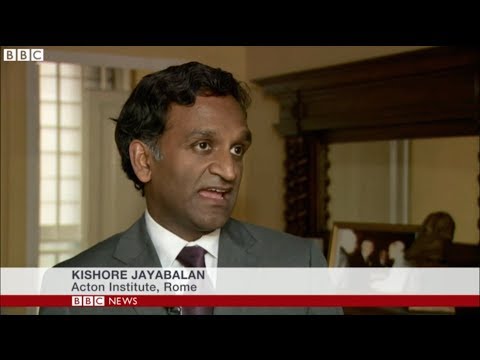
Why do so many clergy and religious activists reflexively attack the free market? Kishore Jayabalan takes a look at recent anti-business campaigns. “The very concepts of business and profit motive are often reason enough for religious leaders to condemn an activity as immoral and unethical, and criticisms of multinational corporations are just the same condemnations on a larger scale,” he writes.

Read more on Religious Leaders Bash the Global Market…

Ecumenical News International (ENI) relates the launch last month of a new initiative in Africa, designed to “to mobilise a strong African voice in development.” The effort is called African Monitor and is led by the Anglican Archbishop of Cape Town, South Africa, Njongonkulu Ndungane.

Read more on Monitoring African Aid and Development…

Jordan J. Ballor
posted by on Monday, May 15, 2006

John Stossel has made an excellent and noteworthy journalistic career by going where the evidence takes him. He possesses an intellectual honesty and curiosity that is refreshing, especially when compared to the banal talking head syndrome which dominates most main stream media.

Read more on The Myth of Aid…

Jordan J. Ballor
posted by on Friday, March 24, 2006

An snippet from Ecumenical News International:

Presbyterians invest $1 million in church ‘bank’ that helps poor

New York (ENI). The Presbyterian Church (USA) has invested US$1 million in Oikocredit, an organization established by the World Council of Churches that assists people in poor countries start small businesses. The investment is the largest in Oikocredit over more than a decade, the church announced earlier this week, making the 2.4-million-member US denomination the second-largest investor in the institution set up in 1975. The largest is the Church of Sweden.

Read more on Giving Credit where Credit is Due…

In this week’s Acton Commentary, “The North American Church and Global Stewardship,” I note that blessed with extraordinary material riches, Christians in North America are increasingly viewing their stewardship responsibilities in a global context. I look at one school in British Columbia and how their local building project also raised funds for a school in Sierra Leone.

Read more on The North American Church and Global Stewardship…

Acton PowerBlog RSS

Google Plus

Twitter Feed

Facebook Fan Page

Support the Acton Institute

The Acton Institute is funded through the generous contributions of individuals such as yourself. Learn more about how you can advance the cause of freedom and virtue.