Posts tagged with: government spending

In yesterday’s edition of the Grand Rapids Press, editorial page editor Ed Golder reflects on the implications of the historically-high levels of government spending, the deficit, and debt.

Most impressively, Golder notes where the government is actually spending money, and it is largely not in the areas of discretionary spending that so many politicians like to talk about. Golder writes,

Read more on What We Have Here is a Failure of Political Leadership…

Ken Larson
posted by on Friday, February 19, 2010

Jordan Ballor’s recent post “What Government Can’t Do” contained a quotation from Lord Acton worth revisiting:

“There are many things the government can’t do – many good purposes it must renounce. It must leave them to the enterprise of others. It cannot feed the people. It cannot enrich the people. It cannot teach the people. It cannot convert the people.”

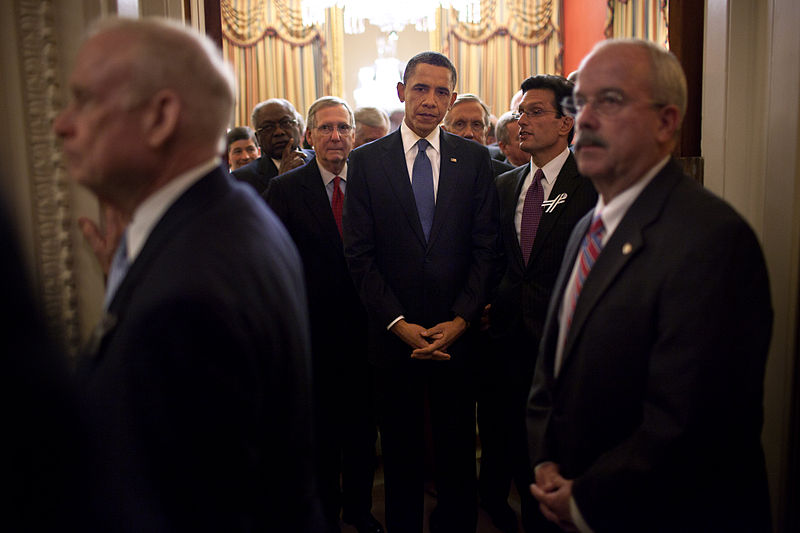
On February 18th Barack Obama announced a “Debt Panel” – officially termed a Bipartisan National Commission on Fiscal Responsibility and Reform – to be headed by former government veterans Alan Simpson of Wyoming and Erskine Bowles of the Clinton White House years by way of Morgan Stanley; and the university at Chapel Hill. (Wiki terms Bowles an “American Businessman” but the only business he’s been in is financial services. Bankers are money lenders. I know it’s a peculiar distinction but that’s hardly on a par with entrepreneurial spirt or creating wealth with an idea and a lot of sweat.) Bankers use OPM — other people’s money — and put it out for a fee.

Read more on Schools Of Government…

Ray Nothstine
posted by on Thursday, April 9, 2009

In this week’s Acton Commentary, I argue for simplifying the tax code. It should also be evident that any sort of tax reform should coincide with reforming the way Washington currently operates when it comes to spending.

Read more on The Tax Code: Business as Usual…

Ray Nothstine
posted by on Tuesday, February 17, 2009

In response to the question, “What are the moral lessons of the American Recovery and Reinvestment Act (ARRA)?”

One of the gravest moral issues related to the American Recovery and Reinvestment Act is the matter of dangerous deficit spending. Anybody plugged into our nation’s financial crisis is likely aware of the unsustainable spending path of not just the federal government, but individual states as well. Because many states have balanced budget amendments, they are not entitled to run deficits, so the federal government proposes bailouts, which comes at an even greater cost to taxpayers from fiscally responsible states. One can easily see how policies like these only encourages irresponsible government spending policies.

Read more on PBR: Dangerous Deficit Spending…

“Government budgets are moral documents,” is the often quoted line from Jim Wallis of Sojourners and other religious left leaders. Wallis also adds that “When politicians present their budgets, they are really presenting their priorities.” There is perhaps no better example of a spending bill lacking moral soundness than the current stimulus package being debated in the U.S. Senate.

Read more on More on ‘The Moral Bankruptcy Behind the Bailouts’…

The Wall Street Journal offers a welcomed reminder of the value of tax revolts titled, “The Spirit of 13.” Proposition 13 is a notable property tax revolt which was led by the late California citizen Howard Jarvis in 1978. There are several books about the famed revolt and many attribute the event to helping fuel the “Reagan Revolution.”

Read more on The Wall Street Journal on Proposition 13…

A call to end poverty through more spending by the federal government is forever professed by some candidates and politicians. Maybe, they say, if just more money was appropriated and distributed this time, the results and relief for those in financial need would be conclusively different? Former President Clinton at least ran for office as a “new Democrat,” went on to declare the end of the era of big government, and signed welfare reform. Clinton was the first Democrat to win consecutive elections to the presidency since Franklin D. Roosevelt, cracking the Republican Party’s hold on the White House.

Read more on Straight Talk on Poverty & The Family…

Acton PowerBlog RSS

Google Plus

Twitter Feed

Facebook Fan Page

Support the Acton Institute

The Acton Institute is funded through the generous contributions of individuals such as yourself. Learn more about how you can advance the cause of freedom and virtue.