Posts tagged with: Hunter Baker

downloadOver at Rough Trade, the always intriguing James Poulos celebrates the increased attention  now being given to the “relationship between economic and religious life,” pointing to the Acton Institute’s very own Samuel Gregg to kick things off.

Yet he remains unsatisfied, fearful of a return to what he views to be unhelpful “conceptual frameworks and cultural antagonisms” of the past, and urging us to push toward “a new mode of analysis that breaks away from the old, exhausting debates.” For Poulos, this means embracing an “economics of grace,” an interrelated component of something he has called “radicaltarianism” in the past (see more on this here and here).

Poulos observes the typical divides among Christians as follows:

Christians who accept these teachings [about the fall of man and grace] tend to split into two economic camps: those who lean toward an uncritical embrace of free-market capitalism, and those who tilt toward a far more skeptical, suspicious attitude. For the first group, the social upshot of Christianity is an institutional framework that supports flourishing with minimal reliance on the state. Christianity supplies a good foundation for market activity. For the second, the most durable and authentic institutional frameworks supplied by Christianity raise damning questions about the sustainability of neoliberalism — the secular “democratic faith” that gives market capitalism its modern philosophical foundations. For both groups, the key is that, ultimately, religion drives sustainable economic life. The difference is that the first group typically understands religion in a Protestant way, as a driver of explosive, and morally legitimate, economic growth, while the second takes a more Catholic view, doubtful of the moral purity of explosive growth, and focused much less on growing capital than other sorts of things, like families.

Although I disagree with where precisely Poulos draw his lines — sharing much of Rodney Stark’s skepticism about an explicitly Protestant ethic (etc.) — such divides do exist, labels aside.

Describing the state of the debate more broadly, Poulos argues that our political factions have also proven unhelpful, using terms like “economic growth” based on limited materialistic assumptions. Read more on Radicaltarianism: Toward an Economics of Possibility and Grace…

Ahead of tonight’s vice-presidential debate between Joe Biden and Paul Ryan, Hunter Baker (a Baptist political scholar) and I (a Reformed moral theologian), offer up some thoughts as “Protestants in Praise of Catholic Social Teaching” in a special edition of Acton Commentary.

Read more on Up for Debate: Catholic Social Teaching and Political Discourse…

One of the nice things about being asked to write an endorsement for books is that you often get a complimentary copy. My copy of Political Thought: A Student’s Guide arrived earlier this week, and it is the latest offering from Hunter Baker, my friend, sometime PowerBlog contributor, and last year’s recipient of Acton’s Novak Award.

Read more on Hunter Baker’s ‘Political Thought’…

Professor Hunter Baker recently appeared on the Research on Religion podcast to discuss, among other things, his latest book, The End of Secularism. Baker’s book, like much of the podcast’s discussion, centers on the treatment of religious matters within the public square. In doing so, the podcast covers a broad range of relevant topics and is worth a listen.

Read more on Prof. Hunter Baker, 2011 Novak Award recipient, featured on Research on Religion podcast…

Don’t forget about tonight’s Acton on Tap, from 6:30pm-8:00pm in East Grand Rapids. The event will be taking place at the Derby Station (2237 Wealthy St. SE, East Grand Rapids 49506). Tonight’s Acton on Tap will focus on the release of the movie version of Ayn Rand’s Atlas Shrugged:

Read more on Acton on Tap Tonight: Ayn Rand at the Movies…

Religion & Liberty’s winter issue featuring an interview with patristics scholar Thomas C. Oden is now available online. Oden, who is a Methodist, recalls for us the great quote by Methodist founder John Wesley on the Church Fathers: “The Fathers are the most authentic commentators on Scripture, for they were nearest the fountain and were eminently endued with that Spirit by whom all Scripture was given.”

Read more on Religion & Liberty: An Interview with Thomas C. Oden…

Jordan J. Ballor
posted by on Wednesday, February 23, 2011

From Abraham Kuyper’s opening address to the First Social Congress in Amsterdam, November 9, 1891, The Problem of Poverty:

The first article of any social program that will bring salvation, therefore, must remain: “I believe in God the Father Almighty, Maker of heaven and earth.” This article is today being erased. Men refuse any longer to recognize God in statecraft. This is not because they do not find the poetry of religion charming, but because whoever says I believe in God thereby acknowledges God’s ordering of nature and an ordinance of God above human conscience–a higher will to which we as creatures must submit ourselves.

Kuyper said this at the close of the nineteenth century, and in the intervening decades the question of the place of the Christian faith in public life has become even more pressing.

Read more on Kuyper on Secularism…

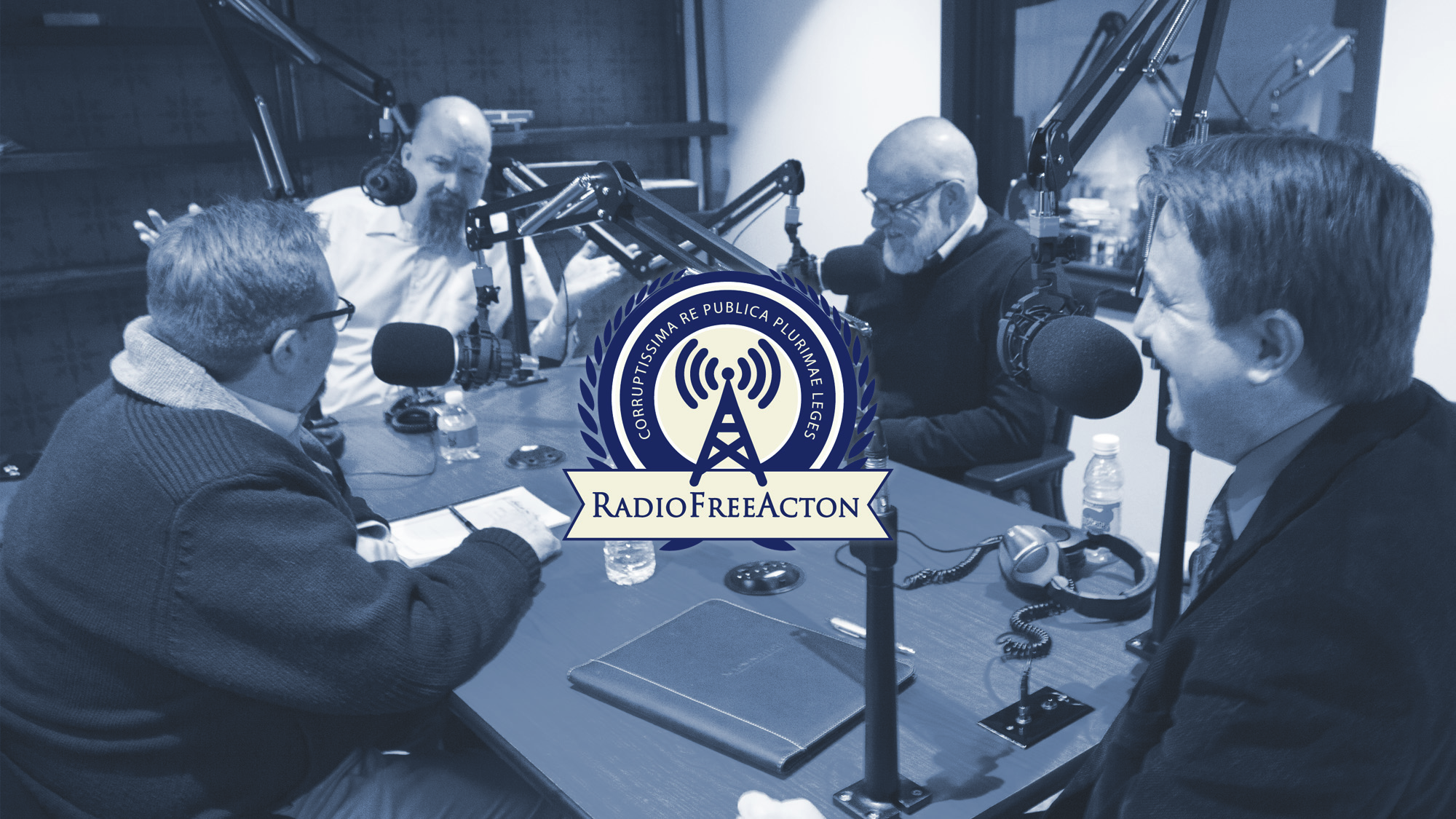
Radio Free Acton hits the web once again today, this time featuring an exchange between Hunter Baker, author of The End of Secularism, and Jonathan Malesic, author of Secret Faith in the Public Square: An Argument for the Concealment of Christian Identity. Their conversation continues an exchange begun in the Controversy section of the latest issue of Acton’s Journal of Markets & Morality. Should Christians be overt about their faith when operating in the public square, or should Christian identity remain concealed in order to protect the faith from being drained of any real meaning? Baker and Malesic provide some thought-provoking perspectives on this vital question. [Ed. note: As an exclusive for PowerBlog readers, you can read the Malesic/Baker controversy in the Journal of Markets & Morality here.]

Read more on Radio Free Acton: Concealing Christian Identity…

Louie Glinzak
posted by on Wednesday, August 19, 2009

Hunter Baker examines the push for the “public option” — the creation of a government backed insurance system — as part of health care reform in his commentary.  Baker takes an interesting approach at examining the push for a public option by dropping his readers into the life of a doctor, articulating the stress and sacrifice of the job:

Read more on Acton Commentary: Imagine You Are a Doctor…

With health care continuing to be a hot button issue, Hunter Baker brings to light a new argument in his commentary.  While Baker provides us with many prudential reasons to oppose the expansion of government health care, such as the currently proposed government plan not having any provision for preventing the trial lawyer windfalls that have helped contribute to medical inflation, he also articulates the fundamental problems that arise with the expansion of government health care:

Read more on Acton Commentary: Healthcare, Democracy, and Freedom…

Acton PowerBlog RSS

Google Plus

Twitter Feed

Facebook Fan Page

Support the Acton Institute

The Acton Institute is funded through the generous contributions of individuals such as yourself. Learn more about how you can advance the cause of freedom and virtue.