Posts tagged with: protestantism

Jordan J. Ballor
posted by on Tuesday, December 21, 2010

Rev. Daniel Meeter, pastor in the Reformed Church of America (RCA), writing in the Reformed journal Perspectives, “Observations on the World Communion of Reformed Churches”:

My participation at Johannesburg is the reason I was an observer at the General Council, and why I was assigned to the General Council’s committee on Accra (though there were many other committees and a host of workshops that interested me, from worship to theology to inter-faith dialogue). Our committee was huge: sixty people or so. We eventually divided into table groups, and I was a pinchhit table leader. My table included Taiwanese, Chinese, Filipinos, and Indonesians. Our tables were charged to come up with a variety of responses to Accra, such as actions and outcomes or further work on its content and theology. Our responses were recorded and two delegates were appointed to consolidate them into a report to the plenary. I had to leave before the report was made, so I look forward to reading the minutes of when they come out.

Read more on The WCRC and Social Justice…

In today’s Acton Commentary I argue that “Christian Giving Begins with the Local Church.”

I note some statistics that show that American Christians are increasingly looking beyond their local congregations and churches as outlets for their charitable giving, in spite of the fact that giving to religiously affiliated and religiously focused charities is increasing.

Read more on Christian Giving Begins with the Local Church…

Madeleine L’Engle, in a 1986 essay, “What May I Expect from My Church?”

And that is what I want my church to speak out about: the Gospel, the Good News. Then I will be given criteria to use in thinking about such issues as abortion, euthanasia, genetic manipulation. It is impossible to listen tot he Gospel week after week and turn my back on the social issues confronting me today. But what I hope for is guidance, not legislation.

L’Engle wrote these words referring to the Episcopal Church, but I echo precisely these sentiments in my critique of the ecumenical movement’s social witness in Ecumenical Babel. What we need is moral guidance and formation from the church, not, as I put it, attempts “to make arbitrary conclusions morally binding.”

Read more on ‘What May I Expect from My Church?’…

Today at Mere Comments I highlight what I’m calling the “Neo-Anabaptist temptation.”

Check it out.

Jordan J. Ballor
posted by on Thursday, June 11, 2009

Upon Sonia Sotomayor’s nomination to the Supreme Court, a number of voices on the Christian and religious blogosphere wondered about the absence of press attention to the religious makeup of the court. The new court’s makeup, whether or not Sotomayor is ultimately confirmed, is historic. As Terry Mattingly wrote at GetReligion, tongue planted firmly in cheek, “prepare for more headlines about Catholics taking over our nation’s legal discourse.”

Read more on Catholicism and the Supreme Court…

I recently received a request from a reporter to respond to the recent spate of studies and stories positing a decline in American Christianity. Here’s how I answered:

Broadly speaking, it is silly to think of secularization as a linear process. The prominence of the Christian faith waxes and wanes during different historical periods. As Rodney Stark has pointed out, the old golden age of faith picture of antiquity is not nearly as strong as many believe. There is, however, always a solid and motivated core.

Read more on A Quick Response to the Christianity Trailing Off Thesis…

In the latest volume of the Mars Hill Audio Journal, host Ken Myers talks with J. Daryl Charles, author of Retrieving the Natural Law: A Return to Moral First Things (Eerdmans, 2008). Charles is associate professor of Christian Studies at Union University, and spent the 2007-2008 year as William E. Simon Visiting Fellow in Religion and Public Life in the James Madison Program at Princeton University.

Read more on J. Daryl Charles on the Revival of Natural Law…

Jordan J. Ballor
posted by on Thursday, December 18, 2008

This year marks the 400th anniversary of the birth of John Milton, best known for his masterpiece, Paradise Lost. An essay by Theo Hobson, author of the newly-released Milton’s Vision: The Birth of Christian Liberty (Continuum, 2008), well summarizes Milton’s integrated theological, political, and social vision (HT: Arts & Letters Daily).

Read more on Milton’s Religious Vision of Liberty…

Jordan J. Ballor
posted by on Wednesday, March 5, 2008

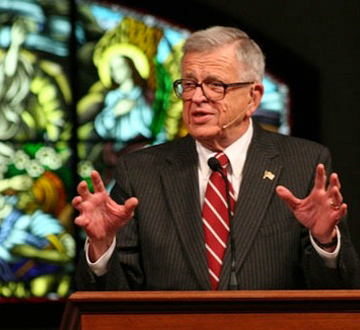
As part of our participation in the blog tour for Chuck Colson’s book The Faith, we got to submit a question for Chuck to answer. Here’s our exclusive Q&A:

PowerBlog: You talk about the history of the faith and tradition in your book a great deal. What do North American evangelicals stand to gain from examining more closely their own history and traditions? In what sense ought Protestantism be understood as “catholic”? Part of that great Christian tradition has to do with the witnesses to the faith, which you survey in the book. What do the concepts of martyrdom and suffering have to do with a Western context where most Christians live comfortably and without the threat of persecution?

Colson: “All true Christians confess the creed: we believe in one holy, catholic, apostolic church. Protestantism of course distinguishes itself from the Roman Church doctrine, but regards itself as part of the one body of Christ, one holy catholic apostolic church.

It is crucial that Christians understand history and tradition. Just look at how America was founded in the midst of a Great Awakening led by George Whitfield, who had been greatly influenced by the Wesley Awakening and by Wesley himself. Look at the role of Jonathan Edwards, not only in shaping the early structures of American society but in producing some of the great writings that is part of our own heritage, both as Americans and as Christians. The Encyclopedia Britannica said that Edwards was the greatest mind produced in the western hemisphere. We also need to understand the history of revivalism and how it profoundly affected the shaping of American society and culture. Christianity’s role in bringing educational institutions to the new world is indispensable.

On the subject of martyrdom and suffering, we’ve had some, but precious little. We’ve lived in a largely contained and protected environment. And that may be one of the reasons why secularism is advancing so rapidly even in the church.”

Be sure to check out the rest of the blog tour, along with all of the other Q&As to come. Next up today: The Dawn Treader. Also, be sure to raise questions in the comments section below. The word is that Chuck will be answering some of the questions raised in the comments throughout the blog tour. (Be sure to comment and raise questions at other stops on the tour, if you find the topics raised there to be of more interest.)

Jordan J. Ballor
posted by on Thursday, February 28, 2008

Following up on our discussion of the Pew survey on the American religious landscape, I have a few thoughts as to what plagues American Protestantism, particularly of the evangelical variety, and it has to do precisely with the “catholicity” of Protestantism.

Read more on Some Problems with Protestantism…

Acton PowerBlog RSS

Google Plus

Twitter Feed

Facebook Fan Page

Support the Acton Institute

The Acton Institute is funded through the generous contributions of individuals such as yourself. Learn more about how you can advance the cause of freedom and virtue.