Posts tagged with: rerum novarum

The Michigan legislature passed right-to-work legislation today, a landmark event that promises to accelerate the state’s rebound from the near-collapse it suffered in the deep recession of 2008. The bills are now headed to Gov. Rick Snyder’s desk. The right-to-work passage was a stunning reversal for unions in a very blue state — the home of the United Auto Workers. Following setbacks for organized labor in Wisconsin last year, the unions next turned to Michigan in an attempt to enshrine prerogatives for their organizing efforts in the state constitution. A union-backed ballot proposal was handily defeated by voters in the Nov. 6 election.

Read more on Big Gains for the Union Liberation Movement…

Here is the comment posted this this morning on the National Catholic Reporter article titled, “Statement on economy denounced by archbishop fails to pass.”

Full statement follows:

An important clarification.

Archbishop Fiorenza’s assertion that the Acton Institute views Rerum Novarum as “no longer applicable today” is incorrect. The archbishop is most likely basing this claim on a June 2012 America Magazine blog post by Vincent Miller titled, “Sirico Completely Wrong on Church’s Social Teaching.”

Read more on Acton Institute responds to National Catholic Reporter article on bishops’ economic statement…

As I leafed through this week’s Wall Street Journal Europe political commentary, I finally felt a little redemption. Hats off to WSJ writers Peter Nicholas and Mark Peter whose brief, but poignant August 20 article “Ryan’s Catholic Roots Reach Deep” shed light on vice presidential candidate Paul Ryan’s value system. This was done by elucidating how Paul Ryan views the relationship of the individual with the state and how the local, small-town forces in America can produce great change for a nation gravely concerned about its weak and vulnerable.

The article references a standard Catholic but still-very-unknown-teaching on “subsidiarity.” Go figure, not even my word processing program recognizes the term in its standard U.S. English lexicon. Alas, subsidiarity is not a word you read about in the secular Wall Street Journal, either, whose op-eds debate many critical intuitions of the free market and democratic society yet seldom examine the intersection of theology and economics, like the Acton Institute does so well.

Indeed the WSJ Europe article was not that erudite (for other more elaborated pieces on subsidiarity go here and here and be sure to watch Fr. Robert Sirico’s  enlightening video (below). Neither do the WSJ writers spell out the details of Ryan’s various economic and welfare reform proposals inspired by the principle of subsidiarity, which include a repeal of nationalized medicine and drastically reducing spending on various excessive national welfare and other expansive public agencies.  Nonetheless, last Monday this secular media outlet gave its readers a very Catholic glimpse into  Ryan’s political world view which is  a product of a hardworking, Irish  Catholic family from  “small-town” America  (Janesville, Wis.)  trying to solve its own problems by the teachings of the Catholic Church. Read more on Small-town Paul Ryan: Defender of Subsidiarity…

Anytime I can get a progressive/dissenting Catholic magazine/blog like the Jesuit-run America simultaneously to quote papal documents, defend the Magisterium of the Catholic Church, embrace the Natural Law and even yearn for a theological investigation “by those charged with oversight for the Church’s doctrine” of a writer suspected of heresy, I consider that I have had a good day.

And to think that all this was prompted by two sentences of mine quoted in a New York Times story on an attempt by adjunct professors at Pittsburgh’s Duquesne University to form a union! Times reporter Mark Oppenheimer asked how I made sense of the resistance on the part of Duquesne, a Catholic University, to unionizing efforts by adjunct professors in light of the Church’s teaching about unions. We had a pleasant half hour talk on the subject in which I first explained that the Church generally looked favorably on unions – certainly not all of them, at all times or in all places, and not at all they do, and not as an end in themselves, but rather for the well-being of those workers and their families (i.e., that the Church’s support for unions is contingent). This favorable bias does not mean that workers are obligated to join a union, nor that management is obligated to accept the terms of a union. The right to join a union, in Church teaching, is rooted in the natural right of association, which of course also means that people have the right not to associate. It all boils down to the details of the specific case, meaning that Duquesne was probably considering the ever-rising costs of education and its impact on the lives of students and their families.

It was in this context that I uttered what the America magazine/blog writer Vincent Miller deemed offensive when I observed that Pope Leo XIII wrote Rerum Novarum, “In the industrial revolution, [when] the church was concerned about communism, and not just capitalism but savage capitalism . . . People were being brutalized. That’s just not the case in Pittsburgh today.” Read more on Rev. Robert Sirico: Reply to America Magazine…

Review of The Tyranny of Cliches: How Liberals Cheat in the War of Ideas, by Jonah Goldberg, (New York, NY: Sentinel, 2012)

With proper training, and maybe a bit of experience on the debate team, it’s easy to recognize logical fallacies in an opponent’s argument. When it comes to popular give and take, the sort of thing we have so much of now on opinion websites and news channels, there hasn’t been decent preparation for arguments outside the columns and blog posts of Jonah Goldberg.

In The Tyranny of Cliches, the National Review contributor, syndicated columnist, author of the bestseller Liberal Fascism, and American Enterprise Institute fellow, convincingly demolishes the Left’s oft-repeated, bumper-sticker slogans that seemingly defy repudiation by many who fear being depicted as a heartless jackanape.

For example, if an impassioned public figure pleads that yet another government expansion and encroachment is “for the children” it is therefore ipso facto in the best interests of everyone. This is a “case-closed” logical fallacy that circumvents rational discussion by declaring that if millions of cute kids benefit, only meanies, bullies, or some contemporary amalgamation of Attila the Hun, Adolph Hitler, Pol Pot, Joseph Stalin, and Darth Vader could oppose it.

Not so fast. Goldberg’s new book wonderfully dissects such liberal shibboleths as “social justice,” “diversity,” attacks on organized religion in general and Roman Catholicism in particular, and “separation of church and state” to reveal the hollowness within. In this regard, Goldberg resembles most William F. Buckley, with the difference that the latter stood athwart history yelling stop, and the former stands astride postmodernism to scream “enough!”
Read more on A Field Guide to the Baseless Claims and Outrageous Canards of the Liberal-Progressive…

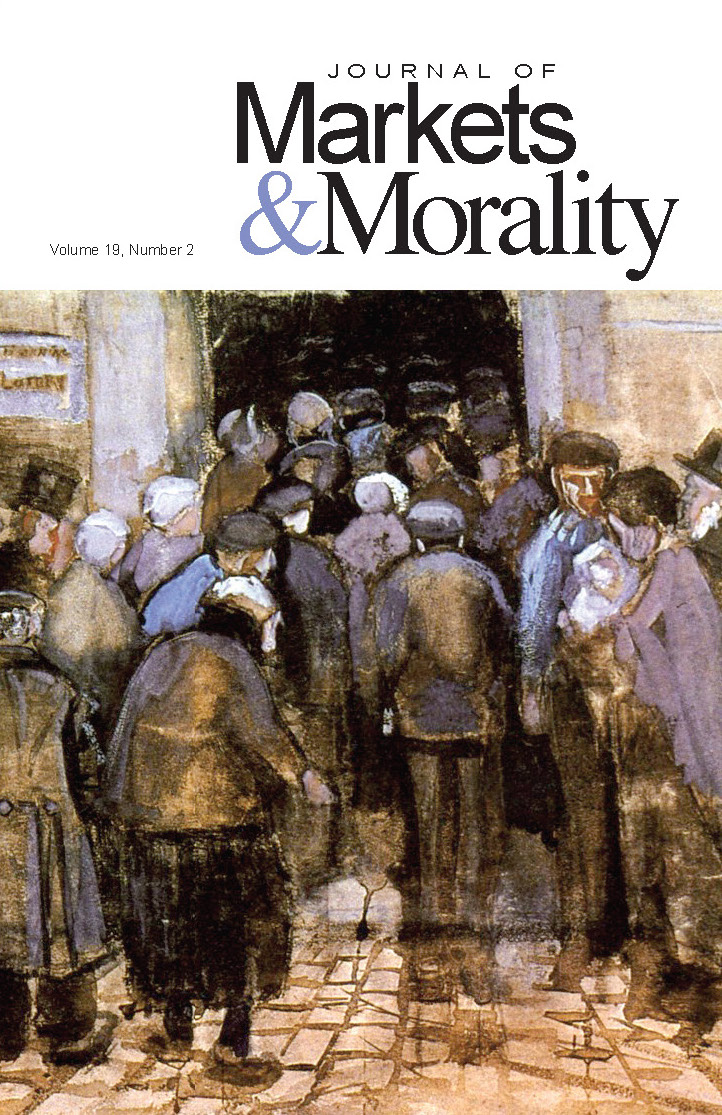
The fall 2011 issue of the Journal of Markets & Morality has now been finalized and will be heading to print. It is a bit overdue, but this issue is one of our largest ever, and it includes a number of noteworthy features on the special theme issue topic “Modern Christian Social Thought.” As I outline in the editorial for this issue (PDF), 2011 marked a number of significant anniversaries, including the 120th anniversaries of Rerum Novarum and the First Christian Social Congress in Amsterdam.

Read more on Preview of JMM 14.2: Modern Christian Social Thought…

The Center for American Progress (CAP) has boldly rebutted the arguments of our own Kishore Jayabalan, director of Istituto Acton, concerning the Vatican’s note on a “central world bank.” It has done so by showing him to be lacking in “respect for the inherent dignity of human life.” … Yes, we are talking about that Center for American Progress.

Read more on BREAKING: Center for American Progress Takes Moral High Ground…

Kenneth Spence
posted by on Thursday, September 8, 2011

Union leaders have been jockeying for position ahead of President Obama’s “jobs speech,” since the proposals he makes will be big opportunities for organized labor. AFL-CIO head Dick Trumka has asked the president to spend with abandon, and has reminded him rather ominously, “This is going to be a moment in history when our members are going to judge him.” Teamsters boss James Hoffa has called for the President to force companies with cash in the bank to spend that money on new hires.

Read more on Big Labor Dumps Rerum Novarum…

James Hoffa put on quite a performance this weekend—first on CNN’s “State of the Union,” and then in Detroit at a Labor rally with President Obama. Also this weekend, President Biden revealed that the White House seems to have given up and decided America is already a “house divided,” with “barbarians at the gate” in the form of the Tea Party. Coverage of these incidents is available from whichever news outlet you trust, but there is one thing that CNN has probably missed: this weekend’s rhetoric is a vivid reminder that most labor organizations have moved far beyond their proper and defensible role.

Read more on Jumping the Shark: Hoffa’s Rant and Rerum Novarum…

I’ve issued a call for publication for a special issue of the Journal of Markets & Morality to appear in the Fall of 2011 (14.2). The details are below, and you can download and circulate a PDF as well.

Read more on CFP: Modern Christian Social Thought (JMM 14.2)…

Acton PowerBlog RSS

Google Plus

Twitter Feed

Facebook Fan Page

Support the Acton Institute

The Acton Institute is funded through the generous contributions of individuals such as yourself. Learn more about how you can advance the cause of freedom and virtue.