Posts tagged with: rodney stark

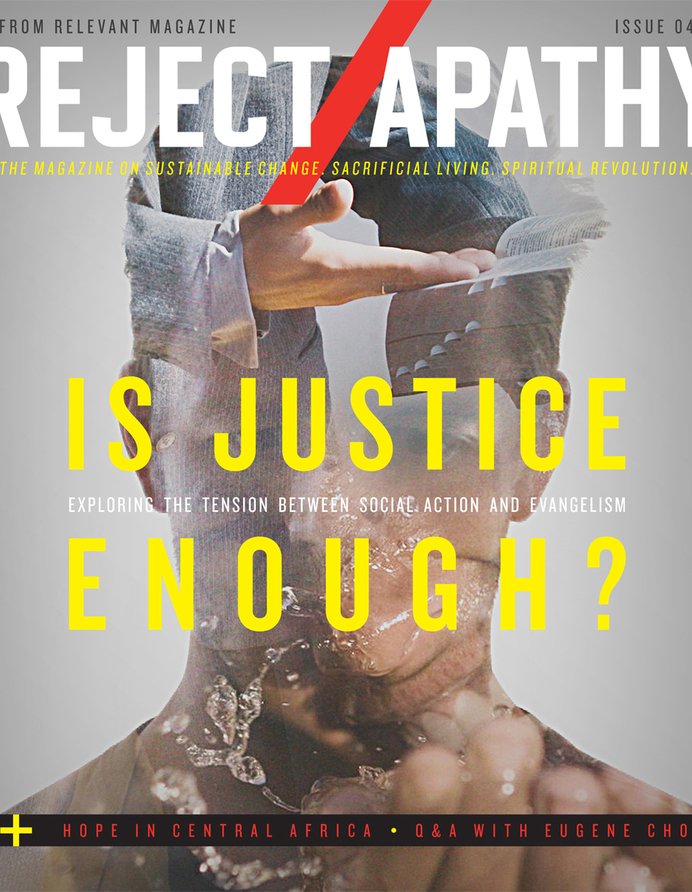
Reject Apathy, RELEVANT Magazine, Tim Hoiland, Is Justice EnoughIn the recent issue of Reject Apathy, an off-shoot publication of RELEVANT Magazine, Tim Hoiland explores what he believes to be a tension between “serving justice” and “saving souls”:

This [young] generation’s passion for justice is, without doubt, something to celebrate. It’s a breathtaking sign that the Spirit is at work, leading young men and women into lives marked by the reigning belief that all of life matters to God, not just the parts we might call “spiritual.”

But in this sincere step toward activism, have other essential aspects of the Christian calling been neglected? As Christians respond to the cries of the oppressed, have they failed to share the life-giving message that is truly good news to the poor?

… If Christians are to bridge the artificial divide between evangelism and social action, they must immerse themselves in the Bible’s story of redemption. They must learn from those who have gone before them. And they must see the strength of the diversity of the Church—a company of uniquely called individuals in God’s cosmic mission.

As Hoiland goes on to remind us, pointing to the work of sociologist Rodney Stark, the church has successfully fused evangelism and social action throughout its history, from the selling and sharing of possessions in the Book of Acts to the church’s widespread establishment of schools, orphanages, and hospitals in more recent centuries (a feature highlighted at length in Rev. Sirico’s recent book).

But in the early 20th century, Hoiland believes, something changed: Read more on Integrating Evangelism and Social Action Across Culture…

Over the last several years I find myself more and more being drawn into conversation about religion—specifically, Orthodox Christianity—and economics. Originally, my interest in the economic side of the conversation was minimal. Embarrassing though it is to say now, I only took one economics class in college and while I got a “B” I was an indifferent student of the subject.

Read more on Review: AEI’s Common Sense Concept Series…

This week’s commentary by Rev. Gregory Jensen. Sign up for Acton News & Commentary here.

Finding the Balance: Privacy and the Civil Society

Privacy in our culture has come to serve not a deepening of community life but an ever deeper sense of social isolation.  Even otherwise laudable behavior is increasingly justified not by the goodness of what is done but by the modern sense of privacy.  Even among those who ought to know better, the Gospel is presented in terms that are almost wholly personal without any sense of its public character and demands.   Our sense of isolation from each other has become so profound that even to suggest that there is a human nature and that true happiness is only possible when we live in conformity to our nature, is seen a provocation and an assault on the radical autonomy of the individual.  

Read more on Finding the Balance: Privacy and the Civil Society…

Acton Media’s seventh Birth of Freedom short features Rodney Stark, author of The Victory of Reason. In the video, he discusses the question “Why didn’t China have an industrial revolution before the west?” Although evidence points to the beginnings of an agricultural and industrial revolution in the 10th century, the lack of protection for private property has been a disincentive for innovation and hard work.

Read more on Birth of Freedom Shorts Series: What happened to China’s Industrial Revolution?…

Jordan J. Ballor
posted by on Friday, August 18, 2006
How different is this…

In a recent WSJ story, “A Novel Way to Reduce Home Energy Bills,” Sara Schaefer Muñoz writes about the possibility of adding windmills to homes in order to cut down on the cost of utilities.

Read more on Wind Power: Not So Novel After All…

Jordan J. Ballor
posted by on Wednesday, August 2, 2006

Do economic, political, and religious freedom go together? Rodney Stark, writing in his recent book The Victory of Reason, says that “It seems doubtful than an effective modern economy can be created without adopting capitalism, as was demonstrated by the failure of the command economies of the Soviet Union and China.” He also writes,

Read more on Religious Freedom in China…

Acton PowerBlog RSS

Google Plus

Twitter Feed

Facebook Fan Page

Support the Acton Institute

The Acton Institute is funded through the generous contributions of individuals such as yourself. Learn more about how you can advance the cause of freedom and virtue.