Posts tagged with: soviet union

Ronald Reagan & Margaret Thatcher

Ronald Reagan & Margaret Thatcher

Margaret Thatcher (1925-2013) provided the West with many morally courageous moments. The moniker, “The Iron Lady” was bestowed upon her by the Soviet Army newspaper Red Star in 1976 because of her piercing denouncement of communism. Thatcher, of course, adored the unofficial title.

Read more on Margaret Thatcher and the Freedom Offensive…

Pravmir.com, a Russian site, has published an English translation of an interview given by Archpriest Nikolai Chernyshev, who is identified as “the spiritual father of the Solzhenitsyn family during the final years of the writer’s life.” The interview touches on Aleksandr Solzenitsyn’s upbringing in a deeply religious Russian Orthodox family, his encounter with militant atheism ( … he joined neither the Young Pioneers nor the Komsomol [All-Union Leninist Young Communist League]. The Pioneers would tear off his baptismal cross, but he would put it back on every time). Fr. Chernyshev describes the writer’s later “period of torturous doubt, of rejection of his childhood faith, and of pain.” The priest talks of Solzhenitzyn’s return to the faith after his experience in the Gulag and how “he suffered and fretted about the Church being in a repressed state. For him this was open, obvious, naked, and painful.” Excerpt from the interview:

Read more on Solzhenitsyn: ‘There’s Plenty of Freedom, But Little Truth’…

Alexander Solzhenitsyn’s The Gulag Archipelago, banned in the Soviet Union until 1989, has been published in a new shorter, Russian-language edition aimed at schools. The book was included in the list of compulsory books in Russian schools only last year, according to a report in RIA Novosti.

Read more on Russian students get a new, shorter Gulag Archipelago. What about Americans?…

John Couretas
posted by on Thursday, October 14, 2010

Russian Orthodox Patriarch Kirill, at a meeting with German President Christian Wulff in Moscow today:

“I am deeply convinced that modern civilization is making the same mistake as the Soviet Union. It doesn’t matter very much why you are removing faith from pubic life. The final result, as engineers say, is the same: you get dismantling of religious consciousness,” the Patriarch said.

Read more on Removing Faith from Public Life, Again…

The Institute on Religion & Democracy’s Faith McDonnell:

Conducting “truth commissions” to denounce American armed forces and organizing divestment campaigns to cripple Israel are vital issues to some American church officials. Raising the banner of Intifada and expressing solidarity with Palestinians are also very important to this collection of liberal leaders. They “spiritualize” the Democratic immigration and health care reform agendas with pompous prayer, but their social justice-focused prophetic vision has strange blind spots. Leftist church leaders hardly ever see, let alone condemn, the imprisonment, enslavement, torture, and murder of Christians in the Islamic world, North Korea, and China.

Read more on Progressive Christianity’s habit of ‘Embracing the Tormentors’…

I want to second Marc’s article recommendation from earlier today. The phrase “a must read” is badly overworked, but in this case I can’t help myself: Claire Berlinski’s A Hidden History of Evil in the latest City Journal is a must-read. A few excerpts:

Read more on Why doesn’t anyone care about the unread Soviet archives?…

rebellion In the new book The Rebellion of Ronald Reagan, James Mann wants you to meet Reagan as the rebel who parted ways from cold war hawks in his own administration and foreign policy “realists” who were loyal to containment. It could be argued that Reagan was the atypical conservative dove in Mann’s view.The author does provide a relatively fresh thesis on Reagan’s role in ending the Cold War, which reinforces his rejection of what he calls “both left wing and right wing extremes.” Mann believes conservatives who champion Reagan as the president who had a well formulated economic and military plan to execute the end of the Soviet Union, and left wing critics who saw Reagan as lucky, overly simplistic and vapid, were both wrong.

When it comes to Soviet diplomacy, Mann’s account is highly praiseworthy of Reagan and his Secretary of State George Schultz. He sees the end of the Cold War as a result of both of men’s instincts and creativity in dealing with Mikhail Gorbachev, rather than the heavy arms build up, resistance to détente, and “saber-rattling” of Reagan’s first term. Critics of Reagan from the right, “failed to see the dynamics that were propelling change [in the Soviet Union]. Reagan would come to grasp the situation better and more quickly than they did,” says Mann. Read more on Review: The Rebellion of Ronald Reagan…

Ray Nothstine
posted by on Thursday, August 21, 2008

Righteous Warrior: Jesse Helms and the Rise of Modern Conservatism, a political biography published in February, crafts a narrative that largely reinforces popular public images of the late Jesse Helms as a demonizing figure. The author, William A. Link, is a history professor at the University of Florida who notes several times in the preface of his book that Helms represented everything he opposes. Link also says his intention was to write a fair biography of the former Senator from the Tar Heel state. While Link’s biography largely fails this test, his depiction is less hostile and more respectable than many modern liberal academics may have been able to attempt. The author does include significant portions of his biography to depicting the impeccable manners, personal morality, and genteel personality that characterized Jesse Helms.

Probably the most controversial position of Jesse Helms was his opposition to the land mark federal Civil Rights legislation of 1964 and 1965 while he was a journalist and television commentator for WRAL radio and television in Raleigh, North Carolina. While not a lawmaker at the time, the controversy is further fueled because Helms never renounced his opposition to the legislation, like some Southern politicians would later do because of a genuine change of heart or perhaps for political survival. Helms always insisted he was not a racist and Link notes that Helms tried to tie his opposition to integration to larger anti-statist arguments against federal intervention. Helms kept his distance from the more radical segregationist groups who opposed integration. At the same time, he attacked the alleged communist influences in Civil Rights groups, and even the personal moral failings of its leaders. Helms felt that good people from both races could come together to solve racial problems without federal intervention. He would take further flak for opposing the Martin Luther King, Jr. holiday and this political ad against quotas.

Link also discusses many commentaries written and read by Helms at WRAL about the dangers of the growing federal government. Helms declared “government could either be man’s servant or master: it could not be both.” Helms also attacked appeasers of communism and would soon emerge as perhaps the most notable elected anti-communist, with the exception of Ronald Reagan.

Trying to decide to run for the United States Senate, a supporter urged Helms to run by saying, “We need you Jesse in order to save the country from liberalism.” In his first Senate campaign Link declares:

Repeating the familiar Viewpoints message, he told voters in 1972 about an expanding and intrusive federal government, the threat of socialism, the excesses of the welfare state, rising crime, deteriorating moral standards – all problems related, he said, to an out of control liberal state. The welfare system, he explained to an audience in the eastern North Carolina tobacco town of Smithfield, was a “mess,” beset by “loafers and parasites.” Helms fashioned a populist appeal that was targeted toward ordinary people and toward the frustrations of white, rural, and small town North Carolinians. His message, Helms said, was directed toward “the person who pulls on his clothes in the morning and grabs his dinner pail and goes off to work.”

In fact, Link notes that Helms was running as a Republican in the 1972 Senate campaign and had recently switched parties. The Republican Party offered little help or resources to Helms. Most of his supporters were Democrats, who had long dominated state politics in North Carolina during this era. Those supporters were admirably dubbed “Jessecrats.” Helms would however benefit greatly from Democratic Presidential Candidate George McGovern’s unpopularity in North Carolina, and a last minute campaign stop by incumbent President Richard Nixon, when it appeared Helms had a chance to win. Helms did win, and while all of his senate races were relatively close, he was always able to hold together a strong and loyal coalition of religious conservatives, white males, and rural and small town voters. Always the underdog, he played up his anti-establishment and anti-liberal crusades, and his political obituary was prematurely written on a number of occasions. Read more on Review: Righteous Warrior…

John Couretas
posted by on Saturday, August 9, 2008

In the Wall Street Journal, Edward E. Ericson Jr. asks whether “this week’s evenhanded obituaries signal merely momentary respect for the newly dead or augur better days ahead for Solzhenitsyn’s reputation.” In “Solzhenitsyn, Optimist,” Ericson observes that the writer “had the last laugh” in his struggle against the Soviets.

Read more on ‘Solzhenitsyn, Optimist’…

Ray Nothstine
posted by on Thursday, January 24, 2008
Ronald Reagan delivers his radio commentary

When I lived in Egypt one of the Egyptian drivers for diplomats at the American Embassy in Cairo explained how people had to wait five to seven years for a phone. He proudly stated he was on the list, but poked fun at the long wait for service. Of course, he also added that you might be able to speed the process up by a few months with bribes, or as it is more affectionately knows as in Egypt, “baksheesh.”

Ronald Reagan loved to tell jokes about the former Soviet Union, especially about the stark differences between the United States and Soviet economic systems. It was a tactic he often used to take the hard edge off his criticism of the Soviets, while still drawing sharp contrasts between the competing systems. It also deftly showed his solidarity or sympathy with the Russian people.

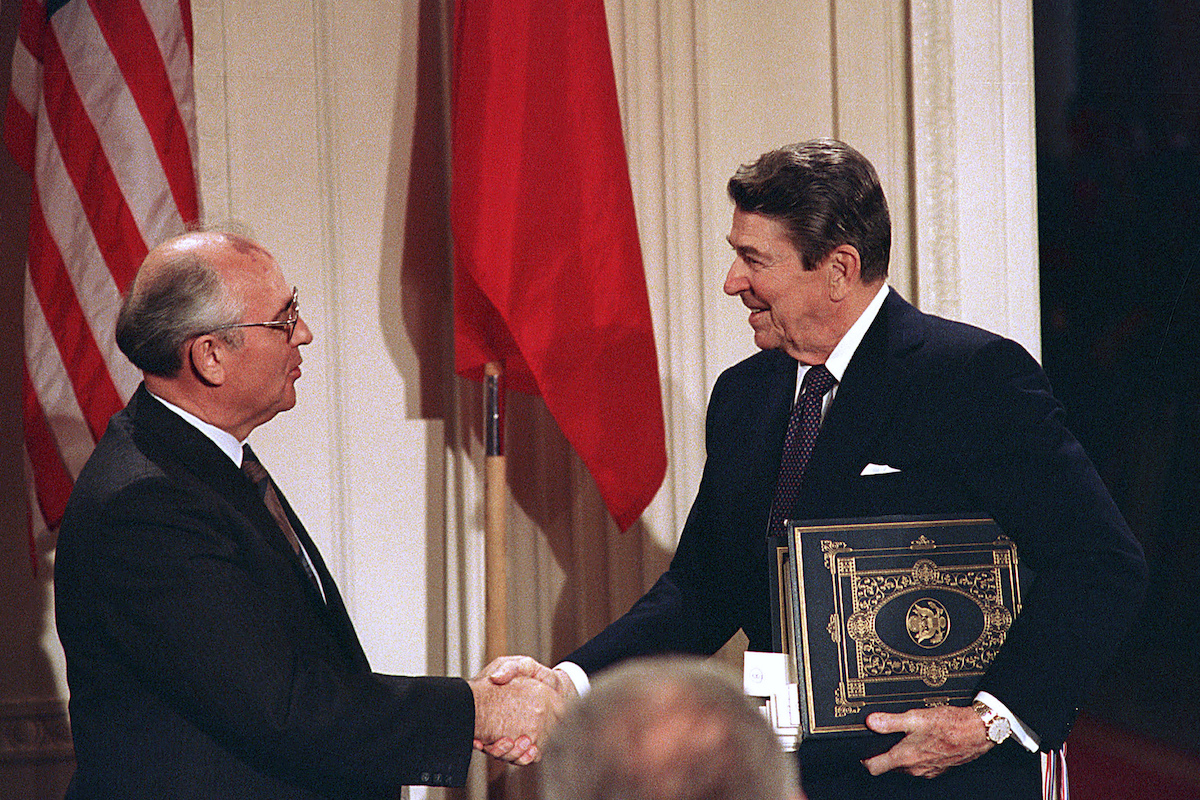
Often to the horror of some of his top foreign policy advisers, he loved delivering the jokes directly to Mikhail Gorbachev at summit meetings. Gorbachev would politely smile or sometimes counter by adding that the joke was just a caricature of the Soviet system. But Reagan had carefully collected many of the jokes from former citizens of the Soviet Union, diplomatic officials, and some of them were passed to him by the CIA. Many of them were real jokes that had circulated inside the Soviet Union.

Many of Reagan’s jokes were a critique of the insufficiency of the Soviet system.

A Russian man goes to the official agency, puts down his money and is told that he can obtain delivery of his automobile in exactly 10 years. “Morning or afternoon,” the purchaser asks. “Ten years from now, what difference does it make?” replies the clerk. “Well,” says the car-buyer, “the plumber’s coming in the morning.”

Another joke Reagan liked to deliver summed up his thoughts well. Two Russians are walking down the street, and one says, “Comrade, have we reached the highest state of communism?” “Oh, no,” the other replies. “I think things are going to get a lot worse.” Read more on Ronald Reagan on Free Enterprise…

Acton PowerBlog RSS

Google Plus

Twitter Feed

Facebook Fan Page

Support the Acton Institute

The Acton Institute is funded through the generous contributions of individuals such as yourself. Learn more about how you can advance the cause of freedom and virtue.