Posts tagged with: The Theory of Moral Sentiments

Sarah Stanley
posted by on Thursday, May 9, 2013

Does the free market encourage moral behavior? Virgil Henry Storr, Research Associate Professor in the Department of Economics at George Mason University, recently wrote a report called “The Impartial spectator and the moral teachings of markets.” He addresses critics’ concerns that the free market brings out and nurtures human vices.

Countless commentators have stated that “engaging in market activity can be corrupting.” Storr highlights two notable quotes. Aristotle “believed that there was something unnatural about the kind of wealth getting that occurred in the market.” Karl Marx “believed that the market could transform man into a ‘spiritual and physical monster.’”

Storr, who is also Director of Graduate Student Programs in the Mercatus Center, addresses these famous claims with quotes from those who have “made the point that markets are moral training grounds where virtues are rewarded and cultivated.” Michael Novak stated that engaging in trade “teaches care, discipline, frugality, clear accounting, providential forethought … fidelity to contracts, honesty in fair dealings, and concern for one’s moral reputation.” Deirdre McCloskey, Distinguished Professor of Economics at the University of Illinois at Chicago, says:

Capitalism has not corrupted the spirit. On the contrary, had capitalism not enriched the world by a cent nonetheless its bourgeois, antifuedal virtues would have made us better people than in the world we have lost. As a system it has been good for us.”

Read more on The Market is a Moral Teacher…

Joseph Sunde
posted by on Thursday, February 14, 2013

heartDespite the inevitable flurry of trite sugary clichés and predictable consumerism, Valentine’s Day is as good an opportunity as any to reflect on the nature of human love and consider how we might further it in its truest, purest form across society.

For those of us interested in the study of economics, or, if you prefer, the study of human action, what drives such action—love or otherwise—is the starting point for everything.

For the Christian economist, such questions get a bit more complicated. Although love is clearly at the center, our understanding of human love must be interconnected with and interdependent on the love of God, which persistently yanks our typical economist sensibilities about “prosperity,” “happiness,” and “quality of life,” not to mention our convenient buckets of “self-interest” and “sacrifice,” into transcendent territory.

The marketplace is flooded with worldly spin-offs, as plenty of cockeyed V-Day ditties and run-of-the-mill romantic comedies are quick to demonstrate. At a time when libertine, me-centered approaches appear to be the routine winners in everything from consumerism to self-help to sex, we should be especially careful that our economic thinking doesn’t also get pulled in by the undertow.

In her book Love and Economics: It Takes a Family to Raise a Village, Jennifer Roback Morse cautions us against these tendencies and points us in the right direction, challenging us to reconsider our basic view of human needs and potential.

Morse begins with a critique of homo economicus (economic man), a portrait of man as Supreme Calculator, capable of number-crunching his way to happiness and fulfillment on the basis of cut-and-dry cost/benefit analysis. Such a view ignores the social and spiritual side of man while submitting to a cold, limiting, earthbound order. As Rev. Robert Sirico notes in the last chapter of his recent book, “Any man who was only economic man would be a lost soul. And any civilization that produced only homines economici to fill its markets, courts, legislative bodies, and other institutions would soon enough be a lost civilization.” Read more on Love Is What Holds Society Together…

Jordan J. Ballor
posted by on Tuesday, December 7, 2010

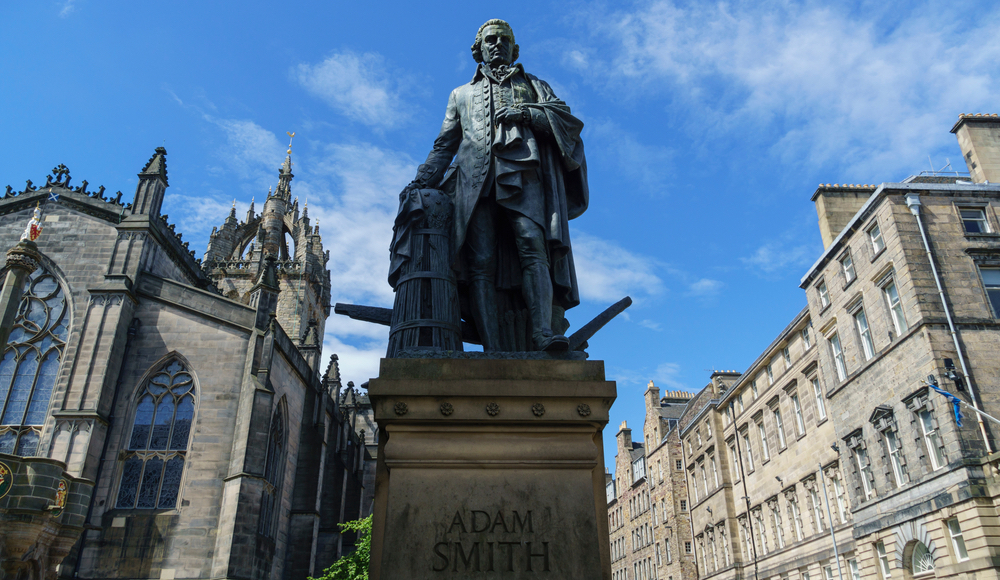
In an edition of the Philosophy Bites podcast last month, “Nicholas Phillipson, his acclaimed biographer, discusses Adam Smith’s view of human beings.” Phillipson argues of Smith that “even his economic thinking is perhaps best understood as part of a broader philosophical project of a science of human beings.”

Read more on Adamic Anthropology…

Acton PowerBlog RSS

Google Plus

Twitter Feed

Facebook Fan Page

Support the Acton Institute

The Acton Institute is funded through the generous contributions of individuals such as yourself. Learn more about how you can advance the cause of freedom and virtue.