Posts tagged with: theology

Armenian Orthodox theologian Vigen Guroian’s The Melody of Faith (2010) seeks to provide an introduction to the basic dogmas of Eastern Christianity, harmonizing various Eastern Christian traditions (and making significant mention of a few Western ones) through continual reference to their writings, to their icons, and especially to their hymnody. The book, however, makes no claim to “constitute a systematic account of the Christian faith in the Germanic style of rational academic theology” (xi). Instead, Guroian muses,

Read more on Listening to Eastern Christianity through the ‘Melody of Faith’…

The Blauwpoort in Leiden in the winter.The newest edition of the Journal of Markets & Morality is now available online to subscribers.

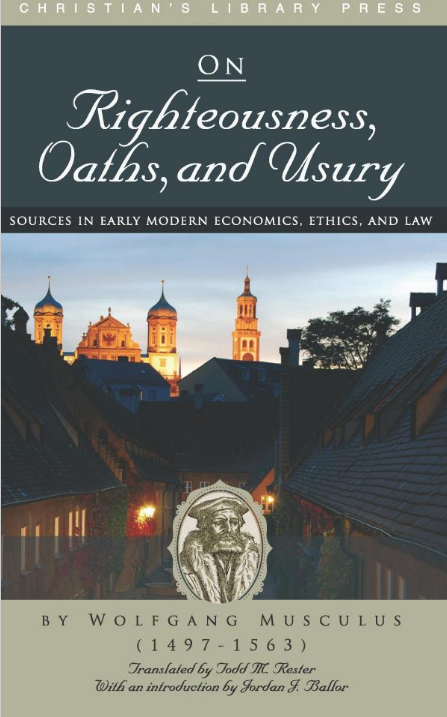
This issue of the journal features a Scholia translation of selections from On the Observation of the Mosaic Polity by Franciscus Junius (1545-1602), the Huguenot, Reformed, scholastic theologian (a Latin version of Junius’ original treatise is available for download at Google Books, along with a host of his other works). Best known as a professor of theology at Leiden University from 1592–1602, Junius authored this treatise in order to address rising challenges in the young Dutch Republic. In his translator’s introduction, Todd Rester summarizes the Republic’s concern, “[I]f Scripture alone is the authority in the Church for faith and morals… how does it apply in the realm of the Christian State?” Junius’ careful and sober analysis of the various kinds of law and each law’s proper sphere of application transcends his time and context, standing as a significant reference for anyone who may seek to address the question, “What relation is there between the Law of Moses and the Law of the State?” Furthermore, the interdisciplinary character and depth of the work serve as an example of the fluidity and overlap of often-perceived contradictory disciplines and methods of the time, such as humanism and scholasticism, theology and law. Thus, for the student of political philosophy and historical theology alike, On the Observation of the Mosaic Polity stands as an excellent resource for the study of the engagement between historic, Christian faith and the rule of law.

Read more on Journal of Markets & Morality 14, no. 1 (Spring 2011)…

Louie Glinzak
posted by on Tuesday, July 5, 2011

Rev. Robert A. Sirico was recently a guest on The Matt Friedeman Show where he discussed the difference between charity and socialism. He talks about not only how we should give, but also how we can best help the poor. Socialism, according to Rev. Sirico, is the forced sharing of wealth and drains  morality out of good actions. A discussion of the Acts of the Apostles also takes place in the following YouTube clip that contains a segment from the show.

Read more on Rev. Sirico on Helping the Poor…

Jordan J. Ballor
posted by on Wednesday, June 29, 2011

Richard Mouw, president of Fuller Theological Seminary and a member of the editorial advisory board for the Journal of Markets & Morality, has written a memoir reflecting on his introduction to and engagement with the thought of Abraham Kuyper. His book is titled, Abraham Kuyper: A Short and Personal Introduction, and in an essay appearing at the Comment site, Mouw writes about the significance of Kuyper for the evangelical world today.

Read more on Mouw on Kuyper and Culture…

Recently, progressive Catholics met in Detroit and issued calls for a married clergy and the ordination of women priests. In a very timely article Samuel Gregg, research director at the Acton Institute, addresses the progressive Catholics who “sit rather loosely with Catholic teaching on questions like life and marriage” and how they are continuing “to press what is often a hyper-politicized understanding of the gospel.” Gregg’s article appearing in Crisis Magazine.

Read more on Samuel Gregg: Hell, Heaven, and Progressive Catholics…

Ray Nothstine
posted by on Friday, March 4, 2011

My first reaction to “What Would Jesus Cut?” is that it tends to reduce Christ to a distributor of material goods through government programs. Jesus is not a budget overseer or a dispenser of government largesse. Sojourners founder Jim Wallis has already countered this accusation with his own post saying, “We haven’t been trying to get Jesus to be the head of any budget committee, or think that he would ever want that job!”

Read more on Jesus as Budget Director?…

Ray Nothstine
posted by on Tuesday, February 15, 2011

Reagan at Danilov Monastery

I point you to Paul Kengor’s insightful 2008 piece on Ronald Reagan’s 1988 summit to Moscow in Christianity Today because it is directly related to this Thursday’s Acton on Tap. I will spend some time discussing the Moscow Summit and Reagan’s revolutionary comments at Spaso House, Danilov Monastery, and Moscow State University. Kengor notes:

Read more on Mission to Moscow…

The following is my latest article for Acton Commentary:

Stewardship and the Human Vocation to Work

By Rev. Gregory Jensen

Paying the bills and contributing to the collection basket are laudable. But Christian stewardship is significantly more than these; like prayer, fasting, and the sacraments, it is an essential part of our Christian life. More than what we say, the way we use our time, talent and treasure, reveals what we value, how we understand ourselves as men and women of faith, and what we believe it means to be human.

Read more on Stewardship and the Human Vocation to Work…

Ray Nothstine
posted by on Thursday, January 13, 2011

Tom Oden

In the forthcoming Winter 2011 issue of Religion & Liberty, we are featuring an interview with Thomas C. Oden. The interview mainly focuses on the importance and wisdom of the Church Fathers and their deep relevancy for today’s Church and culture. The content below however delves into Marxist liberation theology and the direction of Oden’s own denomination, The United Methodist Church. Some of the below portion will be available only for readers of the PowerBlog.

Read more on Preview: R&L Interviews Thomas C. Oden…

Ray Nothstine
posted by on Wednesday, December 15, 2010

Increasingly the Nativity tends to be associated with the political, as the crèche and other overtly religious symbols are banished from the public square by public pressure or the courts. To some that communicates a baby savior with so little power he can’t even defeat the secular legal authorities who seek his removal. If God is out there, “He must be pretty weak,” could be a common refrain today.

Read more on Why the Nativity?…

Acton PowerBlog RSS

Google Plus

Twitter Feed

Facebook Fan Page

Support the Acton Institute

The Acton Institute is funded through the generous contributions of individuals such as yourself. Learn more about how you can advance the cause of freedom and virtue.