Posts tagged with: world war ii

Ray Nothstine
posted by on Thursday, February 7, 2013

ServingGodAndCountry2

I frequently noted in the field, how chaplains – to a man – sought out front line action. And I assume that was because, as one put it, at the time: ‘There is where the fighting man needs God most – and that’s where some of them know him for the first time. – U.S.M.C. Commandant A.A. Vandegrift, 1945

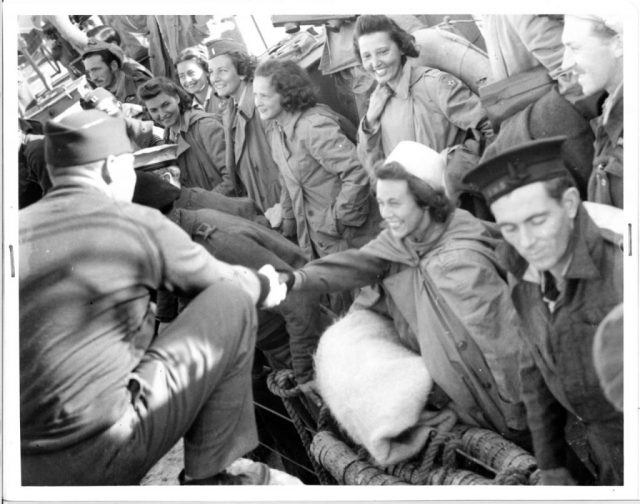
The last two decades has seen a surge in interest in popular historical study of America’s role in the Pacific and Europe during World War II in films and books but little to no individual attention has been given to the role of military chaplains. There were never enough chaplains to serve American soldiers, sailors, Marines, and airmen, but as Dorsett points out those that served found innovative and courageous ways to reach the men. “They can’t say that the church forgot them, when they were called into service and henceforth in their lives they will forget the church,” declared Lutheran Chaplain Edward K. Rogers. “They may forget the church and God, but the church and God’s pastors or priests did not forget them.” Chaplains were integral to America’s victory in Europe and the Pacific. This is the argument put forward in Serving God and Country: US Military Chaplains in World War II by Lyle Dorsett.

Outside of the famous four U.S. Army chaplains who sacrificed their lives to save fellow military and civilian men when the transport Dorchester sank in 1943, there is very little popular historical assessment of the enduring role of chaplains in the war and how they helped shape a post-war society. Chaplains broke new ground when it came to racial desegregation in training classes and contributed to greater ecumenical understanding between churches, denominations, and synagogues. “The clergy integrated well and became pioneers in the integration of the U.S. Armed Forces before President Harry S. Truman’s executive order 9981 of July 1948,” declared Dorsett.

Integration of ideas and practical ecumenicsm also flourished. For example, some Protestant pastors, while well educated, previously may have had limited interpersonal contact with other traditions and faiths like Judaism or Catholicism. As one chaplain pointed out, “It was harder to speak ill of one’s faith when that person was a friend.” Chaplains also had to be trained in the basic rudiments of other faiths in order to offer proper religious counsel for servicemen.

Undeniably, the United States on the eve of Pearl Harbor in 1941 was remarkably less secular than today. Chaplains or “chappies” were, with very few exceptions, Protestant, Roman Catholic, or Jewish. Parents, especially mothers, were comforted by the fact that their sons had professional shepherds to guide them in the field and throughout their military service. World War II was the first American conflict where published images, especially from the Pacific at bloody battles like Tarawa, would relay disturbing images to Americans at home. Chaplains were pressed to the limit on both fronts of the war, but the savage fighting of the Pacific island hopping campaign tested military chaplains to minister in what many combatants called “the depths of hell.” “By their patient, sympathetic labors with the men, day in and day out and through many a night, every chaplain I know contributed immeasurably to the moral courage of our fighting men,” added Admiral Chester W. Nimitz. Read more on Men of God and Country in World War II…

Ray Nothstine
posted by on Tuesday, December 18, 2012

American soldiers on D-Day, June 1944.

American soldiers on D-Day, June 1944.

The history of America is filled with heroic tales of courage and sacrifice. At the outset of World War II, most of the world was under tyranny. Sixteen million Americans served the country during World War II. Four hundred thousand of those Americans died in the war. They made history at places like Wake Island, Guadalcanal, Okinawa, Salerno, Normandy, and the Ardennes. Most of the men who freed the world from Nazi and Imperialist Japanese aggression have now passed from this earth. But while almost 1,000 veterans of the conflict die a day, there are still about a million living in this country.

Read more on Film Review: Honor Flight…

Ray Nothstine
posted by on Friday, May 25, 2012

One of the powerful things about Memorial Day is that we live in a community and an America that is worthy of sacrifice. Many feel, for good reason, the foundational ideals of our Republic are in peril. The proclamation of the first Memorial Day by General John A. Logan in 1868 stated the importance of guarding the graves of those slain in battle with “sacred vigilance.” It is a calling bestowed upon all of us to toil for improvement of the common good and a better nation. We should constantly ask ourselves how do we sustain freedom and what can we do to spread liberty across our land? The Liberty Bell in Philadelphia bears an inscription that comes from Leviticus 25:10: “Proclaim liberty throughout all the land unto all the inhabitants thereof.”

Read more on Reflections for Memorial Day…

For our air superiority, which by the end of 1944 was to become air supremacy, full tribute must be paid to the United States Eighth Air Force. – Winston S. Churchill

Read more on Veterans Day: The Mighty Eighth over Europe…

Jordan J. Ballor
posted by on Tuesday, April 20, 2010

A Polish friend recommended this NYT piece by Roger Cohen reflecting on the most recent tragedy visited upon the Polish people. Cohen’s friend, Adam Michnik in Warsaw, “an intellectual imprisoned six times by the former puppet-Soviet Communist rulers,” had said to him in the past that:

Read more on Extending Europe Eastward…

Jordan J. Ballor
posted by on Wednesday, December 31, 2008

The year is 1943 and Valkyrie, the second release under the revamped United Artists brand, opens with German officer Claus von Stauffenberg (Tom Cruise) on assignment in Africa. He had been sent there because his opposition to Hitler and the Nazi regime had become dangerously explicit and bellicose. His promotion to lieutenant-colonel of the general staff and transfer from the European lines to Africa is intended to give him some protection from pro-Nazi officers who might make trouble for him.

An attack on a transport column in Africa leaves Stauffenberg badly wounded. He loses his left eye, the fourth and fifth fingers of his left hand, and his right hand above the wrist. Given director Bryan Singer’s resume (which includes X-Men) and the opening sequence, initial concerns that the film might be turned into an action movie are quickly dispelled. Given that the end of the movie is never in doubt, the movie never quite becomes a suspense thriller either. Yet Valkyrie still manages to deliver a thought-provoking and moving story of loyalty, betrayal, sacrifice, and doubt. Read more on Movie Review: Valkyrie

Ray Nothstine
posted by on Tuesday, November 11, 2008
The National WWII Memorial

When FDR ordered General Douglas MacArthur out of the Philippines in 1942, the dismal fate of the American and Filipino defenders at Bataan and Corregidor was sealed. Japanese forces had blockaded the island, achieved air superiority, and set their forces up to easily overpower the American defenses. The story of Bataan and Corregidor was a heroic tragedy. Heroic in that American and Filipino forces fought back bravely for months, and tragic in that any relief, retreat, or victory was impossible. The Japanese were on the offensive all over the Pacific, achieving a string of humiliating defeats to the American military.

Read more on Veterans Day: Remember Bataan & Corregidor…

John Gillespie Magee, Jr. is remembered fondly by American aviators who defended and sacrificed for this nation in World War II to the present day. He is remembered for his touching poem High Flight, which he penned in 1941.

Read more on Memorial Day: John Gillespie Magee Jr. & ‘High Flight’…

Ray Nothstine
posted by on Tuesday, November 6, 2007
U.S.M.C. War Memorial

Last summer I visited the National Museum of the Marine Corps in Quantico, Virginia. It is an impressive and moving tribute to the U.S. Marines, focusing especially on WWII to the present War on Terror. There was an even a section which chronicled the transformation of young recruits to Marines who embody the virtues of “honor, courage, and commitment.” David Zucchino of the Los Angeles Times has written a piece titled, “From Boys to Marines.” The article is one in a series of articles about three teenagers and their wartime enlistment in the Marines.

Read more on The Few, The Proud, The Marines…

Dr. Samuel Gregg

Dr. Samuel Gregg – “Acton’s Chief Thinker,” according to our Executive Director Kris Mauren – put his thinking skills on display yesterday as part of the 2007 Acton Lecture Series, delivering an address entitled “The Crisis of Europe: Benedict XVI’s Analysis and Solution.”

Read more on 2007 Acton Lecture Series: The Crisis of Europe: Benedict XVI’s Analysis and Solution…

Acton PowerBlog RSS

Google Plus

Twitter Feed

Facebook Fan Page

Support the Acton Institute

The Acton Institute is funded through the generous contributions of individuals such as yourself. Learn more about how you can advance the cause of freedom and virtue.