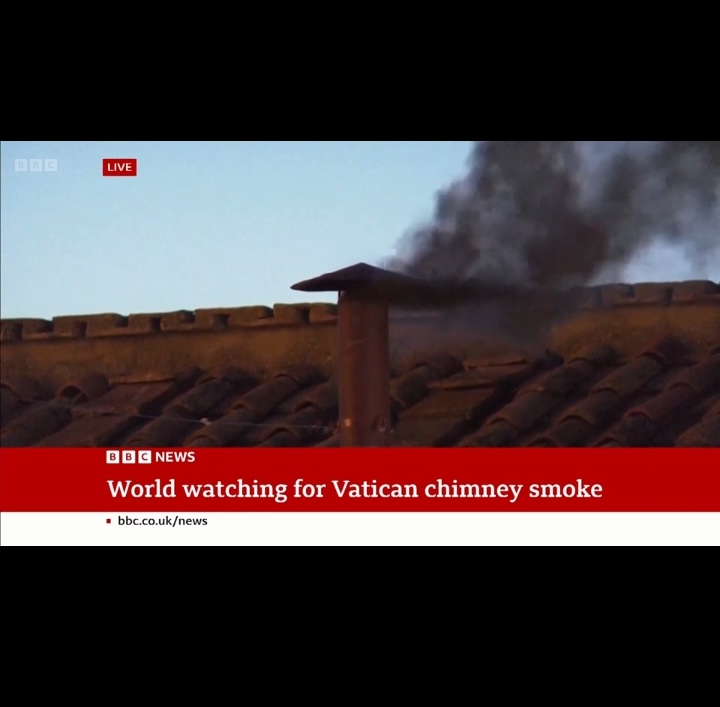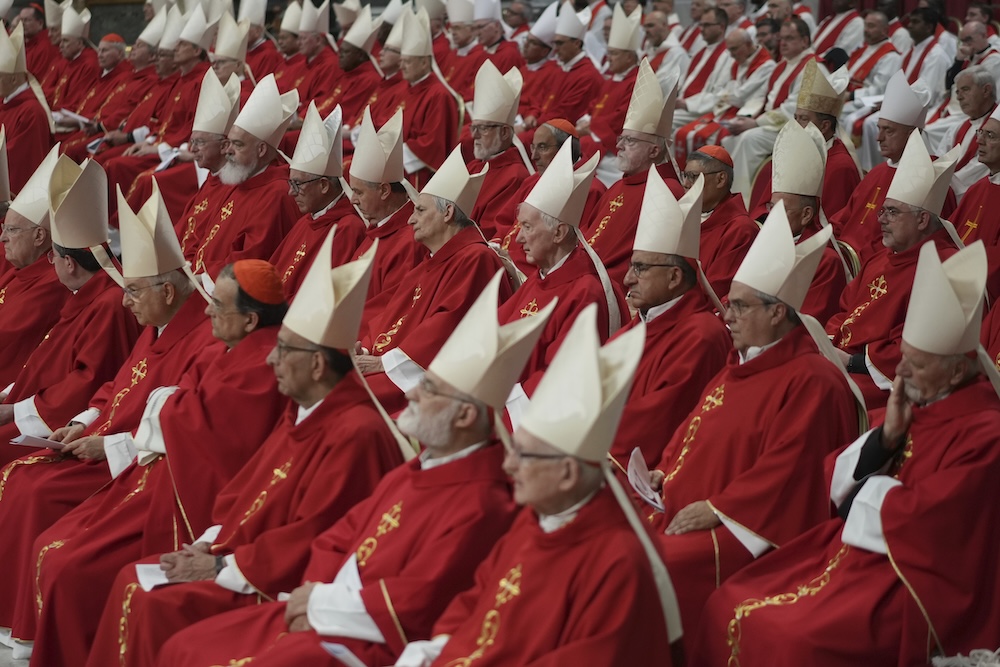
The excitement in Rome is palpable about who’s papabile as the historic conclave that will elect the 267th successor to Peter gets underway. A first fumata nera (black smoke) has blown barely visible at twilight above the Sistine Chapel, ensuring long nights of ongoing debate at the many restaurants immediately adjacent to the Vatican.
The last two weeks of an orphaned Roman Catholic Church have been met with mixed feelings: of shock vs. I-told-you-so’s; mourning vs. defaming; secret conspiring vs. public networking; timid speculations vs. bold predictions. Of course, there were the-show-must-go-on vs. quickly canceled-2025 Jubilee and other big tent events as a few hundred thousand youth descended disappointedly onto Rome—not for the Carlo Acutis canonization but for an all-night papal wake and camp-out with another 150,000–200,000 (no one really counted) who flocked en masse to St. Peter’s and the surrounding Vatican area for the funeral rite.
Papal pundits have been on overdrive, and international news networks are cashing in on 24-hour news cycles during the sede vacante period, with their ad hoc panoramic studios overlooking the Square that Bernini Built. This is much more than just an Olympic moment for the media. For some, it’s a once-in-a-lifetime opportunity to steer the gaze of the world’s eight billion toward Rome, Caput Mundi.
If the pope were not the greatest soft power, leader of the Church Universal, and successor of the Apostle Peter whom Christ loved as his very first vicar, all would be different. But these three factors are facts, and they renew Rome as the center of global intrigue every few decades during an interregnum and pending conclave.
Hegelian Tensions
At play are several tensions, a quasi-Hegelian dialectic of thesis and antithesis. Will there be a resulting synthesis? Was the Pope of the Peripheries and Mercy a real change in paradigm and inspired by the Paraclete inside the Sistine Chapel? Will the cardinals of 2025 again be looking to a diocese in some distant galaxy, far, far away from the Curia and Central Europe? Or has the tolerance and/or fascination for the unknown and unchartered territory proved a one-time exception? Should we, therefore, expect a classic man of the Roman Curia and of Italian popularity? Or will it be a synthesis of the two?
The former might mean a Cardinal Pietro Parolin, Cardinal Marcello Semeraro, or Cardinal Fernando Filoni. All three are classic Italian curial heavy hitters: a Secretary of State, an ex–Secretary of Pope Francis’s Cabinet of Cardinals/Prefect of the Congregation for the Causes of Saints, and a former Prefect of Propaganda Fide, respectively.
A synthesis candidate could mean a previous Vatican outsider but current insider with an impressive résumé: Cardinal Tarcisio Isao Kikuchi from Tokyo , recently appointed president of Caritas Internationalis, or Cardinal Luis Antonio Tagle, the Filipino doppelganger of Francis, successor of Filoni at Propaganda Fide and predecessor of Kikuchi at Caritas.
But the real synthesis just might be Cardinal Peter Turkson: a longtime insider; a man who spans three papacies that favored him as a key archbishop in Cape Coast, Ghana; 16 uninterrupted years (2009–25) in the Roman Curia as former president of the Pontifical Council of Justice and Peace; as former prefect of the curial merger known as the Pontifical Dicastery for Integral Human Development; and now in a blessed position as chancellor of the two Pontifical Academies of Sciences and of Social Sciences. The affable, intelligent, and loved-by-all Turkson, excellent preacher and sometimes soft-spoken/will-not-rock-the-barque prelate, seems to make the most dialectical sense. Plus, everyone is saying it is Africa’s moment. It could be the whispering of Holy Spirit.
Peter the Roman
I am not alone: Many knees are knocking as regards the St. Malachy Prophecy, one of the greatest X factors in the conclave. In brief, St. Malachy, a 12th-century archbishop and papal legate from Ireland, supposedly predicted 112 popes with short enigmatic phrases associated with their papacies or person. Peter the Roman, if elected, will not come from the End of the World. He will be the End of the World. If you don’t believe me, read the New York Post:
Saint Malachy is credited with creating the Prophecy of the Popes, writing 112 short, mysterious phrases about the papal progression after he received a vision. … According to the final entry surrounding “Peter the Roman,” the “last pope” … “In the final persecution … there will reign Peter the Roman, who will feed his flock amid many tribulations, after which the seven-hilled city will be destroyed and the dreadful Judge will judge the people. The End,” the last passage reads.
Let’s find out which Peters there are. The clear, first-name candidates are Pietro Parolin (Italy), Péter Erdő (Hungary), Peter Turkson (Ghana), Peter Ebere Okpaleke (Nigeria), and Pierre Nguyễn Văn Nhơn (Vietnam).
Secondary eligibility would be given to at least a middle name or hyphenated part of the first name: Jean-Pierre Ricard (France), Jean-Pierre Kutwa (Ivory Coast), Pierbattista Pizzaballa (Jerusalem), Timothy Peter Joseph Radcliffe (England), or Odilo Pedro Scherer (Brazil). Of these, Pierbattista Pizzaballa is the clear front-runner. The crowds cheered and sung off their beloved Latin Patriarch in Jerusalem as he departed the Holy Land, sensing he may not return. He speaks all the languages and has all the diplomatic and charismatic skills. Conservatives mostly adore him, too, while liberals respect his character and handling of his office in a most tense part of the world so dear to Francis and the subject of his last Message for World Peace during his Easter Urbi et Orbi.
Third eligibility goes to last names associated with Peter: Christophe Pierre (France).
The major problem—a technical one—is that that 112th and last pope is counted as Francis. That means the conclave will elect … no one?
Francis certainly ruled over many worldwide tribulations—the COVID-19 pandemic, for starters, that killed or nearly killed millions. Then there have been wars in the Holy Land and Ukraine-Russia, as well as nuclear threats from North Korea and China’s potential axis with Russia to rule all of Eurasia and smash the American superpower.
However (a big however): The last time I counted, all seven hills are still standing and have not been set ablaze or destroyed, like the hills of Los Angeles. And Francis did manage to feed his flock, counting many gracious meals at no cost to countless homeless residents of Tentopoli in and around St. Peter’s Colonnades. Their tribulations, in a disastrous Italian economy, are none too few. This is shoehorning the prophecy, with some nervous levity, if only one shoe seems to fit, then let’s go for it. No one wants the real Peter the Roman to stand up on the Loggia wither today, May 8, or even May 9, 2025, considering the conclave should be over in one to three days.
Any if there really has to be a Peter, then in my judgment the title goes to Peter Turkson, but owing more to a Hegelian middle position, a papal synthesis whom both conservatives and liberals can admire or tolerate, in addition to computing acceptable data-trends for shifting tendencies to Africa, where the Catholic Church is vibrant and lionhearted.
A Francis II?
Indeed, the Francis consistories have resulting in stacking the deck of Cards (forgive the pun) in favor of a Francis-like Pope 267. Don’t forget that, in this 2025 conclave, the Spirit of Francis will be flapping wings alongside the Holy Spirit, having elevated during his pontificate 108 of 133 electors. This amounts to 81% of red hats voting as of today, when the Sistine Lock-In commenced.
This was obviously Francis’s earthly strategy, which could well result in a continuation of his pontifical style and agenda. Francis II would surely be Louis Antonio Tagle, the Filipino Francis. There are also his right- and left-hand men in Cardinal Pietro Parolin, dutiful and trustworthy secretary of state, and Cardinal Marcello Semeraro, his former secretary of the Cabinet of Cardinals. And both seem to be ideologically aligned with Francis, including on such hot topics as China, corruption, and various homosexual issues inside the Church.
There are many others who could be a Francis II, but these two seem to be the front-runners. Yet I do not believe there will be the same chance of Francis continuity as was achieved between John Paul II and the brains behind his pontificate, Benedict XVI , in the 2005 conclave, with all but two electors being rubberstamped at JPII Consistories (113/115—virtually 98%—of electors were elevated by the Polish pope).
Grandpapa: The Grand Father 80+ Pope
When we hear “anuncio vobis gaudium magnum; habemus papam,” it is not the 200,000-plus gathered masses who will have trouble hearing. Rather, it might be the newly elected pope himself! No kidding. Rules allow for any living cardinal to be elected, even if not eligible to vote in the actual conclave. The cutoff for voting is the 80th birthday.
An elderly pope, a grandpapa (to fuse the Italian and English for grandfather pope), is indeed possible and perhaps wanted. Even Bishop Robert Barron, perhaps the brightest lamp in the American episcopate, said he wouldn’t mind a quiet papacy. I think this means a much older pope with a less young-minded disrupter mentality on the throne. Even if 80 is the new 70!
I have heard many other pundits express the same concern. At least a short, unimpressive, and ultimately destressing, tranquillo, reign will enable the cardinals to regroup, gather some calm, and have a real rethink about what a pope can and cannot do, perhaps setting an age limit for the papacy, and the creation of a formal pope emeritus position, which Benedict XVI self-created and managed well in his silence and prayer.
The leading candidates for the grandpapa are definitely in this order: Cardinal Ladaria Ferrer (ex–Prefect of the Congregation of Doctrine of the Faith, and this despite being another Jesuit); Cardinal Sean Patrick O’Malley (archbishop emeritus of Boston and former leader in the Vatican’s committee to eliminate priestly sexual abuse); Cardinal Mauro Piacenza (ex–Major Penitentiary of the Apostolic Penitentiary); and Cardinal Oswald Gracias (archbishop of Bombay, whom I particularly admire for his brilliance, charm, and able administration but perhaps less well-known).
This is a very unlikely scenario and might even amount to a refusal by the elected grandpapa, or an acceptance—and then immediate retirement in protest.
An American Pope?
Again, Bishop Barron in his EWTN interview makes some sense in declaring that the world is not ready for an American pope until the United States is no longer a superpower. (Side note: In any event, he definitely wouldn’t be a quiet one, as Americans are, in general, loud, experimental, and opinionated.) Barron rightly assumes that too much influence would be found under the American papal cassock.
Nonetheless, anything is possible, and Barron’s first prerequisite is a prelate who unabashedly loves the Church and the gospel. This is none other than Cardinal Timothy Dolan, whose many virtues include being loved by left and right, Republicans and Democrats, but without being a people-pleaser. He not only has a gift of the gab but is a courageous and audacious administrator, as former rector of the Pontifical North American College and current archbishop of New York, both of which are no easy tasks.
Other candidates are more ideological and left-aligned and will not have a good consensus: Cardinals McElroy, Tobin, Gregory, and Cupich. The same goes for Cardinal Burke, who finds himself on the other end of the spectrum in his deeply admired, courageous conservatism and authentic love of tradition. None of these five cardinals, right or left, could gather enough supporting ballots.
The other long shot (perhaps not-so-long-shot) is Cardinal Robert Francis Prevost, the American Augustinian (read: super disciplined and serious). He is more than capable of cleaning up some messes Francis had encouraged inside and outside the Curia. More than anything else, he knows what makes for the right stuff of a good bishop, even the Bishop of Rome, as he is currently the Prefect of the Dicastery for Bishops. Let’s not forget that his impressive résumé includes his continuing to serve as the president of the Pontifical Commission for Latin America; his trilingual capacity in English, Spanish, and Italian; he was bishop of Chiclayo (Peru) for eight years (2015–23), and was even prior general of the Augustinians (2001–13); and is as affable as Cardinal Dolan, charming the socks off his sheep and clergy under his leadership.
Postscript: There is also the beloved Cardinal James Harvey, retired senior Vatican official as former Prefect of the Papal Household, who had a special set of eyes and ears close to the Holy Father and was a genuinely helpful and generous liaison between Americans and things Vatican. He is now the archpriest of the Papal Basilica of St. Paul’s Outside the Walls, a splendid retirement post and a beautiful way to sunset a storied career in Rome. It is very unlikely he will be elected, even if wildly popular with American conservative Catholics who gathered in Rome last week to celebrate his Golden Jubilee of Priesthood, being of the ordination class of 1975.
Last Word: One of the Three Peters
Let us merely pray that the next pope is filled with our Lord Jesus’s infinite love for his Church on earth. But he must have more than great piety—hint, hint: a Pius XIII, but definitely not of the same impious ilk of that antipope of the same title, Lucian Pulvermacher. He will need also to be upskilled in many practical, earthly ways; he must be technically savvy; and he must possess a political sway and swagger to confront the World War-ish, Armageddon-felt tensions that threaten world peace.
This is why some point to two Peters: Parolin and Turkson. The first is an erudite, albeit controversial diplomat; the second is one of the most knowledgeable political and economic firebrands in the Curia, but with a peace-loving heart and a sharp social-justice-warrior mindset.
An antithesis, rather than a synthesis, might be a third Peter and a true conservative favorite: Cardinal Péter Erdő, archbishop of Esztergom-Budapest—a man of law, order, and doctrinal orthodoxy. Miracles do happen!
If I were to place a bet, one of these three Peters will be standing atop the loggia when the “Habemus papam!” is proclaimed to the world.