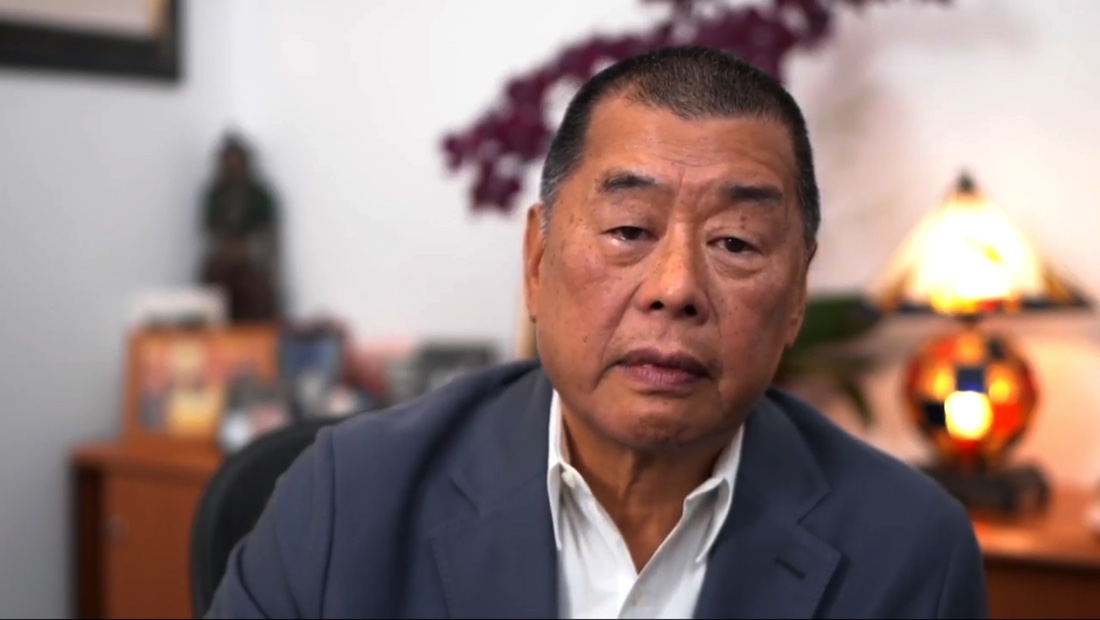
“I think knowledge does not determine experience; I think experience determines knowledge. Because I had the experience of Hong Kong being a free market, that’s why I could understand Hayek to such an extent.”
This is what my father, Jimmy Lai, said on the 6th of January 2025 when he was asked, on the stand, whether it was his admiration for Hayek that led to his belief in the free market. In his characteristic humor, he noted the misspelling of “Hayek” in the evidence used to prosecute him. “H-A-Y-E-K” he articulated before being assured that the error had been corrected. His experience of Hong Kong, the place my father found, then lost, freedom, he said, is what led to him understanding Hayek and spending 15 years studying his works.
While I inherited my love of books from my parents, most of my father’s beliefs are anecdotally founded. In his evidence, he mentioned that most of his writings were based on his personal experiences. That was why he rightly predicted that for people with strong convictions like him, “no matter how cautious I am, there is no way for me to eliminate the opaqueness of the red line” that still, to this day, keeps shifting. His thirst for knowledge, despite his lack of formal education, then equipped him with a deeper understanding of certain truths, as well as a library of books he studied and reflected on.
The commitment he has shown to the free market and the rule of law came from his meteoric rise in Hong Kong during the years of John Cowperthwaite’s “positive non-interventionism.” Hong Kong’s lack of natural resources meant the economy was reliant on attracting entrepreneurs and ingenuous risk-takers. People like my father.
Low taxes, free trade, and a strong protection for private property rights defined that era. As my father said during his trial, “Hong Kong was a free market. I benefited a lot from it all my life.” It was there he found professional success, first in retail, then in media. Starting by working on factory floors as a boy, his wealth of experience, curiosity for knowledge, and understanding of theories equipped him with a knack for identifying and solving problems. An early example is when he optimized the supply chain in retail, leading Giordano, the brand he founded, to its success.
On the stand, he described his attitude toward the constant changes he faced in life as “alert but not frightened.” This attitude equally applied to the Beijing-imposed National Security Law—which criminalized “carrying a torch before reality” and believing that “truth prevails in God’s kingdom.” These were sentences that he uttered during testimony that perhaps best summarize that for which he was given a 20-year sentence.
The many seasons of my father’s life gifted him with conviction and discernment. Born in a place where information was tightly controlled, he then arrived in Hong Kong, where it was plentiful. Later, he went to America and became cognizant of knowledge, ideas, and freedom. He immersed in his surroundings with awe, and thrived—professionally and personally. It is that which Apple Daily owes its birth to. His belief that the greatest service he could perform was to equip individuals with information to exercise their agency. That is why he described his work as “to participate in delivering freedom.”
Having experienced the wheels of fortune from a young age, my father recognizes the dignity of all as made in God’s image. This is seen in his efforts to evangelize since his imprisonment. Early on, he heard a man scream in his cell throughout the night. Instead of approaching him with fear or judgment, he wrote down Our Lord’s prayer in Chinese for him and urged guards to ask him to pray. He said that in the man’s voice he heard agony that he knew from experience could only be conquered by approaching God’s mercy, as he himself did almost 30 years ago.
My father’s imprisonment has taught him, and me, the true meaning of “godly grief,” according to St Paul. In his letters from prison, my father reflects a desire to repent and get closer to God. In times of weakness, he is reminded of what Archangel Gabriel told the Blessed Mother: “Do not be afraid.” In one prayer he sent to me, he wrote, “Oh Lord my God, let me not walk my own way without thinking of you … I seek your leave for everything I do and give myself wholly to you.” He trusts the provisions of Divine Providence and abundance of God’s mercy rendering his cross easier to carry.
I grew up admiring those who have shown exemplary faith in turbulent times, whether it was St. Gregory the Great or St. John Paul II. Being born shortly before the establishment of the People’s Republic of China, my father certainly has faced his storms. In his exercise of faith from his prison cell, I have come to know that exemplary faith perhaps comes from the knowledge of God’s unconquerable grace in the chaos of spiritual warfare. For all his fallibilities, my father has found a resting place at the foot of the Cross on Cavalry, which he describes as “a divine gift, like I have been touched by God.” In this he has made it clear for us to see the wellspring of our Savior’s mercy.