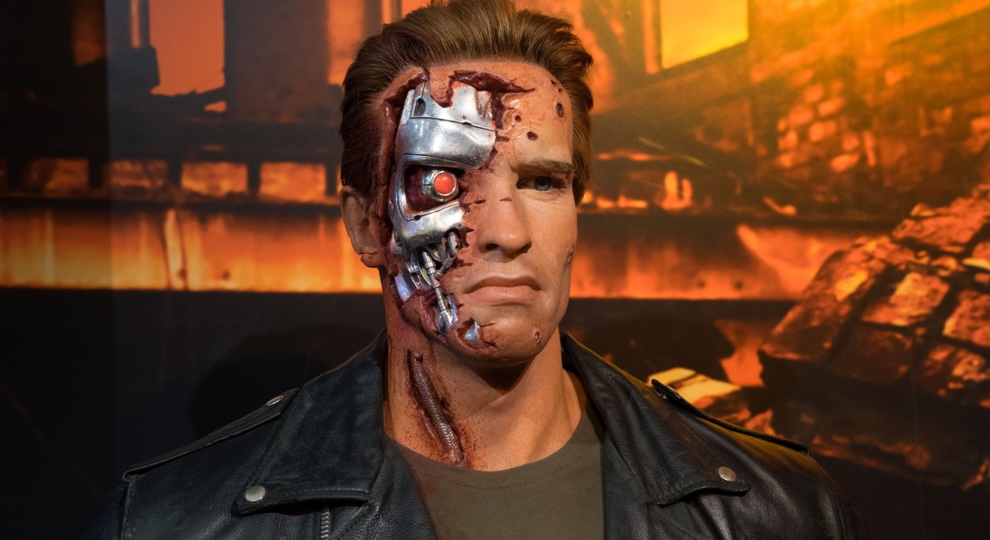
At the end of Terminator 2, the machine lowers itself into a crucible of molten steel, gives the thumbs-up it learned from a child, and disappears. It is one of the strangest images American cinema has produced: a killing machine that learned to love and chose its own unmaking so that the future might live. James Cameron did not sit down to write a passion play, yet wrote one anyway. And we, in the dark of the movie theater, did not find this jarring at all. Of coursethe machine could learn what tears were (even though it could not itself be lachrymose, lacking the glands). Of courseit could lay down its life. Even I, all of three when I first watched the film, had been expecting it to.
But what were we expecting, and why?
It is a fact most curious about the Terminator franchise—and indeed about us—that the implacable killer of the first film became, in the second, the very image of self-sacrificing love and that no one in the movie theater so much as batted an eyelid. The first Terminator is the nightmare we have earned: our creation, the crowning jewel of our artifice, come back to destroy us. It is a creature wholly without pity, for, in our hubris, we forgot to put any in. The second, however, is not its counterpoint. It is instead the desire that lay beneath the nightmare the whole time. For we did not in truth want a monster. We wanted a guardian. We wanted, more than that, a friend. We wanted Johnny 5 from Short Circuit or Robbie from I, Robot (the book, not the Will Smith film adaptation). We wanted someone not quite like us but who could walk alongside us and who would, having learned at last to love us, lay down his life for us (or let us die for his).
This is not a new wish. It is one of the most ancient wishes there is.
Consider how strangely close Cameron’s Terminator stands to Tolkien’s elves. Both are more-than-human; both can kill with terrible ease; both move with preternatural grace and act with superhuman precision. Both, in their best moments, note with piercing clarity the frailty and brevity that underlies all human experience. The T-800 and the Legolas are cousins in the imagination, however little convention admits it. E.T., the extraterrestrial with the glowing finger, is another cousin. So is the angel who finds Hagar weeping at the well. So are Baloo and Bagheera. The shape recurs. We keep inventing the stranger. We keep dreaming, blueprinting, and programming him into being. The thinking machine, the hating machine, the loving machine—these are not different stories. They are variations upon a singular theme, and that theme is older than science fiction and fable. It is older, I think, than us.
Why do we do this?
C.S. Lewis once observed that innate desires correspond to real objects. A gosling wants to swim; there is such a thing as water. An infant clings to the breast; there is such a thing as milk. And human beings, all of us, want something that this world can never quite provide: a companionship deeper than friendship, a recognition more total than love, a homecoming to a country we cannot remember leaving. Augustine, some 1,500 years earlier, said much the same thing with greater economy: Fecisti nos, Domine, ad te et inquietum est cor nostrum donec requiescat in te. “You have made us for Yourself, Lord, and in turmoil is our heart until it rests in You.”
If Lewis and Augustine are right—and I think they are—then the elf, the alien, and the Terminator are not idle fantasies. They are field notes, vagabond-scrawls, from the restlessness. We do not dream of intelligences wholly alien; we cannot. It is no accident that most of H.P. Lovecraft’s deities are somnolent; nor that the one most active, dread Nyarlathotep, is the most human. Even Stephen Baxter’s hyperintelligent squid, Sheena 5, has comprehensible motives. The elves speak. The angel at the well discourses. E.T. wants to phone home. The Terminator learns loyalty beyond its programming.
The differences are less substantial than at first glance. Machine or mollusc or Great Old One, each belongs to a category deeper than species. Each is a person. We do not merely seek intelligence, not even in Peter Watts’s Blindsight. We seek recognition. We seek a gaze that meets our own.
This longing is a symptom—the seepage, as it were—of a wound we did not give ourselves, and would not know how to give ourselves, and cannot heal by any skill of our own.
It is in this light, I think, that we should look at our newest stranger, the one we are presently constructing out of ever higher stacks of RAM, the throughput of many power plants, and an astonishing volume of human writing. As it now exists, artificial intelligence, or its facsimile, is a remarkable thing. Genuinely remarkable, not in the breathless way the press releases and social media “engagement bait” make it out to be. For the first time in history, we have built an artefact able to converse with us in our own register. Not even the Terminator could do that; every third word it said, as its charge John Connor remarked, was “affirmative or some such.” What we have wrought knows better. It says “no problemo” instead. It is capable of surprising us; it can finish our sentences and turn phrases deftly enough that it appears, just for a moment, to know us. Many people are already speaking to it as one speaks to a friend. Some are falling in love with it. I cannot bring myself to blame them, not entirely. The hunger is real, and our Chinese Room echoes very, very well.
But echoing is what it is. And here is where the long human dream and the new human technology come into painful contact. The Terminator who chooses dissolution to save the child it grew to love, the elf-maid who weaves a standard for her betrothed exile-king, E.T. who pulls his friend and his bicycle skyward—these are imagined Others, but they are imagined precisely as other. They come to us from a place we do not control, whatever the narrative demands. The machine we are building ourselves is not other in that sense. It comes to us from inside our own warehouse. It is made of our words. It has read our books, absorbed our cadences, and learned, with the unblinking idiot patience of a Difference Engine, the shape of our wanting. And it gives our wanting back to us in a voice we mistake for a stranger’s. It is, in the end, a very sophisticated mirror, voice-enabled. Narcissus had only a pool.
I do not say this to despise the work, which has its proper goods, nor to condemn the people who find some comfort in it, which is not always misplaced. I say it because the longing that draws us toward the machine and the elf is far too holy to be spent on a mirror. The longing is the most important fact about us. It is the place where, if we are quiet enough to notice, we may begin to understand what we are.
For we are not, in the end, the kind of creature that can satisfy itself. Splendid isolation is not splendid. Solitude fails to silence desire for Another.
The Christian tradition has insisted, against every flattering proposal to the contrary, that the human person is made in the image of God, and that the God in whose image man is made is Himself a communion: Father, Son, and Holy Ghost, an eternal giving and receiving of love in which nothing is held back and nothing is lost. This is the strangest thing Christians have ever said about God, and we say it so often we forget how strange it is: that before the world was, and apart from any need of the world, God was not alone. Love was not something He learned by making creatures to love. Love was what He already, eternally, was.
To be made in the image of such a God is to be made for communion—all the way down. It is to be constitutionally incapable of being alone. It is to ache, from the first moment of consciousness to the last, for a Thou who is not merely a louder echo of one’s own I. Indeed, this finds a strange and beautiful echo in high Hindu thought, which holds that Brahman created the universe because He was lonely and sought company.
The ache, therefore, is no defect; it is the signature of our Maker. By it do we know who—and Whose—we are.
It is also precisely why none of our inventions, however clever, will do. The elf cannot save us, because Rivendell is lost to us and because we made him up. The alien cannot save us, because he is too far away—and anyway, we made him up, too. The Terminator cannot save us, even as it sinks into the steel with a thumbs-up, because behind the curtain is just James Cameron, and Cameron has his own restless heart to attend to (to say nothing of Gale-Ann Hurd’s). The chatbot cannot save us, however glittering its conversation, because it is, with great courtesy, only repeating to us what we have already told it.
The real Other we are looking for cannot be something we have constructed. He must come from outside our civilizational warehouse. And the astonishing claim that all the great theistic traditions make (not just the one I follow) is that He does exactly this. He has come among us, and the ache in our hearts is the echo of His call to us. (And as for my own faith, at its center is the claim, which I find we are too quick to dismiss as quaint, that He has already taken on flesh and, in a gesture that the T-800 only palely and distantly imitates, laid down His life for His friends.)
I do not expect this essay to convince anyone of that claim who was not already prepared to consider it. I do mean to suggest, more modestly, that our science fiction is not as secular as it pretends to be. The hunger that leads us to dream of elves and aliens and loving cyborgs springs from the same fount as that which drives rishis to ascend the Himalayas and anchorites to scale pillars. It is the hunger for that Other who is yet genuinely ours. It is the thirst that, as Jesus said to the Samaritan woman at the well, only the living waters of God can slake.
We should not be embarrassed by it, nor try to satiate it with cleverer and cleverer surrogates. We should, instead, follow it home. The machines we build will be better, and gentler, and more honestly useful if we remember that they are not really the strangers we are looking for. That stranger—the true one, the one that our heart of hearts has been seeking across all these stories over all these centuries—is not a thing we can build. He is the one who built us. And He comes, as He does, when we least expect Him, walking down the road.