
Defenses of religious freedom are often moral. They begin from the premise that conscience is not the property of the state and that no government can justly compel belief, worship, or religious conformity. John Locke’s A Letter Concerning Toleration is one of the most famous defenses of religious freedom and a classic example of a moral argument for such freedom. Locke argues that “the care of souls is not committed to the civil magistrate,” because government has authority over civil peace and property, not salvation. Genuine faith cannot be forced: “Faith is not faith without believing” and “true and saving religion consists in the inward persuasion of the mind.” On this view, religious freedom is defended first as a matter of human dignity, conscience, and the proper limits of political power. Civil authority may preserve public order, but it may not command the soul. As Locke puts it, “Men cannot be forced to be saved whether they will or no,” and therefore “they must be left to their own consciences.”
There are, of course, consequentialist defenses for religious freedom as well. These usually focus on peaceability: Societies that protect religious freedom are less likely to be torn apart by sectarian conflict, while societies that empower the state to police religion invite resentment, instability, and violence. Roger Williams made this argument in The Bloudy Tenent of Persecution for Cause of Conscience, warning that “God requireth not a uniformity of religion to be enacted and enforced in any civil state,” because such enforced uniformity is “the greatest occasion of civil war.” James Madison made the same point in more political terms in his Memorial and Remonstrance Against Religious Assessments. “Torrents of blood,” he wrote, had been spilled by governments trying to extinguish religious disagreement by force; the true remedy was not repression but liberty, since “every relaxation of narrow and rigorous policy” had been found to “assuage the disease.”
But what about an economic defense of religious freedom? Can an argument be made that religious freedom leads to greater economic freedom and, as such, increased economic growth?
There have been a number of studies conducted on the relationship between religious freedom and economic growth. A 2014 study determined that “religious freedom contributes to better economic and business outcomes and that advances in religious freedom are in the self-interest of businesses, government, and societies by contributing to successful and sustainable enterprises that benefit societies and individuals.” The study also found that religious freedom was one of only three out of 25 measured variables to have a significant positive impact on global GDP growth.
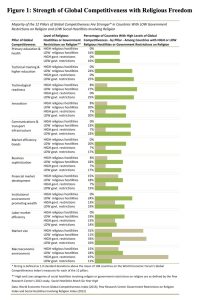
The Acton Institute’s own Dylan Pahman, also in 2014, examined the relationship between economic freedom and religious freedom, and found a “strong correlation.”
There is, however, a chicken-and-egg problem. Countries with protections for religious freedom generally also have protections for economic freedom and vice versa. To that end, it can be difficult to determine what the causal relationship is between religious freedom and economic growth.
Montesquieu, for instance, argued that commerce itself has a general liberalizing effect. In The Spirit of the Laws, he famously wrote that “peace is the natural effect of trade,” because commerce makes people mutually dependent and habituates them to dealing with difference. Trade requires repeated interaction with strangers, foreigners, and even members of religious communities one might otherwise distrust. Over time, this dependence can soften manners, reduce fanaticism, and make persecution less attractive. On Montesquieu’s account, then, economic freedom can help produce religious toleration: Commerce teaches people to live peaceably with those whose beliefs they do not share. But can religious freedom still encourage economic freedom? That is, if economic freedom can encourage religious freedom, can religious freedom also encourage economic freedom?
The causal relationship between economic and religious freedom likely goes both ways. One thing’s for certain, though: Religious freedom has some sort of causal relationship with economic freedom.
In a 2021 paper, using panel data from 126 countries between 1995 and 2014, Andreas Makridis generally found religious liberty to be a stronger predictor of future economic freedom than economic freedom is of future religious liberty. Specifically, a one-unit increase in religious liberty—meaning a one-point increase on the indexes used in the study—is associated with a 0.15-unit increase in economic freedom one year later and a 0.22-unit increase five years later. Makridis theorizes that religious liberty may act as a prerequisite for economic freedom for at least two reasons. First, the freedom to choose what to believe is necessary for individuals to assign meaning to their actions and make genuinely voluntary choices. Second, religious liberty may provide a foundation upon which other freedoms, such as property rights and freedom of contract, can emerge and be protected. To that end, his analysis also showed that improvements in religious liberty tended to precede gains in the rule of law, property rights, civil liberties, and access to justice, while contributing to reductions in corruption and violence.
In practice, it’s also easy to see how religious freedom can positively impact economic freedom. Societies that restrict religion tend to create the very conditions that make commerce harder: corruption, instability, arbitrary regulation, discrimination, and legal uncertainty. A simple comparison of Pew Research Center’s 2022 Government Restrictions on Religion Index and Transparency International’s 2025 Corruption Perceptions Index shows a notable overlap between countries that heavily restrict religion and countries perceived as more corrupt. Pew found that 24 countries or territories had “very high” government restrictions on religion in 2022. Of the 23 that also appear in the 2025 CPI, 19 scored below 50 out of 100, a range Transparency International describes as indicating serious corruption problems. When governments claim broad power to police belief, worship, religious identity, or religious expression, they also normalize arbitrary state power more generally. That makes it easier for officials to favor insiders, punish disfavored minorities, or manipulate legal rules for political or economic ends.
Similarly, The Price of Freedom Denied shows that religious restrictions often produce the very instability that makes economic growth difficult. When religious freedoms are not respected, the result can be violence and conflict. Normal economic activities become vulnerable to disruption, local and foreign investment is driven away, and sustainable development is undermined. Pakistan provides one example: Human Rights Watch reported in 2025 that blasphemy laws have been exploited for blackmail, profit, property seizures, and attacks on business rivals, including businesses owned by religious minorities. More generally, tolerance is a key ingredient in peace and stability. And stable societies create more opportunities to invest, trade, hire, and conduct ordinary commercial activity in a predictable way, especially in new and emerging markets.
One apparent exception to this argument, though—China. China has had seemingly increasing economic freedom while at the same time not experiencing an increase in the civil liberties that many in the West believed would follow an increase in economic freedom. But this is less of a counterexample than it first appears. China has not enjoyed economic freedom in the full sense—secure property rights, independent courts, and free capital markets. Its growth only came after it moved away from Maoist central planning and introduced real, though incomplete, market liberalization, such as allowing foreign direct investment, establishing the Shanghai Stock Exchange and the Shenzhen Stock Exchange, and joining the World Trade Organization.
Something similar is true of religious freedom in China. After the Cultural Revolution, when all religious activity had been banned, China partially reopened spaces for religious belief and practice. Article 36 of the Constitution of the People’s Republic of China, which was adopted in 1982, protects “normal religious activities.” The same year the Chinese Communist Party Central Committee issued a document titled “The Basic Viewpoint and Policy on Religious Question during Our Country’s Socialist Period.” In this document, the party recognized the complexity and longevity of religion, and the crucial role religion plays in individual and societal development, clearly stating that the freedom of religion must be protected for all citizens.
But like China’s limitations on economic freedom, religious freedom was sharply limited from the beginning: only undefined “normal” religious activities were protected, and religious life remained subject to state administration. Under Xi Jinping, those limits have tightened even further through the “Sinicization” campaign, which seeks to align religious belief and practice with Chinese Communist Party ideology and state objectives, placing religious communities under greater political supervision and control. To that end, religious freedom in China has been rapidly deteriorating. ChinaAid, a human rights organization committed to promoting religious freedom in China, found that China’s religious policy has evolved over the past decade from “stability-centered control” (2014–17), to “institutionalized control” (2018–21), to the comprehensive politicization and ideological reshaping of religion (2022–24), and finally to a system of “multidimensional reconstruction and digital governance” in 2025 characterized by real-name registration requirements, facial-recognition monitoring, online sermon censorship, loyalty screening of clergy, and extensive state surveillance of religious communities.
Simultaneously, per the Heritage Foundation’s Economic Freedom Index, economic freedom in China has sharply declined over the past five years.
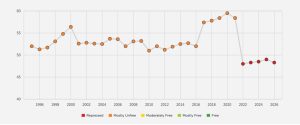 Both religious freedom and economic freedom have contracted under Xi Jinping. So, to the extent that China does represent an example of economic and religious freedom diverging, it does not fully do so because both economic and religious freedom have continued to be heavily circumscribed and have become only more limited in the past few years. But continued limits on political freedom, including religious freedom, will only inhibit further economic growth. Market reforms can generate significant growth for a time, but when the state retains the power to override property rights, civil society, and freedom of conscience, economic dynamism eventually faces constraints. Despite superficially appearing as a counterexample to the relationship between religious and economic freedom, China’s recent trajectory still suggests that restrictions on religious liberty and other civil freedoms are not independent from economic growth; they are symptoms of a broader concentration of power that can ultimately weaken the institutional foundations necessary for long-term prosperity.
In sum, while religious freedom may appear to be a right that should be discussed in solely moral terms—and moral arguments for religious freedom should still absolutely be made—there’s no less of a reason to make economic arguments for religious freedom. Whether you are religious or not, and whether you belong to a minority or majority religion, greater protections for religious freedom will benefit the economy, and as such benefit all people. Ultimately, religious freedom is not only a moral good but also a practical foundation for human flourishing. A society that protects conscience limits arbitrary power, strengthens the rule of law, and creates the conditions in which both people and economies can prosper.