Category: Acton Commentary

Anthony Bradley looks at the inspiring life story of Thomas L. Jennings (1791–1856) who was granted a patent, the first for an African American, for developing a process that led to modern-day dry cleaning. “Do we not want new stories like this in the United States and around the world?” asks Bradley. “Do we not want people to be free to use their creativity to meet marketplace needs in their communities and freely use their wealth creation to contribute to civil society as they see fit?” The full text of his essay follows. Subscribe to the free, weekly Acton News & Commentary and other publications here.
Read more on Commentary: When Freedom, Creativity, and Opportunity Meet…

One has to wonder how Dr. Martin Luther King, Jr. would respond to the state of black America in 2013. From the nonsense that regularly spews from the mouth of rappers like Lil Wayne to the black-on-black violence that continues to plague many black urban and rural neighborhoods, we are moving further away from King’s dream. Did MLK die so that rappers like Lil Wayne could saturate their music with misogyny and materialism? Did MLK die so that young black males could sabotage their lives and the lives of others in their neighborhoods? Moreover, what continues to baffle many of us is the curious absence of a discussion about the promotion of moral values in low-income communities as a way to undermine the mass incarceration epidemic in the black community because of the government’s failed drug policies.

Maria Lloyd, Business Manager for Your Black World Network, recently wrote a column outlining a few of the social consequences of the mass incarceration of African American men resulting from failed federal drug policy including the proliferation of HIV/AIDS, unemployment, and mass incarceration. In fact, a December 2012 recent Justice Department report observes that “nearly half (48%) of inmates in federal prison were serving time for drug offenses in 2011, while slightly more than a third (35%) were incarcerated for public-order crimes.” Lloyd continues,
Read more on The Moral Elephant in Black America’s Room…

Joe Carter
posted by on Wednesday, February 20, 2013

“While president, Calvin Coolidge warned Americans that if it was the federal government that came to their mind when they thought of ‘the government,’ it would prove costly,” writes Ray Nothstine in this week’s Acton Commentary. But as Nothstine points out, everywhere we turn the federal government is increasingly visible and intrusive. The full text of his essay follows. Subscribe to the free, weekly Acton News & Commentary and other publications here.

Read more on Commentary: Is America the Federal Government?…

Kishore Jayabalan
posted by on Monday, February 11, 2013

Shock waves went through Rome at about noon today and the rest of the Catholic, make that the entire, world, as news came that Pope Benedict XVI will resign as Pope on February 28.

Read more on Pope Benedict Resigns…

In March 1933, through various political maneuvers, Adolf Hitler successfully suppressed Communist, Socialist, and Catholic opposition to a proposed “Enabling Act,” which allowed him to introduce legislation without first going through parliament, thus by-passing constitutional review. The act would give the German executive branch unprecedented power. “Hitler’s rise to power is a sobering story of how a crisis and calls for quick solutions can tempt citizens and leaders to subvert the rule of law and ignore a country’s constitutional safeguards,” Anthony Bradley writes. The full text of the essay follows. Subscribe to the free, weekly Acton News & Commentary and other publications here.
Read more on Crisis and Constitution: Hitler’s Rise to Power…

President Barack Obama has put gun control high on his second-term agenda, pushing also for more police forces and mental health services in schools. “The American mental health system is broken, but this back-door approach under the guise of preventing crime is not the way to fix it,” writes Acton’s Elise Hilton. “It will only further stigmatize the mentally ill, and prevent many from getting help.” The full text of her essay follows. Subscribe to the free, weekly Acton News & Commentary and other publications here.
Read more on Commentary: Linking Gun Control to Mental Health Misguided, Ineffective…

“If I had cash to spend on promoting the values and ideas and policies that I believed were best for this country, you can bet that I would be out finding talented directors, writers, and producers who shared those values,” writes R.J. Moeller. The full text of his essay follows. Subscribe to the free, weekly Acton News & Commentary and other publications here.
Read more on Commentary: Hollywood 2012: What Messages are the Movies Sending Us?…

In this week’s Acton Commentary, “The Mundane Morality of Les Misérables,” I explore the new musical film and in particular a transitional episode where the main protagonist, Jean Valjean, is faced with a moral dilemma: “If I speak, I am condemned. If I stay silent, I am damned!”

Here’s a performance of the scene from the musical’s 10th anniversary, featuring Colm Wilkinson as Valjean:

Read more on Valjean, Lord Acton, and the Common Moral Code…

New York Post illustration

New York Post illustration

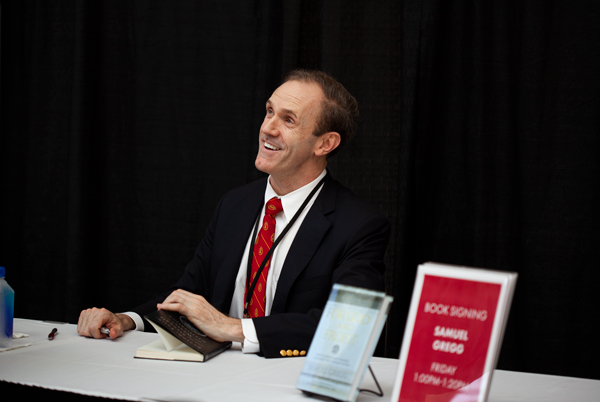
In the New York Post, Acton Research Director Samuel Gregg looks at “the spread throughout America of economic expectations and arrangements directly at odds with our republic’s founding” and asks what the slow walk to “Europeanization” means for the long term. Gregg:

Unfortunately there’s a great deal of evidence suggesting America is slouching down the path to Western Europe. In practical terms, that means social-democratic economic policies: the same policies that have turned many Western European nations into a byword for persistently high unemployment, rigid labor markets, low-to-zero economic growth, out-of-control debt and welfare states, absurdly high tax levels, growing numbers of well-paid government workers, a near-obsession with economic equality at any cost and, above all, a stubborn refusal to accept that things simply can’t go on like this.

It’s very hard to deny similar trends are becoming part of America’s economic landscape. States like California are already there — just ask the thousands of Californians and businesses who have fled the land of Nancy Pelosi.

Europeanization is also reflected in the refusal of so many Americans to take our nation’s debt crisis seriously. Likewise, virtually every index of economic freedom and competitiveness shows that, like most Western European nations, America’s position vis-à-vis other countries is in decline.

Is there a way out, even as the “fiscal cliff” negotiations vividly illustrate the inability of Washington’s political elites to take spending and tax problems seriously? Gregg holds out hope: Read more on Samuel Gregg: United States succumbing to ‘Eurosclerosis?’…

Joe Carter
posted by on Friday, December 28, 2012

Every Wednesday we publish the Acton Commentary, a weekly article that covers topics related to Acton’s mission. As 2012 comes to a close I thought it would be worth highlighting the superb commentaries that have been produced by Acton Institute staffers over the past year.

Read more on The Year in Commentary: Various…

Acton PowerBlog RSS

Google Plus

Twitter Feed

Facebook Fan Page

Support the Acton Institute

The Acton Institute is funded through the generous contributions of individuals such as yourself. Learn more about how you can advance the cause of freedom and virtue.