Category: Christian Social Thought

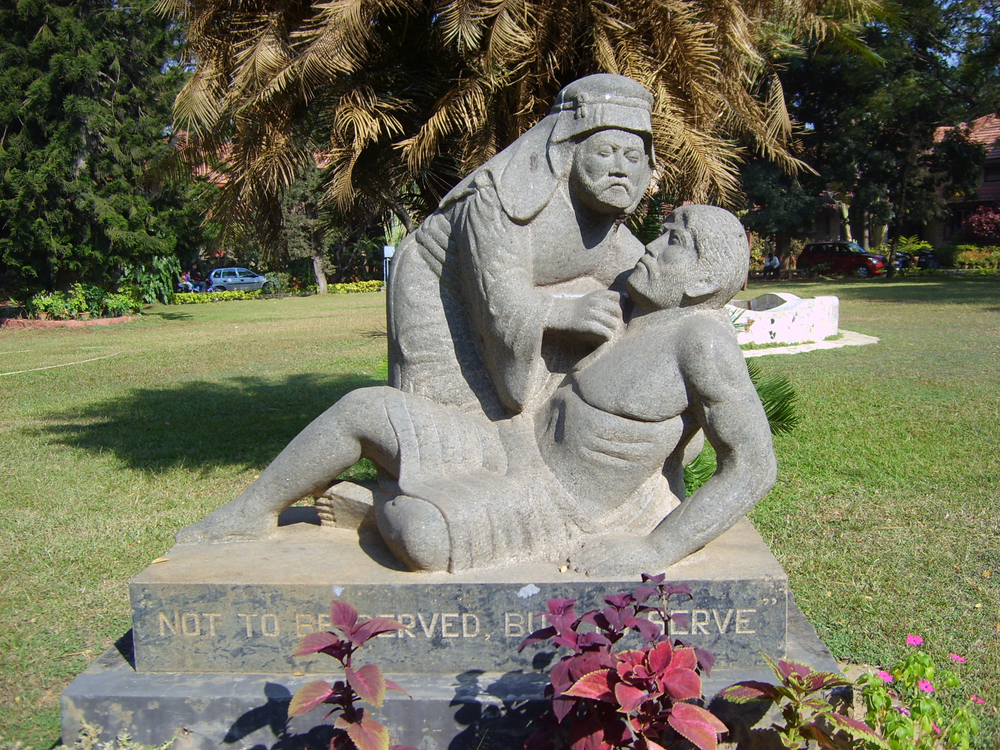
The Emperor Theodosius does public penance for his own scandal before the bishop St. Ambrose.

Ray Pennings recently wrote a thoughtful reflection at The Cardus Daily on the recent surge in (exposed) political scandals, Canadian and American. He bemoans that “the current version of democracy isn’t looking all that attractive right now,” writing,

It is discouraging to read stories regarding blatant ethical questions involving the President of the United States, Prime Minister of Canada, the Canadian Leader of the Opposition and the Mayor of Canada’s largest city on the same day. Although the natures of these purported scandals are quite different from each other, the bottom line reduces to the same — can we count on our leaders to carry out their office with the basics of integrity and transparency? Whatever the facts are regarding the specific cases, at a minimum it must be said that those involved in each of these cases have been less than forthcoming in explaining themselves. If the events themselves don’t merit the scandal label, the lack of explanation almost certainly does.

To summarize, even apart from the scandals themselves, the proclivity of politicians not to be forthright about the details is itself a scandal. Read more on Corruption, Repentance, and Restoration in a Time of Scandal…

AllAfrica.com published a press release from the Guttmacher Institute, the research division of Planned Parenthood, summarizing a new study that “the poorest countries are lagging far behind higher-income developing countries in meeting the demand for modern contraception. Between 2003 and 2012, the total number of women wanting to avoid pregnancy and in need of contraception increased from 716 million to 867 million, with growth concentrated among women in the 69 poorest countries where modern method use was already very low.”

Around the developing world, “Roughly three-quarters (73%) of the 222 million women in developing countries who want to avoid a pregnancy but are not using a modern method now live in the poorest countries, compared with 67% in 2003,” according to the report. “Furthermore, women in the poorest countries who want to avoid pregnancy are one-third as likely to be using a modern method as those living in higher-income developing countries.” Thankfully, between 2003 and 2012, “there was a shift away from sterilization (declining from 47% to 38% of all modern method use in developing countries) toward methods with higher failure rates, namely barrier methods (increasing from 7% to 13%) and injectables (from 6% to 9%).”

For those who value human dignity, this is actually good news. The “lagging behind” of birth control availability and success is the greatest hope for the developing world. In addition to the rule of law and sustained property rights, what Africa needs is more people, not less, in order for many countries to build the types of sustainable economies that allow real needs to be met in the long-run. In Centesimus Annus, Pope John Paul II explains why:
Read more on The Failing Success of Population Control in the Developing World…

There is no doubt that higher education is costly. Textbooks alone can run $1000 a semester for some undergraduates. Waiting tables and flipping burgers won’t cover those costs. With many parents just as strapped for cash as their children, how does one pay for a college diploma?

For some young women, the answer is to sell themselves. There are websites that offer “matching” services for “mutually beneficial relationships”; that is, a young woman signs up for a “sugar daddy”. He pays for college and she has her money problems solved. One website does offer helpful information, such as “keep your emotions in check” and “sugaring is not welfare”. All just business, plain and simple. Although young men sign up for this type of arrangement, the vast majority are young women. Read more on Paying For College By Selling Yourself…

In a May 16 address to four new Vatican ambassadors, Pope Francis denounced the “cult of money” in today’s culture, stating that we are now living in a disposable society, where even human beings are cast aside.

Read more on What capitalists can learn from Pope Francis…

Jordan J. Ballor
posted by on Monday, May 13, 2013

Michael J. Gerson’s encomium to Jim Wallis’ book on the common good includes this curious paragraph:

Nearly every Christian tradition of social ethics encompasses two sorts of justice. The first is procedural justice: giving people what they deserve under contracts and the law. The second is distributive justice: meeting some needs just because human beings are human beings. This is not the same thing as egalitarianism; confiscation is not compassion. But distributive justice requires a decent provision for the vulnerable and destitute. And this is not just a matter of personal charity. Social justice is more than crumbs from the table; it depends on the existence of social and economic conditions that allow people to live, work and thrive.

Gerson should be applauded for grappling with such substantive doctrines as the common good and social justice. It is certainly brave to do so within the confines of a short opinion piece.

But his treatment of these in the context of this short op-ed illustrate the difficulty of doing so in a responsible fashion. For one thing, the common good is perhaps one of the most difficult concepts to get a handle on in the history of Christian moral reflection. In the end, Gerson summarizes it as “the set of social circumstances that allows everyone to flourish.” We might quibble with this description as not quite getting at the common good as a telos rather than a process, but given that he quotes John Paul II in the previous line, this isn’t that large of a quibble.

We might also note that even though it is commonly associated with modern Roman Catholic social thought, as Gerson notes, the idea of the common good is much more of a catholic legacy of Christianity shared by a variety of Christian traditions. See, for instance, Gerson’s claim that Wallis’ invocation of the common good is “further evidence of the intellectual advance of Catholic social teaching across Christian confessions.” I think this is probably true in the case of Wallis and many evangelicals, and in this Roman Catholic social thought has done a great service in preserving this inheritance and serving as a reminder and inspiration for those who have forgotten the place of the common good in their own tradition’s moral reflection.
Read more on Gerson on the Common Good…

Joe Carter
posted by on Thursday, May 9, 2013

wilhelm-ropkeSome Christian free market enthusiasts mistakenly believe we have to make a choice between socialism and Randianism. But as Joel Miller points out, there are far better intellectual leaders than Ayn Rand. Wilhelm Röpke is a prime example:

Read more on Less Ayn Rand, More Wilhelm Röpke…

Sarah Stanley
posted by on Thursday, May 9, 2013

Yahoo! Sports recently posted this interesting video about the Angola Prison Rodeo. In the Volume 22, Number 3 issue of Religion & Liberty,  Ray Nothstine had a chance to go to Angola and interview Burl Cain, the longest serving warden. During the interview Cain says:

Read more on Video: This is Angola…

Elise Hilton
posted by on Wednesday, May 8, 2013

“Let us not forget: we are a pilgrim church, subject to misunderstanding, to persecution, but a church that walks serene, because it bears the force of love.” ― Oscar A. Romero, The Violence of Love

It is no secret to Christians that being one is not easy. However, the public practice of Christianity is becoming more and more difficult world-wide. The recent kidnapping of two Orthodox bishops in Syria is but one story of the on-going violence towards Christians in that country. Nigeria was recently cited for its attacks on Christians and Christian churches. Cadida Moss, a professor at the University of Notre Dame, is questioning the existence of Christian martyrs in the early Church. Rather than dying for their faith, she asserts, the stories of martyrs are myths created by a young church eager to establish itself as something worth dying for. Now, John Blake of CNN reports on American Christians as a “hated minority.” Read more on ‘A Church That Walks Serene’…

As commencement ceremonies once again are being celebrated around the country, I was reminded again of the moral crisis of US education.

Elise Hilton recently surveyed the dismal employment rate among young adults in the US, writing that we have moved in twelve years from having the best rate in the developed world to being among the worst, following the path of Greece, Spain, and Portugal.

She highlights two possible solutions. The better one is from Acton’s director of research Samuel Gregg:

Gregg says we must rely on free markets rather than redistribution of wealth, economic liberty, rule of law, entrepreneurship and the ability to take risks economically – all things that have made America great in the past.

The second comes from David Leonhardt, who, among other ideas, suggests, “Long term, nothing is likely to matter more than improving educational attainment, from preschool through college.”

Notice the language he uses? Not educational quality, nor even job-training, but “educational attainment.” With no intended disrespect to Mr. Leonhardt, it is precisely this well-meaning, widespread, but ill-informed mentality that has led, in large part, to our current educational crisis. Read more on The Injustice of US Educational Attainment…

Silicon Valley certainly has a reputation for innovation and risk. But Christianity? Businesses designed not only to innovate but to pursuing business as an “intimate” adventure with God? That seems unlikely.

Christianity Today tells the story of several entrepreneurs in Silicon Valley who are grounded in faith, but are shrewd business people. Take, for example, Sonny Vu. Read more on Silicon Valley Misfits: Human Flourishing In California…

Acton PowerBlog RSS

Google Plus

Twitter Feed

Facebook Fan Page

Support the Acton Institute

The Acton Institute is funded through the generous contributions of individuals such as yourself. Learn more about how you can advance the cause of freedom and virtue.