Category: Economics

This morning at Acton University I attended a fascinating lecture by Dr. Edd Noell, “Origins of Economics: The Scriptures and Early Church Fathers.” I have briefly examined one ancient Christian perspective on wealth in the past (here), but Dr. Noell’s survey today was far more expansive. For the benefit of PowerBlog readers, I would like to reflect on some of the major themes of his talk here as a sort of preview of what one could expect once the audio is available for sale. Read more on Edd Noell: Early Christians on Wealth and Poverty…

Joe Carter
posted by on Thursday, June 13, 2013

Among the most significant economic challenges in America today is getting Americans to understand what an economy is.

measure-economyWhen the Latin term oeconomia was first used in the 1500s it meant “household management.” A few centuries later, the term political economy was used in reference to the economies of states or polities. It wasn’t until the modern era, though, that “economy” became to refer primarily to the production and distribution of national income and wealth and lost almost all connection to the household.

Because of that shift, we often see a confusion of terms and concepts. Take, for instance, the opening sentence of this recent news report:

The U.S. economy grew at a modest 2.4 percent annual rate from January through March, slightly slower than initially estimated.

The problem with this is that “U.S. economy” is conflated with gross domestic product (GDP) — the market value of all officially recognized final goods and services produced within a country in a given period of time. While GDP can potentially be an important economic indicator, it is not a true measure of the nation’s economy (aka political economy).

Derek Scissors provide a superb explanation for why a better measurement is one that gauges the original economy:
Read more on How to Measure an Economy…

Many thanks to Ancient Faith Radio for graciously sharing its podcasts of the Conference on Poverty at St. Vladimir’s Orthodox Theological Seminary in Yonkers, N.Y. The May 31-June 1 event was co-hosted by the Acton Institute. The conference was offered as a tribute to Deacon John Zarras, a 2006 alumnus of the seminary who earned his M.Div. degree over a period of several years as a late–vocations student. Deacon John, who fell asleep in the Lord last year, also served as a member of the Board of Trustees and the president of the St. Vladimir’s Seminary Foundation.

VoicesFromSVSWhat follows are four separate audio feeds, including Q&A follow up, from the Poverty Conference. Ancient Faith is broadcasting these as part of its regular podcasts by the Very Rev. Dr. Chad Hatfield, Chancellor of St. Vladimir’s. But first listen to Fr. Chad’s May 24 broadcast, in which he addresses negative reaction to Acton’s participation in the conference by some associated with the seminary. He reminds listeners that Acton, on the issue of poverty, can provide a fresh and different approach that’s effective.

[Audio clip: view full post to listen]

From Ancient Faith: Read more on Audio: Acton-St Vladimir’s Poverty Conference…

Elise Hilton
posted by on Thursday, June 6, 2013

The call to “buy American” is one we hear frequently or see plastered on the bumper of the car in front of us. Donald Boudreaux, senior economics advisor at Mercatus Center, explains the problem with this ideal in a letter to the Washington Post:made in usa

Read more on The Problem With ‘Buy American’…

Joe Carter
posted by on Wednesday, June 5, 2013

trip_hurdles_400_clrOne of the most basic concepts in economics and business is marginal or incremental cost, the additional cost needed to produce or purchase one more unit of a good or service. For example, if a business can produce 100 widgets at a total cost of $5,000 and 101 widgets for $5,500, the marginal cost of the 151st unit is $500. At that rate, the company has a disincentive to produce more than 100 widgets since the cost rises sharply (an average additional cost of $4.45 per widget).

The same principle applies to the cost of labor. Imagine a worker who makes $16 an hour for 29 hours per week but whose incremental cost for the 30th hour of work each week rises to $112.15. For the 29 hours of labor, the cost is $464 while for 30 the cost is $576.15. That sharp increase would prevent many employers from hiring workers for more than 29 hours per week.

According to Jed Graham at Investor’s Business Daily, that is exactly what effect Obamacare will have on wages.
Read more on The 30-Hours-Per-Week Job Hurdle…

From 1990 to 2010, the global poverty rate dipped from 43% to 21%. The Economist explains why the rate halved in twenty years:

How did this happen? Presidents and prime ministers in the West have made grandiloquent speeches about making poverty history for fifty years. In 2000 the United Nations announced a series of eight Millenium Development Goals to reduce poverty, improve health and so on. The impact of such initiatives has been marginal at best.

Read more on How Did the Global Poverty Rate Halve in 20 Years?…

Joe Carter
posted by on Tuesday, June 4, 2013

MDG-soil-map-of-Africa-0011-300x296“We poverty junkies spend a lot of time examining the fruits and the roots,” says Mark Weber at PovertyCure, “But what of the soil?” Tyler Cowen also recently noted that economists don’t talk nearly enough about soil, despite their contributing to some of the biggest problems in the entire world.

The problems can be seen in the European Union’s Institute for Environment & Sustainability recently published Soil Atlas of Africa. Robin Grier highlights some of the findings:
Read more on Dirt and Development…

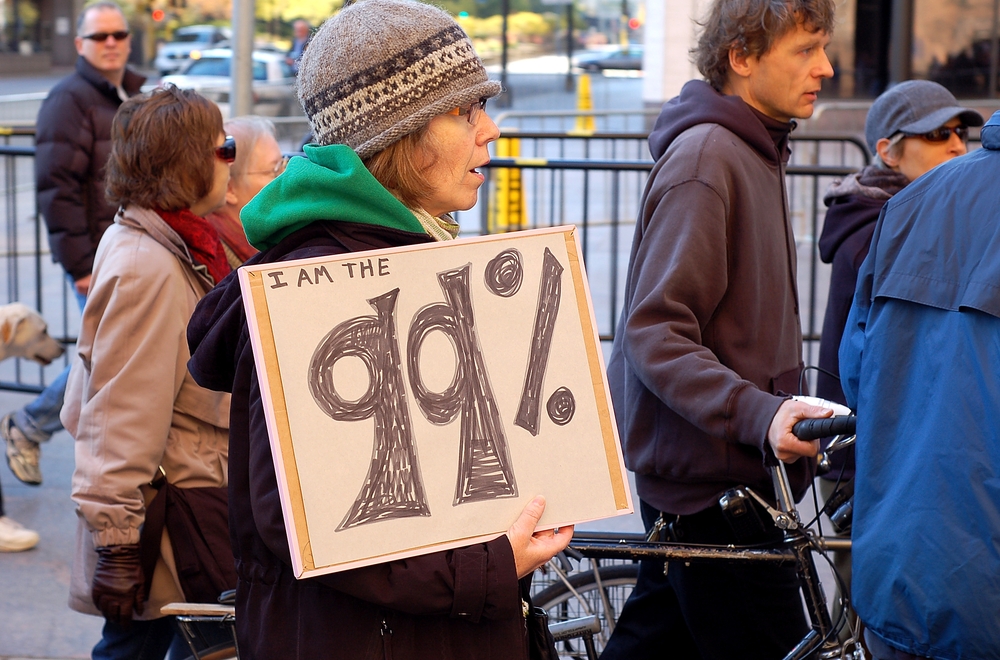
Leaders from Canada, France, Germany, Italy, Japan, Russia, the U.S., and UK will meet at Lough Erne in Northern Ireland for the G8 Summit June 17-18, 2013. These international negotiations among the world’s largest economies provide opportunities to discuss the fluidity of trade between nations but also provokes public protest. All over social media, various groups are set to organize protests about the global trade conference because capitalism and international trade are viewed as evil.

For example, the “Stop G8 Network” developed the following set of guidelines “that were agreed by anti-capitalist resistance movements from across the world who came together to form the ‘Peoples’ Global Alliance’(PGA):
Read more on G8 Summit Protests Sponsored by Capitalism…

German Finance Minister Wolfgang Schaeuble is a frustrated man. With unemployment rates in Germany hovering at around 8 percent, and Greece and Spain at almost 60 percent, he believes the EU is on the brink of “revolution.” His answer is not to protest signscrap the welfare model however; he wants to preserve it.

While Germany insists on the importance of budget consolidation, Schaeuble spoke of the need to preserve Europe’s welfare model.

If U.S. welfare standards were introduced in Europe, “we would have revolution, not tomorrow, but on the very same day,” Schaeuble told a conference in Paris.

Not everyone agrees. Italian Labour minister Enrico Giovannini says European youth are being asked to put their lives on hold, and that this is “unacceptable.” Werner Hoyer, head the European Investment Bank, acknowledged that there is no plan at this point to direct the spiraling downturn of the EU economy. There is, instead, a country-by-country “patchwork” approach. For instance, Greece is attempting to focus on job training and entrepreneurship for 350,000 young people, and France is working on a similar plan within its own borders. Read more on You Say You Want A Revolution? Count The EU Out…

300px-MotherTeresa_0902Forbes‘ Ralph Benko explains what a chance encounter with Mother Teresa taught him about good economic policy:

I had walked by a homeless man (or, as then was called, bum) sleeping on the 41st Street sidewalk. People sleeping on the sidewalk were a familiar sight in the New York City of that era. I hadn’t even noticed him.

Read more on A Lesson in Economic Policy from Mother Teresa…

Acton PowerBlog RSS

Google Plus

Twitter Feed

Facebook Fan Page

Support the Acton Institute

The Acton Institute is funded through the generous contributions of individuals such as yourself. Learn more about how you can advance the cause of freedom and virtue.