Surf Acton.org:
The PowerBlog is managed by the Acton Institute, a non-profit think tank dedicated to promoting a free and virtuous society characterized by individual liberty and sustained by religious principles. Its authors are a diverse group of scholars, writers, clergy, and businesspeople who discuss a wide variety of topics connected to the relationship between religion and economics. Click here to learn more about the Acton Institute...

Posted by John Couretas
on Wednesday, April 29, 2009
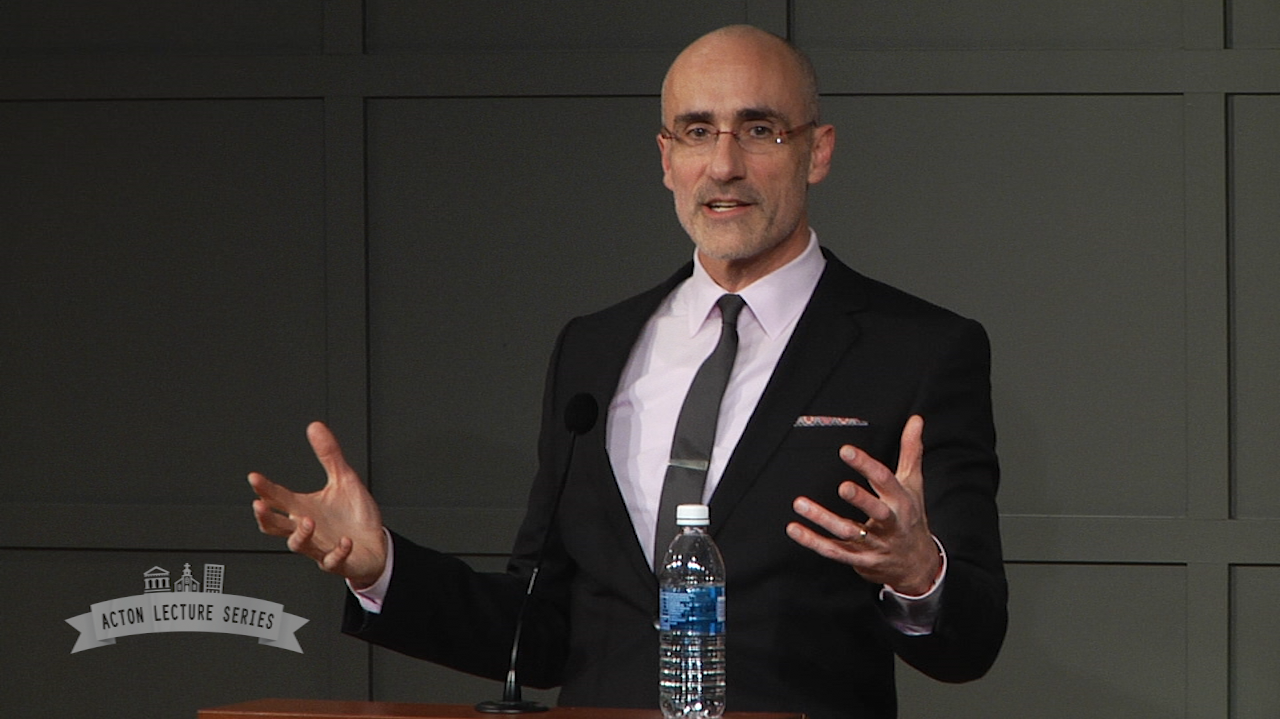
In “The Real Culture War Is Over Capitalism,” Arthur C. Brooks argues in the Wall Street Journal that the “major cultural schism” in America today divides those who support capitalism and, on the other side, those who favor socialism. He makes a strong case for the moral foundations of free enterprise and entrepreneurship and points to the recent “tea parties” as evidence that Americans still favor the market economy. Brooks, the president of the American Enterprise Institute, says Americans are revolting against “absurdities” like the bailout of General Motors that will be financed with ballooning budget deficits and trillions in new federal debt. He writes:
… the tea parties are not based on the cold wonkery of budget data. They are based on an “ethical populism.” The protesters are homeowners who didn’t walk away from their mortgages, small business owners who don’t want corporate welfare and bankers who kept their heads during the frenzy and don’t need bailouts. They were the people who were doing the important things right — and who are now watching elected politicians reward those who did the important things wrong.
Voices in the media, academia, and the government will dismiss this ethical populism as a fringe movement — maybe even dangerous extremism. In truth, free markets, limited government, and entrepreneurship are still a majoritarian taste. In March 2009, the Pew Research Center asked people if we are better off “in a free market economy even though there may be severe ups and downs from time to time.” Fully 70% agreed, versus 20% who disagreed.
He also points out that the government has been increasingly “exempting” Americans from paying taxes, an intentional strategy to create a larger class of government-dependent citizens.
My colleague Adam Lerrick showed in [the Wall Street Journal] last year that the percentage of American adults who have no federal income-tax liability will rise to 49% from 40% under Mr. Obama’s tax plan. Another 11% will pay less than 5% of their income in federal income taxes and less than $1,000 in total.
To put a modern twist on the old axiom, a man who is not a socialist at 20 has no heart; a man who is still a socialist at 40 either has no head, or pays no taxes. Social Democrats are working to create a society where the majority are net recipients of the “sharing economy.” They are fighting a culture war of attrition with economic tools. Defenders of capitalism risk getting caught flat-footed with increasingly antiquated arguments that free enterprise is a Main Street pocketbook issue. Progressives are working relentlessly to see that it is not.
Read the “The Culture of Charity,” the Spring 2007 interview with Brooks in Acton’s Religion & Liberty. Watch a 16-minute video interview with Brooks recorded at the Acton Grand Rapids office in May 2008

Posted by John Couretas
on Monday, December 29, 2008
Nicholas Kristof’s Dec. 21 New York Times column was, he says, “a transparent attempt this holiday season to shame liberals into being more charitable.” He quotes Arthur Brooks’ “Who Really Cares” book which shows that conservatives give more to charity than liberals.
The upshot is that Democrats, who speak passionately about the hungry and homeless, personally fork over less money to charity than Republicans — the ones who try to cut health insurance for children.
“When I started doing research on charity,” Mr. Brooks wrote, “I expected to find that political liberals — who, I believed, genuinely cared more about others than conservatives did — would turn out to be the most privately charitable people. So when my early findings led me to the opposite conclusion, I assumed I had made some sort of technical error. I re-ran analyses. I got new data. Nothing worked. In the end, I had no option but to change my views.”
Kristof echoes Rev. Robert Sirico’s Dec. 17 Acton commentary “Why We Give” (published on Dec. 23 in the Detroit News) which also looks at Brooks’ work on giving and the deeper theological dimensions of charity.
… the tradition of gift-giving is rooted in the gift that God offers to the world in his Son who comes in the appearance of a frail babe. Likewise, the Magi, the Wise Men, who came from the East, brought the Christ-child exotic gifts to celebrate his Advent.
There is another, perhaps more practical aspect of the giving of gifts that is worth pondering which was brought to the fore by Arthur Brooks, author of the 2006 book “Who Really Cares: America’s Charity Divide - Who Gives, Who Doesn’t and Why it Matters.” Brooks investigated the American habit of giving and what he found surprised some, irritated others and confirmed some suspicions that I have had for some time. Among his findings was that the general profile of the gift-giver is one who has a strong family life and who attends church regularly.
Read more of Rev. Sirico’s column >>>

Posted by Jordan J. Ballor
on Tuesday, October 16, 2007
As a quick follow-up to Ray’s post yesterday, be sure to check out the work of Arthur C. Brooks on charitable giving. The spring issue of Religion & Liberty featured an interview with him, and his book, Who Really Cares?, was the basis for a special focus on ABC’s 20/20 (hosted by John Stossel):
John Stossel: “But it turns out that this idea that liberals give more is a myth. These are the twenty-five states where people give an above average percent of their income, twenty-four were red states in the last presidential election.”
Arthur Brooks, Who Really Cares, author: “When you look at the data, it turns out the conservatives give about thirty percent more per conservative-headed family than per liberal-headed family. And incidentally, conservative-headed families make slightly less money.”
Connecting the links between so-called “red” states, conservatism, religiosity, and the south are interesting and instructive exercises.
2
commentsshare yours