Posts tagged with: Caritas in Veritate

Questions about poverty and social teaching are on the forefront of Pope Francis’ mind, as he’s made convincingly clear in his young papacy. This calls for cogent thinking on the topic, according to Fr. John Flynn, LC in “Francis and Catholic Social Teaching: Debates About Economy, Equality and Poverty Sure to Continue.”

Flynn cites Jerry Z. Muller, professor of History at the Catholic University of America, who gives credit to the astonishing “leap in human progress” that capitalism has brought about, but cautions that some find the disparity between rich and poor, the powerful and the dispossessed, to be grounds for anti-capitalist sentiment. Muller points out that this type of inequality seems to be growing internationally. Read more on Neither Worshipping Nor Demonizing Capitalism…

Reflecting on the pontificate of Pope Benedict XVI, Philip Booth, professor at Cass Business School in London, says the pope was clear on his economic ideas.

As he said in Caritas in Veritate: “Economy and finance, as instruments, can be used badly when those at the helm are motivated by purely selfish ends. But it is man’s darkened reason that produces these consequences, not the instrument per se”. In other words, credit derivative swaps are not evil, but those who abuse them might be.

Read more on Pope Benedict: The Capitalist System is Virtuous…

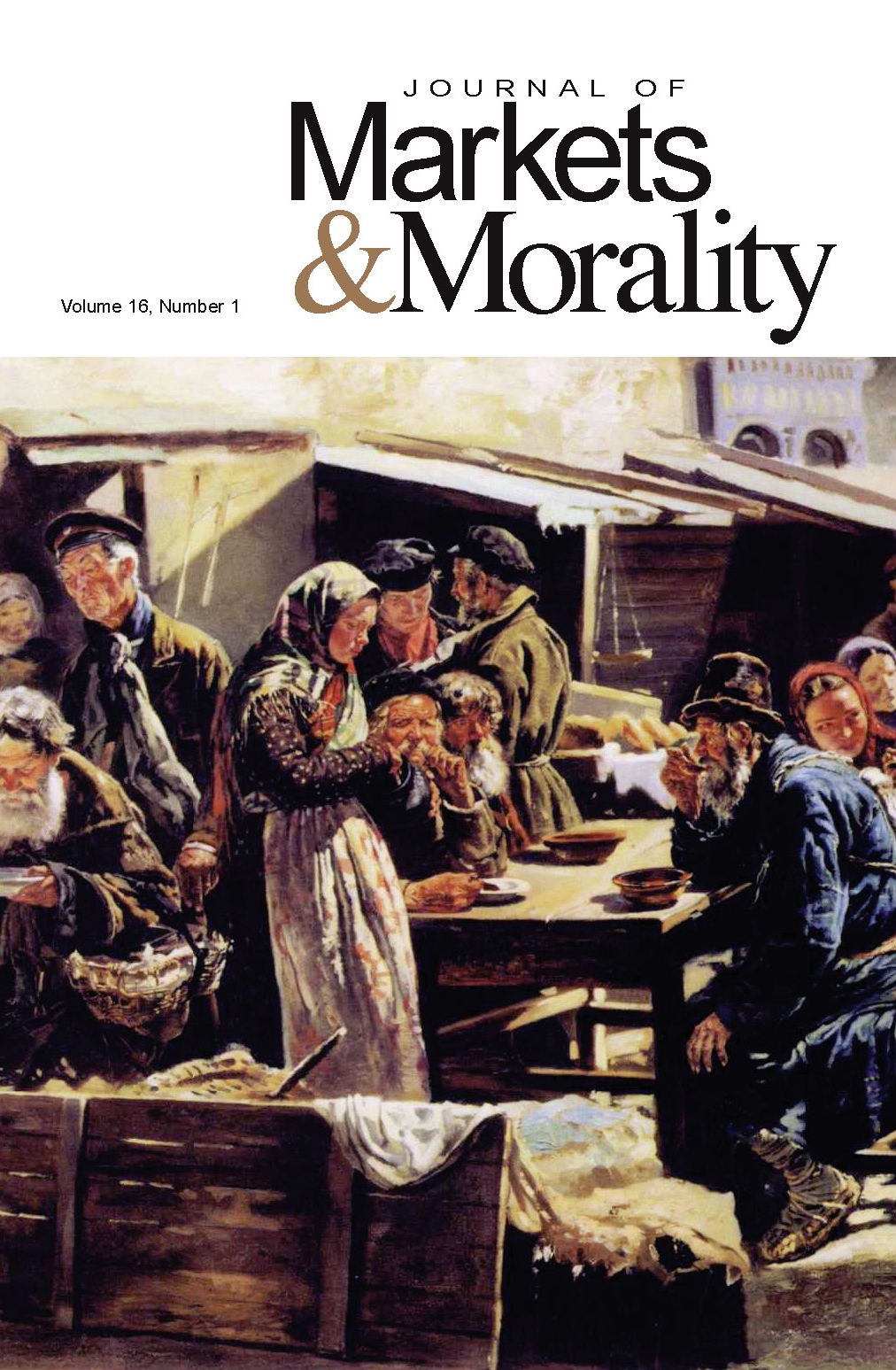
For next spring’s issue of the Journal of Markets & Morality, we’ve planned a special issue devoted to the theme “Integral Human Development,” guest edited by Peter Heslam and Manfred Spieker. The deadline for submissions is December 1, a month away as of today. Details about submission procedures can be found on the JMM website. Check out the full CFP at the site as well, and consider the following from Caritas in Veritate:

Read more on “Integral Human Development” Deadline Approaches…

Jordan J. Ballor
posted by on Friday, August 17, 2012

Article: “Catholicism, Human Rights and the Public Sphere”
Christopher McCrudden, International Journal of Public Theology

This article suggests that the scope and meaning of human rights, and its relationship to religion, is anything but settled, and that this gives an opportunity to those who support a role for religion in public life to intervene. Such intervention should address four main issues. First, it should ensure that judges engage in attempting to understand religious issues from a cognitively internal viewpoint. Secondly, it should articulat a justification for freedom of religion that fully captures the core of the significance of religious belief, and the importance of the religious principles in the public sphere. Thirdly, it should ensure engagement and dialogue between the churches and others on the meaning of human dignity, given its centrality to religious and secular perspectives on rights. Lastly, the churches should consider more carefully what it means to give ‘public reasons’ in the political and cultural context, and how it can engage in the process of ‘public reasoning’ regarding human rights.

Article: “New Challenges for Catholic-Inspired NGOs in Light of Caritas in Veritate
Jane Adolphe, Catholic Social Science Review

Read more on ResearchLinks – 08.17.12…

Dylan Pahman
posted by on Wednesday, March 14, 2012

The Journal of Markets & Morality is planning a theme issue for the Spring of 2013: “Integral Human Development,” i.e. the synthesis of human freedom and responsibility necessary for the material and spiritual enrichment of human life. According to Pope Benedict XVI,

Read more on Integral Human Development…


Pope Benedict XVI delivered inspiring remarks at the European Year of Volunteering (EYV) summit held in Rome this past Nov. 10-11. He explained why gratuitous giving of personal talent and resources is so important in restoring a healthy vocational perspective to everyday business.

Read more on Benedict XVI: Giving of Talent and Resources in Crisis Economy…

This morning the Pontifical Council for Justice and Peace issued a bold statement advising how to bring order to the global financial crisis. I was in attendance at the much anticipated press conference that was organized to debrief reporters on the statement’s content.

Read more on Vatican Releases Note on Global Financial Reform…

Kenneth Spence
posted by on Wednesday, July 6, 2011

Last week, Pope Benedict XVI addressed the annual conference of the UN Food and Agriculture Organization, and expressed particular concern over rising food prices and the instability of the global food market. In his 2009 encyclical Caritas in Veritate, the pope issued this challenge: “The problem of food insecurity needs to be addressed within a long-term perspective, eliminating the structural causes that give rise to it and promoting the agricultural development of poorer countries.”

Read more on Pope Addresses Rising Food Prices…

The budget proposed by House Republicans has lead to a heated debate; one key facet being whether funding should be cut for programs that benefit the poor and vulnerable. Critics claim the House Republicans’ proposed budget violates Catholic social teaching (click here to read the critics’ open letter to Speaker Boehner). Rev. Robert A. Sirico’s first response to Boehner’s critics appeared in NRO. In this week’s commentary Rev. Sirico expands upon his first response and articulates how Catholics can disagree on how to assist the poor and vulnerable. The article originally appeared in Crisis Magazine.

Read more on Rev. Sirico: Not Whether to Help the Poor, But How…

John Boehner

On National Review Online, Acton’s Rev. Robert A. Sirico has a new commentary on the letter sent by a group of Catholic academics to Speaker of the House John Boehner. The occasion for the letter is Boehner’s commencement address at Catholic University of America in Washington this weekend. The letter accuses the Ohio Republican of having “among the worst” record in Congress for supporting legislation that addresses the “desperate needs of the poor.”

Rev. Sirico:

It appears then that these Catholic academicians who have written to Speaker Boehner do not understand the distinctions the Church herself makes between fundamental, non-negotiable dogmas and doctrines, and the prudential and debatable give and take when it comes to applying the principles of Catholic social teaching. Here Speaker Boehner need only consult the text of the Compendium of Catholic Social Teaching, which the authors of the letter say they have delivered to him, wherein he will read: “The Church’s Magisterium does not wish to exercise political power or eliminate the freedom of opinion of Catholics regarding contingent questions.” (no. 571)

The specifics of the 2012 Budget proposed by the Speaker and his colleagues are, the letter’s authors contend, the result of either ignorance or “dissent.” I think they are neither; they simply reflect a different, and in many people’s estimation, more accurate and economically-informed way, of proposing how we achieve worthy goals. Indeed, it could be said that what these Catholic academicians are proposing is not a “preferential option for the poor,” but rather a preferential option for the State. They make the unfortunately common error of assuming that concern for the economically weak and marginalized must somehow translate into (yet another) government program.

That assumption is wrong, and flies in the face of another principle of Catholic social teaching — the principle of subsidarity. With good reason, this is something the Catholic Left — or whatever remains of it these days — rarely mentions or grapples with, because they know that it would raise many questions about the prudence of any number of welfare programs they support.

Indeed, what strikes me about this letter to Speaker Boehner is how reactionary it is.

Read “Boehner’s Catholic Critics Rush to Protect Welfare State” on NRO.

Acton PowerBlog RSS

Google Plus

Twitter Feed

Facebook Fan Page

Support the Acton Institute

The Acton Institute is funded through the generous contributions of individuals such as yourself. Learn more about how you can advance the cause of freedom and virtue.