Surf Acton.org:
The PowerBlog is managed by the Acton Institute, a non-profit think tank dedicated to promoting a free and virtuous society characterized by individual liberty and sustained by religious principles. Its authors are a diverse group of scholars, writers, clergy, and businesspeople who discuss a wide variety of topics connected to the relationship between religion and economics. Click here to learn more about the Acton Institute...

Posted by Jordan J. Ballor
on Friday, April 11, 2008
Late last month I argued that recipients of the federal government’s stimulus package “should use this rebate money as they see fit, since they are the ones most familiar with their own situations and their own needs. Consider giving part of the money to charity or saving, paying off debt or investing.” Now other voices are giving similar advice, recommending saving rather than spending.
Rick Haglund, a Michigan business columnist for the Grand Rapids Press, notes that “Some saving measures can go a little too far, though. I recently heard a personal financial consultant say people can save by no longer buying that cup of coffee and newspaper on the way to work.”
“Give up the coffee, but please, please keep buying the paper. The newspaper business is in a terrible financial state,” he writes. Haglund thinks that newspapers are more important to the country than coffee…a debatable proposition. Coffee, not oil, might well be the lifeblood of American enterprise.
But the economic status of newspaper publishing is in a strange place. I’ve been getting the weekend paper for a year or so, and when I renewed I received a call from the paper just to tell me that I’d be getting the rest of the week for free (a good thing too, or I would have missed Haglund’s column).
It reminded me of getting a postcard in the mail from the government telling me to expect a rebate…no notice necessary, just send the free stuff and the money. I don’t think it cost the Grand Rapids Press millions of dollars to make the phone calls, though (it cost the feds $42 million to mail out those inane little rebate notices).
In any case, it makes more sense for many newspapers to give their issues away to get a boost in circulation numbers than it does to count on the income from subscriptions. I also recently saw one of the narrowest daily newspapers I had ever seen last weekend, part of the trend to cut printing costs. (I can’t complain too much, though, since the Port Huron Times Herald has published more than one of my commentaries. Keep up the good work!)
Of course, some folks, like Betty J. Mazur, are going to do just what the government wants them to do with the money. “I’m going to buy new clothing with my check,” she said. (The piece linked above is in part about how it is necessary to file federal taxes for 2007 in order to get the 2008 rebate. Marketplace discusses that, and also debunks some myths about the rebate, here.)
Oh, and don’t forget to blame conservative theology for the credit crisis. After all, it seems as if adherents to so-called “conservative” theology don’t save as much as they ought.
How any decent sociologist could have this reaction is beyond me: “Keister was surprised that when demographic factors — such as education, age and race — were held as constant, religion still proved to be an influential factor in wealth accumulation” (emphasis added).
Amazing, just amazing. Can you dare admit that religious beliefs really do influence behavior?
Keister says a typical “conservative Protestant” might be a member of the Assemblies of God, Churches of Christ, Nazarene and Pentecostal churches. I guess they’ve forgotten what John Wesley said.

Posted by Jordan J. Ballor
on Thursday, October 4, 2007
The Free Exchange blog at Economist.com (HT) concludes a long and thoughtful post on fair trade, specifically in response to this recent NYT article, “Fair Trade in Bloom,” by wondering:
And how does this affect coffee supply? If a premium is available for fair-trade coffee, shouldn’t other growers enter the market to take advantage of it until the price of coffee is bid down to market levels, leaving total producer take–baseline coffee price plus premium–where it stood before? Such a scenario would also raise distributional questions. If higher coffee prices attract market entrants, then coffee-growing nations will shift resources into that sector, which might be good for grower incomes, but could potentially inhibit the development of other economic activities.
Not to take anything away from the stated goals of the fair-trade movement or the well-meaning consumers who wish to do better by farmers in poor countries. Still, in any economic process, it’s often difficult to foresee the second- and third-order effects of a decision. It will be interesting to observe how growth in fair-trade products changes the structure of markets for targeted commodities.
These sorts of questions and concerns are at the heart of my past criticisms of the fair trade movement.
To the extent that fair trade certifiers are simply acting as agents to inform consumers and guarantee certain practices, to which coffee buyers can freely respond either affirmatively or negatively, there’s no real complaint. Fair trade becomes a boutique item that has to compete in the free marketplace.
But to the extent that the fair trade movement reflects a more thoroughgoing critique of market forces and the “fairness” or justice of market prices, it becomes more problematic. It becomes an entirely different paradigmatic alternative to a system of free trade.
You’ve essentially replaced market prices with arbitrarily determined prices, which are subjectively determined to be “fair.” Compare this with the traditional and classic scholastic understanding of a “just” price as the market value in the absence of any and all fraud and conspiracy.
The Free Exchange blog piece points out all sorts of negative consequences of the change from “just” to “fair” prices, not least of which is the increasing saturation of an already saturated market because of artificial subsidization of a particular commodity. Furthermore, it’s hard to see how it makes good economic and environmental stewardship to subsidize and promote the growth and production of a commodity of which we already have too much.
For more on the disconnect between the intentions and the consequences of the fair trade movement, check out this study, “Does Fair Trade Coffee Help the Poor?”

Posted by Brooke Levitske
on Friday, August 24, 2007
Railing against corporate dictatorship, delocator.net helps consumers find locally-owned cafes, bookstores, and movie theatres in their area — alternatives to the “invasion” of Starbucks, Borders, and their ilk. The site itself is actually quite an interesting capitalist idea in its freshness and creativity, and people certainly should eat or drink or shop where they are most comfortable. That’s the beauty of competition! And the kind of community-building that often takes place at familiar, time-tested, local shops is to be encouraged.
But to say local businesses possess some kind of moral magic simply by virtue of being family-owned and homey is preposterous. Such shops may be more ethically run in some ways, partially through close personal ties to the community and to fellow owners and employees. But this bespeaks the virtue of the management, not of the abstract institution of the local business itself (just as it indicates the poor character of the management of a corporate business, and not all of corporate business itself, when one falls into unethical dealings). Also, independent stores are often smaller, so they may provide fewer jobs to people in the community and supply fewer products to their customers. Neither of these are inherently good qualities for businesses to have.
In saying that independent, community-operated businesses “deserve your dime,” delocator.net forgets that consumers may have different preferences, needs, and reasons for choosing bigger stores, and that it is not immoral for them to do so. While it is true that corporate business is not inherently praiseworthy, neither are small businesses — but inherently good things can come out of both types of stores in different circumstances, even if ignoring the economic benefits of competition. Making books more widely available to average people is a good thing. Having a choice of coffee shops — for atmosphere, taste, cost, or convenience — is a good thing. Even facing more snack options at a bigger movie theater is, in its own sense, desirable.
If delocator fans don’t find these things desirable, they should by all means avoid them. But to limit personal choice and to condemn the multiplicity of options seems to defeat the principle of independence that claims to inform them in the first place.

Posted by Jordan J. Ballor
on Monday, January 8, 2007
A NYT editorial informs us today that retail prices for coffee products are rising (HT: Icarus Fallen). We are assured, however, that the price rise has been “relatively modest” and that an important factor is “changes in supply and demand in a global economy.”
No kidding.
The bad news in the editorial, at least for the fair trade crowd, is that these same forces of suppy and demand are raising the price for the commodity itself.
According to the International Coffee Organization, the composite price of coffee rose over 36 percent from the beginning of 2005 to the end of 2006. The organization predicts a down year for the Brazilian coffee crop, which could lead to a supply shortfall and even higher prices this year. While world demand has grown at annual rates of 1.5 to 1.8 percent over the last five years, it has been rising at a much faster clip of roughly 15 percent for smaller players like Russia and China. As more people enter the global middle class, the demand for coffee rises, putting upward pressure on the price.
I have argued previously that the very low price of coffee internationally was a pointer to the fact that we had a global glut in the bean supply.
That trend seems to be reversing and the rising commodity price for coffee is thus undermining the long-term viability, relevance, and credibility of fair trade coffee.
For an opposing perspective, check out Black Gold, a new movie on the fair trade coffee movement, which I have not yet seen (HT: The Advocate).

Posted by Jordan J. Ballor
on Tuesday, August 8, 2006
Unlike the flooded market for conventional coffee products, the specialty coffee market enjoys increasing demand along with limited supply. This means that the potential exists for developing countries to increase the quality and quantity of their coffee production to meet the demand.
Rwanda is a case in point, and shows how market pressures help to effectively and efficiently signal which and in what quantity such commodities should be produced. As Laura Fraser writes in The New York Times, “From the late 1960’s until the genocide, most of Rwanda’s coffee was sold to Rwandex, a virtual monopoly controlled by the postcolonial government, for whatever price the company would offer, so farmers had no incentive to pick out the bad cherries.”
The government monopoly stifled any incentives to innovate and improve quality, since there was no potential for increased profits. More recently, however, under the administration of President Paul Kagame, the coffee industry has been liberalized and Rwandan growers are now enjoying the increased ability to compete freely with other specialty growers around the globe.
Over the last decade, “Worldwide, overproduction of high-yielding varieties caused conventional coffee prices to bottom out, but specialty coffee prices remained relatively strong. President Kagame liberalized coffee trade, sold the government’s interest in Rwandex and began working with A.I.D. to develop specialty coffee.”
According to the International Coffee Organization, Rwanda’s production of coffee has remained relatively steady between the years 2000-2005. But with the increased competitive incentives and profit motivations, the quality of Rwandan coffee has blossomed.
Writes Fraser, “Partly because of abundant labor, which allows farmers to pick through and hand-sort cherries, the coffee that goes to market is exceptionally clean, or free of imperfect beans.”
“Geoff Watts, who oversees coffee buying for Intelligentsia Coffee and Tea Inc., a premium roaster based in Chicago, said, ‘Rwanda’s gone from zero to sixty, from a complete unknown in the specialty coffee industry to becoming the source of some of the cleanest coffees in East Africa.’”
“Five years ago, all Rwandan coffee sold at the C-grade, or lowest-quality, price. Now, demand for fully washed Rwandan coffee (about 7 percent of the crop) far exceeds supply.”
The liberalization and opening the Rwandan market to freely compete has allowed the specialty coffee industry to thrive, without artificial incentives of “fair trade.” The incentives of the market are helping reward an area that has natural resources well-fit for the production of quality coffee. Coffee exports now account for about thirty percent of Rwanda’s exports, or about $35 million.

Posted by Jordan J. Ballor
on Monday, March 20, 2006
I was intereviewed for this article in yesterday’s New York Times, but I apparently didn’t make the cut. Nevertheless, in “Fair Prices for Farmers: Simple Idea, Complex Reality,” Jennifer Alsever does an excellent job bringing to light some of the dangers that are inherent with external and artificial adjustments to the price mechanism.
In the case of the fair trade food movement, the price floor is set artificially at a certain amount, determined to meet or surpass the subsistence needs of the local farmer. For coffee, this is currently set at $1.26 per pound by the fair trade community.
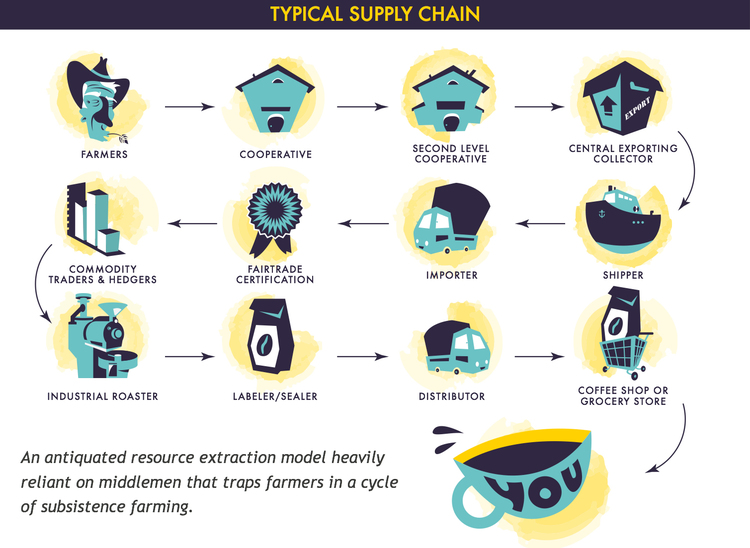
Alsever writes, “Despite good intentions, most consumers who shop according to their social convictions don’t know how much of their money makes it to the people they hope to help. Critics say too many fair trade dollars wind up in the pockets of retailers and middlemen, including nonprofit organizations.”
The problem is that the fair-trade certification organizations themselves, and also the retailers, can add several layers of increase into the price of a fair trade commodity. We might say that the fair trade consumer, who is presumably already willing to pay more than the market price, has a greater level of acceptable price elasticity.
TransFair USA, the certifying body in the US, “generated $1.89 million in licensing fees from companies that used the logo. It also spent $1.7 million on salaries, travel, conferences and publications for the 40-employee organization.”
“Farmers often receive very little,” said Lawrence Solomon, managing director of the Energy Probe Research Foundation, a Canadian firm that analyzes trade and consumer issues. “Often fair trade is sold at a premium, but the entire premium goes to the middlemen.”
Of course, these are the self-professed middlemen who cut out the layers of middlemen under a market based, free trade system. Those were the “bad” middlemen, while TransFair apparently represents the “good” sort of middleman.
One other aspect of this tinkering with the price mechanism is that the fair trade movement does nothing to recognize the reality reflected by purchasing power parity (PPP). So, writes Alsever, “a price that is fair in one country may not be in another. In Brazil, ‘$1.26 per pound for coffee is a fortune,’ said Kevin Knox, a coffee consultant in Boulder, Colo. ‘In the forest in the mountains of Mexico, the money barely is enough to justify doing it. Their yields are small, and the costs of production are higher.’”
These are just a few of the problems that arise when people try to artificially manage the price mechanism. When it is allowed to do its job, the market price of something provides a lot of good information. It can tell us, for example, that the supply of coffee far outstrips the demand, and so some coffee growers should think about getting into another product or industry. It would be in their best interests to do so, and the best interests of all of us, so that the world doesn’t end up with too much coffee and too little of something else.
The economic ignorance behind the fair trade movement leads me to believe that it really is just a sort of passing fad, especially popular among naïve church groups, which will at some point be replaced by far more effective methods of alleviating poverty around the world, such as micro-enterprise development (for more on this, see groups like Five Talents, Opportunity International, and Kiva). It’s hard to see real staying power behind a movement that thinks the answer to the reality of poor coffee farmers is simply to subsidize the production of commodities of which we already have an oversupply.
For more on some of the emotional and psychological reasons people are willing to pay more for fair trade items, see “Absolution in Your Cup: The real meaning of Fair Trade coffee,” by Kerry Howley. The fair trade movement currently lack the ability to enforce their pricing schemes through the coercive power of the state, so they must rely on other tactics.
0
commentsshare yours