Posts tagged with: dignity

Joseph Sunde
posted by on Wednesday, March 20, 2013

factory workers, monotonyDiscussions about faith-work integration are on the rise, with an ever-increasing number of related books, sermons, and blog posts (ahem) appearing with every passing day.

Over at Faith, Work & Culture, Jeff Haanen poses a challenging question to the movement, asking, “Is the faith and work movement just for white guys?” (HT):

Just a cursory glance around the faith and work landscape, and you’ll find a bunch of middle class white men (with the occasional woman or Asian). So what’s going on here? Does integrating your faith and work only matter for white professionals and not African-Americans or Latinos? (For the sake of this post, you’ll have to excuse some generalizations.)

After offering a brief history of 20th-century American prosperity and the widespread self-actualization that followed, Haanen offers his hypothesis:

Twentieth century America did not bless all ethnic groups evenly with wealth and comfort. African Americans lived under the thumb of institutionalized racism even years after the civil rights movement, and struggled for years to acquire the kind of jobs, and thus material comfort, that their white counterparts did. Today, it’s mostly Latinos who occupy the bottom rung of the socioeconomic ladder; they make even less than blacks per capita across age groups.

All that to say this: while white guys were wondering about their purpose in life, blacks and Latinos were just trying to survive. When I was a pastor of a Latino congregation, it wasn’t terribly surprising that questions of existential despair or vocational fit never arose. Dignity and providing for the family trumped “fulfilling the cultural mandate.” Getting a job and paying rent was a bit higher on the hierarchy of needs.

Haanen’s point about disparate shifts in the makeup and distribution of work is an important one. The minimum-wage McDonald’s worker will likely face a host of spiritual challenges distinct from those faced by the white-collar executive. Likewise, the differences in time and comfort outside of that work will play no small part in defining that struggle. As Haanen also indicates, “intangible” factors like racism are bound to transform these struggles further, even among workers in the same job type and industry.

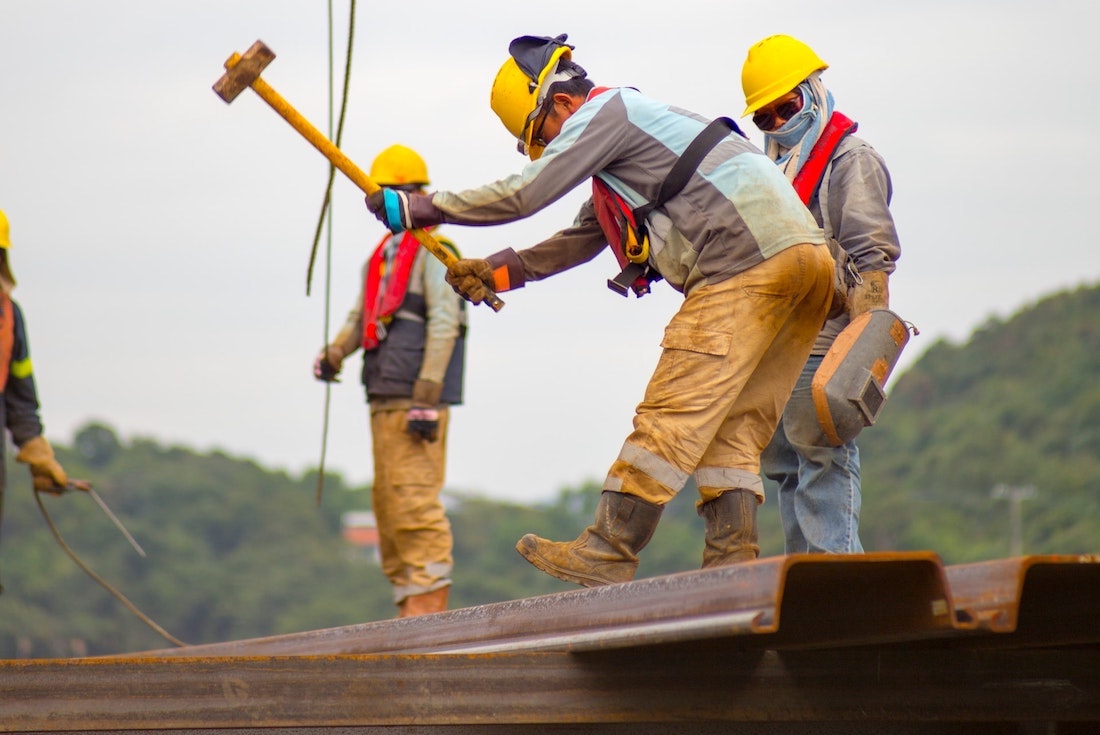
But having recognized all of this, it’s also important to recognize that just because a worker hasn’t the time, resources, or energy for armchair theologizing on “vocational fit,” it doesn’t mean that meaning, purpose, and transcendent activity isn’t taking place amid the strenuous circumstances. Whether or not we are actively thinking and talking about “cultural mandate,” the basic dignity of our work and the basic activity of serving society and providing for one’s family is an integral part of fulfilling that mandate. At a certain level, “needs-based” work has a forceful way of tempering our individualistic inclinations, and at that level, I think we need to seriously reconsider how closely we’re aligning “vocation” with our own personal preferences or our end-game goals. Does God not also call us to that initial job or task that begins a longer trajectory filled with other more “fulfilling” things? Read more on Before and Beyond Vocation…

dirty_jobsTelevision is often lamented for its propensity to exaggerate the mundane and the ordinary. Yet when it comes to something as routinely downplayed and unfairly pooh-poohed as our daily work—the “rat race,” the “grindstone,” yadda-yadda—I wonder if television’s over-the-top tendencies might be just what we need to reorient our thinking about the broader significance of our work.

As I’ve argued previously, we face a constant temptation to limit our economic endeavors to the temporal and the material, focusing only on “putting in our 40,” working for the next paycheck, and tucking away enough cash for a cozy retirement. Whether we know it or not, plenty of transcendent activity is also taking place in such efforts, whether through our service, creativity, productivity, collaboration, relationship-building, or plain-old ordinary exchange. How we think about the greater significance and spiritual potential of our efforts is bound to impact how we behave in our daily efforts, either pushing us in the direction of earthbound toil or unleashing us further toward transcendent ends.

If, as Lester DeKoster puts it, work is the “meaning of our lives,” whether we’re scrubbing toilets or selling high-priced widgets, it would seem that such a striking and all-encompassing reality deserves at least a little drama. Thus, below is a select list of my favorite TV shows that draw out some of these features (some more sincerely and effectively than others). None are “Christian” in any explicit sense, and each involves its own share of tasteless theatrics and contrived scenarios, but each nevertheless illuminates some untold truths about the significance of our work beyond the merely material.

(Tip to producers: Add a concerted focus on the will of God and the power of the Holy Spirit to any one of these shows, and that Emmy is a shoo-in.)

5. Dirty Jobs

Dirty Jobs host Mike Rowe is passionate about “celebrating hard work and skilled labor,” and by trying his hand at some of the dirtiest jobs in the land, from coal miner to sewage sifter to animal-husbandry parts-grabber, he has drawn enormous attention to some of the less celebrated and most essential jobs around. Each has its own unique requirements and pay scale, but plenty of Rowe’s undertakings involve manual labor that we might be tempted to label “undignified” or “dehumanizing.” Yet even the persistently cheery Rowe—who is surely well paid for his toil—is rarely able to outdo the positive attitudes of these workers. These are folks who ooze with passion, pride, and an acute awareness of the pressing needs they are meeting in their local communities and society at large. Read more on 5 TV Shows That Demonstrate the Importance of Ordinary Work…

I was one of the estimated 200,000 faithful who arose at the crack of dawn to join the crowds swelling St. Peter’s Square and its surrounding streets. I was also joined by millions more by way of television, radio, and the internet. We had come on this historic day to express deep personal affection and solidarity for Benedict XVI, whose February 27 audience served as his last public appearance and farewell address in Rome.

DSCN0117Benedict reassured us that he will resign his papacy tomorrow “in full consciousness of its gravity and also novelty, but with profound serenity of soul.” He therefore confirmed his full personal freedom to do so, as originally announced on February 11 and in accordance with the Church’s legal canons which protect against forced resignations.

All said, there was not an air of gloom-and-doom in St. Peter’s Square. The unexpected spring-like sunny weather broke weeks of an endless stormy winter (literally and figuratively) in Rome. This glorious day, surely, was seen a positive sign for the Church’s future. The theological virtue of hope was indeed palpable among the vivacious crowd who expressed their gratitude with brightly colored banners of affection (“You will not be alone!”, “We love and thank you Holy Father!”, “We are young and will not fear!”) and culminated in festive joy as a Bavarian folk band broke into song. There was a cheering confidence, as if the Pontiff were on a final “victory lap” in his popemobile. The normally non-emotive German pope went off script during the rhythmic, joyful chant of Italian “Be-ne-det-to!”: “I am truly moved! And I see the Church is alive!”
Read more on Benedict Bids Farewell: Church Alive, Not Sinking…

Earlier this month I attended the First Kuyper Seminar, “Economics, Christianity & The Crisis: Towards a New Architectonic Critique,” in Amsterdam.

One of the papers presented was from Jan Jorrit Hasselaar, who discussed the inclusion of non-human entities into democratic deliberation in his talk, “Sustainable Development as a Social Question.” I got the impression (this is my analogy, not Hasselaar’s) that there was some need for a kind of tribune (for plants instead of plebeians), who would speak up for the interests of those who could not speak for themselves.

The framing of the issue of the dignity of animals, plants, and the natural environment more broadly connected the integration of these interests into our public discourse as analogous to the civil rights revolutions concerning race and sex in the West over the previous century. The following video makes an argument in similar terms:

Read more on Do Plants and Animals Have Civil Rights?…

Bono, foreign aid, development, capitalismBono, lead singer of U2 and co-founder of charity-group ONE, recently offered some positive words about the role of markets in reducing global poverty and spurring economic development (HT):

The Irish singer and co-founder of ONE, a campaigning group that fights poverty and disease in Africa, said it had been “a humbling thing for me” to realize the importance of capitalism and entrepreneurialism in philanthropy, particularly as someone who “got into this as a righteous anger activist with all the cliches.”

“Job creators and innovators are just the key, and aid is just a bridge,” he told an audience of 200 leading technology entrepreneurs and investors at the F.ounders tech conference in Dublin. “We see it as startup money, investment in new countries. A humbling thing was to learn the role of commerce.”

The remarks have led to relative hype in “pro-market” circles, but I’d remind folks that these are brief statements made to a small group of innovators and entrepreneurs. ONE has plenty of wrinkles in its past, and Bono’s primary legacy in this arena consists of promoting the types of ineffective, top-down social engineering that groups like PovertyCure seek to expose. When Bono continues to claim that foreign aid, as he understands it, is still a “bridge”—even if just a bridge—it’s reasonable to assume that his orientation toward “bridge-building” has been left largely unchanged by his newfound appreciation for markets.

But although I’m not overly confident that Bono’s sudden self-awareness is enough to radically shift his aid efforts away from fostering dependency, this small admission helps illuminate one of our key obstacles to doing good in the world: overzealousness paired with overconfidence.
Read more on Bono, Babel, and the Myth of Economist as Savior…

This morning at Ethika Politika, I argue that “acting primarily for the sake of national interest in international affairs runs contrary to a nation’s highest ideals.” In particular, I draw on the thought of Vladimir Solovyov, who argued that, morally speaking, national interest alone cannot be the supreme standard of international action since the highest aspirations of each nation (e.g. “Life, Liberty and the pursuit of Happiness”) are claimed to be universal goods. I would here like to explore his critique with reference to the subject of international trade. Read more on Are Protectionism and Patriotism Incompatible Principles?…

Does the Vatican think water should be ‘free’?” asked Kishore Jayabalan in his post examining the Pontifical Council for Justice and Peace’s latest document on water. Although he is now the director of Istituto Acton, the Acton Institute’s Rome office, Jayabalan formerly worked for the Pontifical Council for Justice and Peace as the lead policy analyst on sustainable development and arms control.

In his post, Jayabalan referenced the analysis of George McGraw, the Executive Director of DigDeep Right to Water Project, a human rights and development NGO headquartered in Los Angeles. Mr. McGraw asked if we’d be interested in providing a counter-argument from a conservative perspective, so we’ve decided to publish his response below:

Read more on Counterpoint: The ‘Right to Water’ is not ‘Free Water for All’…

Dylan Pahman
posted by on Wednesday, March 14, 2012

The Journal of Markets & Morality is planning a theme issue for the Spring of 2013: “Integral Human Development,” i.e. the synthesis of human freedom and responsibility necessary for the material and spiritual enrichment of human life. According to Pope Benedict XVI,

Read more on Integral Human Development…

The Center for American Progress (CAP) has boldly rebutted the arguments of our own Kishore Jayabalan, director of Istituto Acton, concerning the Vatican’s note on a “central world bank.” It has done so by showing him to be lacking in “respect for the inherent dignity of human life.” … Yes, we are talking about that Center for American Progress.

Read more on BREAKING: Center for American Progress Takes Moral High Ground…

Acton Research Fellow Dr. Anthony Bradley spoke about his book Black and Tired: Essays on Race, Politics, Culture, and International Development at The Heritage Foundation earlier this month, and the video is now online.

Read more on VIDEO: Anthony Bradley on ‘Black and Tired’ at The Heritage Foundation…

Acton PowerBlog RSS

Google Plus

Twitter Feed

Facebook Fan Page

Support the Acton Institute

The Acton Institute is funded through the generous contributions of individuals such as yourself. Learn more about how you can advance the cause of freedom and virtue.