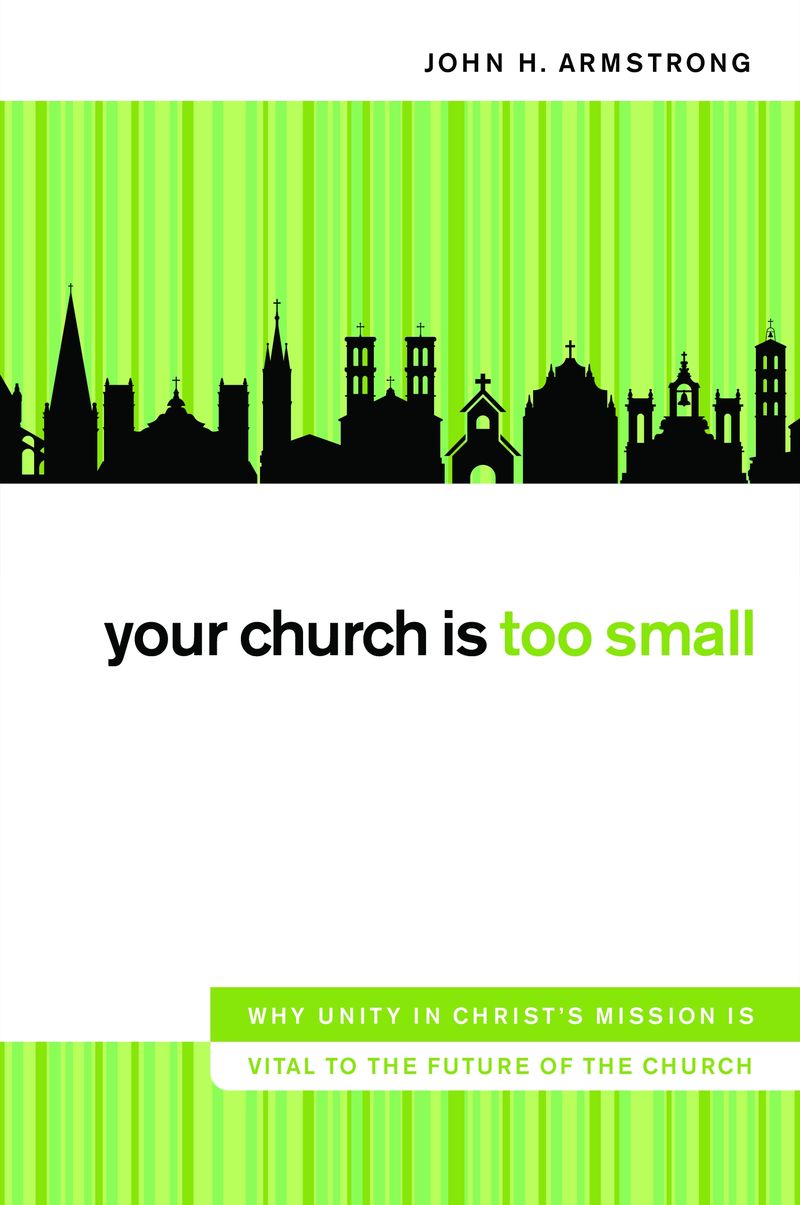
My friend John Armstrong examines “How Market Economies Really Work.” Armstrong concludes, “The gospel makes people free and teaches them to be virtuous. This is what is inherently Christian and no economic system can thrive long-term without them.”
Last night a band of hearty travelers braved the first snow of the season here in Grand Rapids (and the attendant slick and dangerous roads) to hear Dr. John H. Armstrong speak at the November/December Acton on Tap, “Ecumenism and the Threat of Ideology.” Dr. Armstrong is founder of ACT 3 and adjunct professor of evangelism at Wheaton College.
Read more on Acton on Tap: Ecumenism and the Threat of Ideology…
Today is my last day at the Evangelical Theological Society (ETS) meeting in Atlanta. I plan to make my purchases from the various book sellers this morning, having already reconnoitered the exhibits and mapped out my plan of attack.
One thing that has struck me is that there are a number of new books discussing ecumenism and Christian unity from host of different perspectives. On the one hand this shouldn’t be surprising. The unity of the church is a constant theme, one that is confessed in the Nicene Creed (“We believe…in one holy catholic and apostolic Church.”).
But for a period of time it seemed that ecumenism was in decline. After all, it used to be its own area of theological specialization; there have been (and still are some) professors of ecumenics. On the broader level one thing that breathed life into the ecumenical movement in the last half-century was the founding of what is now known as the Pontifical Council for Promoting Christian Unity (I had the pleasure of meeting the pope’s representative, Fr. Gregory Fairbanks, at the WCRC Uniting General Council earlier this year in Grand Rapids).
An ENI story notes a recent address from Pope Benedict XVI regarding ecumenism: “Today, some people believe that this journey has lost its impetus, especially in the West,” the Vatican Information Service quoted Pope Benedict XVI as saying. “Thus do we see the urgent need to revive ecumenical interest and give a fresh incisiveness to dialogue.”
Now this story is in the context of Roman Catholic, Orthodox, and Anglican dialogue. But “new energy” needs to be found in the mainline ecumenical movement as well. I outline some of the reasons for the decline of groups like the WCC, LWF, and WCRC in my book, Ecumenical Babel. And as the Vatican celebrates fifty years of institutional ecumenical efforts, we have seen a corresponding decline in vigor in the mainline Protestant groups. Some evidence of this is the consistent outreach and emphasis on engaging “evangelicals” from the WCC, whose new president expressed such sentiments at both the WCRC Uniting General Council and the recently concluded Cape Town 2010 meeting of the Lausanne Movement.
So says Mark Tooley of IRD. “Sadly, over the last 50 years, it (the ecumenical movement) has faded into the sidelines and is now largely ignored,” he said. In the 1980s Ernest Lefever, founder of the Ethics and Public Policy Center, observed that “the ecumenical movement’s social witness has become obsolescent, marginal, irrelevant, or worse.”
I outline some of the things needed to reinvigorate the mainline ecumenical movement in my book. I outline correctives on three main levels: the ecclesiastical, the social ethical, and the economic. But I conclude too that
Without pursuing correctives along these general lines, the answer to Gustafson’s challenging question, “Who listens to the moral teachings of Protestant churches?” will continue to be indeterminate, and deservedly so. Without doing the hard work of serious ethical deliberation that engages a variety of conflicting perspectives, the ecumenical movement has little claim to possess authentic moral authority in the public square or among the churches.
After the break you can read the full ENI story on the fiftieth anniversary of the Vatican secretariat (now council) for promoting Christian unity. Read more on The Ecumenical Future…
For those PowerBlog readers in the Chicago area, I’ll be in town next Tuesday for a luncheon where I’ll be discussing the topic, “How Ideology Destroys Biblical Ecumenism.”
The event is sponsored by the Chicago-based ministry ACT 3 and will be held at St. Paul United Church of Christ, 118 S. First Street, Bloomingdale, IL. The event will begin at 11:45am (Tuesday, November 9) and you can register for the luncheon at the ACT 3 website.
Read more on Chicago Event: How Ideology Destroys Biblical Ecumenism…
Three tasty morsels of Acton commentary goodness for you today:
Robert Joustra, writing on the website of the Canadian think tank Cardus, has published a thoughtful review of Jordan Ballor’s Ecumenical Babel: Confusing Economic Ideology and the Church’s Social Witness. The reviewer understands that when,
Join us in Grand Rapids on Thursday for the next Acton Lecture Series with Jordan Ballor, Research Fellow and Executive Editor, Journal of Markets & Morality. The lecture should be of interest to anyone whose church is a member or observer of ecumenical organizations.
Read more on Acton Lecture Series: Ecumenical Ethics & Economics…