Posts tagged with: government

Jordan J. Ballor
posted by on Friday, December 7, 2012

Patrick Brennan graciously noted my engagement with his piece on subsidiarity, charitably calling it “substantive.” He takes issue, however, with my pace Brennan.” He rightly responds that “the very point of the book to which my chapter is a contribution is a ‘comparative’ perspective on subsidiarity.” He continues, “My assigned task in writing the chapter was to tell the what subsidiarity means in Catholic social doctrine, period.”

To clarify, it seems to me that Brennan is quite ably articulating and explicating a particularly vigorous and metaphysically robust version of subsidiarity often associated with Catholic social teaching, and particularly the neo-Thomist revival of the previous two centuries. My quibble, and I’m not sure if it amounts to much more than that, is with the idea that this is identical to “what subsidiarity means in Catholic social doctrine, period.”

In the papers linked in the previous post I do make more specific claims with respect to subsidiarity in “other” traditions, particularly the Reformed. But given the shared medieval (and even to a great extent the early modern) background and the diversity there, I do wonder whether that more robust, ontologically-freighted version of subsidiarity is the only version at play in the specifically Roman Catholic tradition, either before or after 1891.
Read more on Defining Subsidiarity Down…

Joe Carter
posted by on Wednesday, December 5, 2012

What is the “fiscal cliff”?

The term “fiscal cliff”, which is believed to have originated in Congressional testimony by Federal Reserve Chairman Ben Bernanke, refers to the substantial changes to tax and spending policies that are scheduled to automatically take effect in January 2013. The changes are intended to significantly reduce the federal budget deficit.

What are the tax and spending policies that will change?

Several major tax provisions are set to expire at year’s end:
Read more on The FAQs: What is the Fiscal Cliff?…

President Obama has been re-elected, and as many commentators point out, he faces a nation even more divided than when he took office.

In his victory speech, the President’s message came back to unity, how “we rise and fall together as one nation and as one people.” This comes, I should note, after a campaign that sought to demonize the rich and downplay the efforts of the entrepreneur. For those who believe prosperity comes from a full-scope appreciation of mankind, from the minimum-wage worker to the business owner, the President’s calls for national unity likely ring hollow. This is an administration that has taken a fracturing zero-sum approach to human engagement. If unity is at all possible, as the President hopes, it will require a fundamental realignment of rhetoric and policy.

Yet I am hopeful that such a realignment is indeed possible. Unlike his victory speech in 2008, the President seemed refreshingly aware of the inevitability of ideological conflict. “Each of us has deeply held beliefs,” said the President. “And when we go through tough times, when we make big decisions as a country, it necessarily stirs passions, stirs up controversy. That won’t change after tonight, and it shouldn’t.”

As I’ve written elsewhere, this stirring of the passions is a positive sign of social and moral engagement—what Madison called democracy’s “relief”. If properly identified and channeled, such sparring can be a boon for authentic unity should we actually recognize our disagreements and move to the dirty work of sorting things out. Ideology is important, and the first step to restoring economic confidence, whether through the investor, the entrepreneur, or the low-level laborer, will be for this administration to recognize that it has thus far led a significant segment of economic producers to feel isolated, insecure, and picked on.
Read more on Have Faith in America: Obama, Coolidge, and Restoring National Confidence…

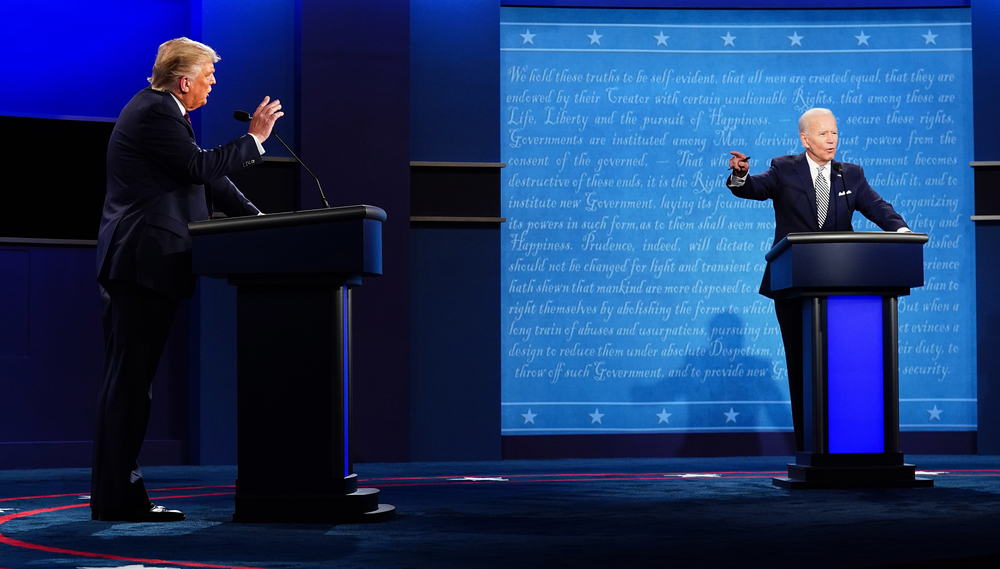
Ahead of tonight’s vice-presidential debate between Joe Biden and Paul Ryan, Hunter Baker (a Baptist political scholar) and I (a Reformed moral theologian), offer up some thoughts as “Protestants in Praise of Catholic Social Teaching” in a special edition of Acton Commentary.

Read more on Up for Debate: Catholic Social Teaching and Political Discourse…

During the recent Democratic National Convention, the party played a video which stated, “The government is the only thing we all belong to.” Daniel Kelly explains what’s wrong with such claims:

Read more on Do We Belong to the Government or Does that Government Belong to Us?…

Ray Nothstine
posted by on Wednesday, September 5, 2012

Last night, there was a moment at the Democratic National Convention in Charlotte that may have alarmed some. The line from a video produced by the host city of Charlotte, declared, “government is the only thing we all belong to.” While some have simply used the line as a reference point for partisan purposes, it needs to be widely discussed. I have to admit I found the words profoundly disturbing. Not because I blame Democrats as a whole but rather whoever penned the script in the video really had no understanding that the line was troubling. I am sure we could say that of too many Americans regardless of political affiliation. In fact, partisans are more apt to embrace this message if their guy or gal is in power. It looks like the Obama political campaign at least felt uncomfortable with the language, as they wasted no time distancing themselves from the quote.

Read more on Big Government’s Belongings?…

Joe Carter
posted by on Friday, August 10, 2012

People do not love markets,” says Pascal Boyer of the International Cognition & Culture Institute, “there is a lot of evidence for that.” Sadly, Boyer is right and I suspect he’s right about the cause too: People do not like markets because people seem not to understand much about market economics.

We don’t fully understand this antipathy, Boyer notes, because there hasn’t been much research on folk-economics, a study of “what makes people’s economic modules tick.” But I think Boyer has identified one of the key reasons why people tend to prefer government interventions to market-driven solutions:

Read more on Why People Prefer Government to Markets…

President Obama’s speech last week in which he asserted to businesspeople, “You didn’t build that,” has been getting some pretty harsh and some pretty hilarious responses.
In this week’s Acton Commentary, “It Takes a Village to Raise a Business,” I caution against responses that play into a simple individualist/collectivist dichotomy that underlays the president’s message:

Read more on Acton Commentary: It Takes a Village to Raise a Business…

Jordan J. Ballor
posted by on Friday, January 13, 2012

David Theroux of the Independent Institute concludes his two-part article on “secular theocracy” here (the full article can be read here). In this second part, Theroux observes that “C.S. Lewis understood that natural law applies to all human behavior including government officials.”

Read more on Natural Law and the Rule of Law…

Ray Nothstine
posted by on Wednesday, December 14, 2011

In terms of the blogosphere, I’m sure this polling data from Gallup published two days ago showing that fear of big government dwarfs fear of big business and big labor is ancient history. I only want to offer a few observations.

Read more on Fearing Big Government…

Acton PowerBlog RSS

Google Plus

Twitter Feed

Facebook Fan Page

Support the Acton Institute

The Acton Institute is funded through the generous contributions of individuals such as yourself. Learn more about how you can advance the cause of freedom and virtue.