On the blog of The American Spectator, Acton Research Director Samuel Gregg looks at how Europe refuses to address the root causes of its unending crisis:
Read more on Samuel Gregg: Europe Can’t Face Economic Reality…
On the blog of The American Spectator, Acton Research Director Samuel Gregg looks at how Europe refuses to address the root causes of its unending crisis:
Read more on Samuel Gregg: Europe Can’t Face Economic Reality…
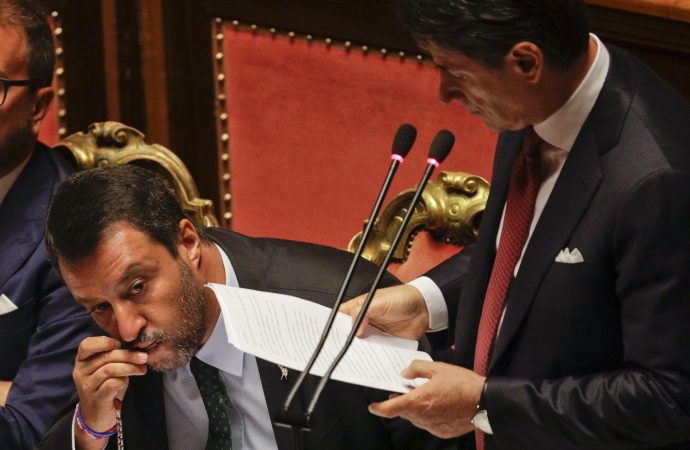
An Italian friend of mine recently complained to me while painfully witnessing the climax of the Italian debt crisis: “Cosi Berlusconi, cosi l’Italia!” (As with Berlusconi, so too with Italy!).
My friend’s comment was an allusion to the Italian Prime Minister’s personal responsibility in dragging the entire Italian nation down with him. News broke late on Wednesday that Berlusconi had agreed to step down from office, as he effectively admitted his 17 years of political power had done nothing more to fix a broken system and as more members of his loose PDL coalition defected to centrist parties.
Read more on Pointing Fingers: Berlusconi or Ourselves to Blame…
The Brotherhood of St. Moses the Black, an Orthodox Christian organization that provides information about “ancient Christianity and its deep roots in Africa,” is holding a conference Aug. 26-28 in the Detroit area. In a story in the Observer & Eccentric newspaper about the upcoming conference, a reporter interviewed a woman by the name of Sharon Gomulka who had visited an Orthodox Church several years ago on the feast day of St. Moses the Black (or sometimes called The Ethiopian). She watched “as white worshippers kissed the image of a dark-skinned man.” They were reverencing the image of the saint.
Read more on The Church’s African, Middle Eastern and Asian Roots…
Over the past few weeks, Kishore Jayabalan – Director of Acton’s Rome office – has been called upon a couple of times to comment on Italian and American budget negotiations for Vatican Radio. On Saturday, Jayabalan discussed the then-ongoing US budget negotiations:
Read more on Audio: Kishore Jayabalan on Debt and Austerity…
Kishore Jayabalan, Director of Istituto Acton in Rome, was interviewed by Vatican Radio to discuss the Italian budget. Italy has a large budget crisis, and if it isn’t resolved, it may face serious financial problems similar to those experienced by Greece.
Water is becoming scarcer and even more of a necessity than it was before. And while stories of water scarcity typically occur in underdeveloped, arid countries, the United States and other developed countries must realize they are no longer exceptions and must take into consideration the importance of water and the allocation of its use.
The original Article Who’s Responding: “The Call of the Entrepreneur” in La Spezia was written by Francesco Bellotti for the Italian newspaper “Avvenire” (translation and editorial contributions from Michael Severance):
Kishore Jayabalan responds to questions in the industrial city of La Spezia
“The Christian entrepreneur is not the person who goes about wealth creation all week and then leaves a nice offering at church on Sunday. Rather, he is exemplified by the type of person who gives the best of himself to create wealth and opportunity for himself and others,” said Mr. Kishore Jayabalan, Director of the Italian office of the American think tank, Acton Institute, while introducing the premier showing of the Acton documentary “The Call of the Entrepreneur” at the Teleliguria Sud TV studios in La Spezia, Italy last February 19.
The documentary’s showing and debate on television was organized in collaboration with the Movement of Christian Workers of La Spezia before a private audience of entrepreneurs, business executives, and free-lance professionals invited from the northern Italian region of Liguria.
Read more on Acton’s ‘The Call of the Entrepreneur’ premieres in Italy…
The front page of a recent issue of the Vatican daily L’Osservatore Romano read like an Italian “Help Wanted” listing: “Lavori per Giovani Cercasi” (cf. Aug. 13 2010).
Unfortunately, this eye-catching headline was not a classified ad targeting young professionals for job openings at the Holy See’s many curial and administrative offices – the prized “stable” positions that would have Roman youth queuing in lines much longer those to enter Sunday Mass at St. Peter’s Basilica!
In August, the Wall Street Journal Europe published an article exploring the difference in health care received by domesticated animals and humans. (see “Man Vs. Mutt: Who Gets the Better Treatment?” in WSJ Europe, August 8, 2009) The editorialist, Theodore Dalrymple (pen name for outspoken British physician and NHS critic, Dr. Anthony Daniels) argued that dogs and other human pets in his country receive much better routine and critical healthcare than humans: their treatment is “much more pleasant than British humans have to endure.”
Dalrymple outlines just why this is so: pets in the U.K. actually have it better than their owners since: a) they receive immediate treatment with no waitlists or postponed operations “(and) not because hamsters come first”; b) there is no fear that somehow they are being denied the proper treatment for economic reasons: there is “no tension, no feeling that one more patient will bring the whole system to collapse…; (no one is) terrified that someone is getting more out of the system than they.”; and c) pets in veterinary facilities have more options and flexibility for choosing a healthcare practitioner: “if you don’t like him, you can pick up your leash and go elsewhere.”
British humans, on the other hand, have to deal with navigating the rapids and swells of NHS bureaucracy, which requires the skills of a “white-water canoeist”. They must also endure interminable wait-times for prostheses and life-improving operations. Often they receive sub-standard administrative services, nursing assistance and meal provisions.
As President Obama continues to promote a Europeanization of the American healthcare model, the WSJ Europe editorialist beckons us to listen to such howling in the twilight of the Old Continent’s rapidly aging nationalized healthcare systems. Part of this howling is caused in the less dignified forms of public health services and treatment of human patients. Yet, there is plenty of loud barking over the mismanagement and abuse within nationalized healthcare across Western Europe, particularly in terms of mishandling budgets and sources of revenue. Read more on The Dog Days of European Socialized Medicine…
In the July 24 edition of the Vatican newspaper L’Osservatore Romano , a couple of articles related how Italians are reading less than their European counterparts, with 62 percent of the population failing to read even a single book during the year. “Above all, reading increases innovative capabilities, the ability to understand phenomena and in the ultimate analysis, worker productivity,” said Federico Motta, president of the Italian association of publishers.
Read more on Can the Pope Save the Art of Reading in Italy?…
Comments