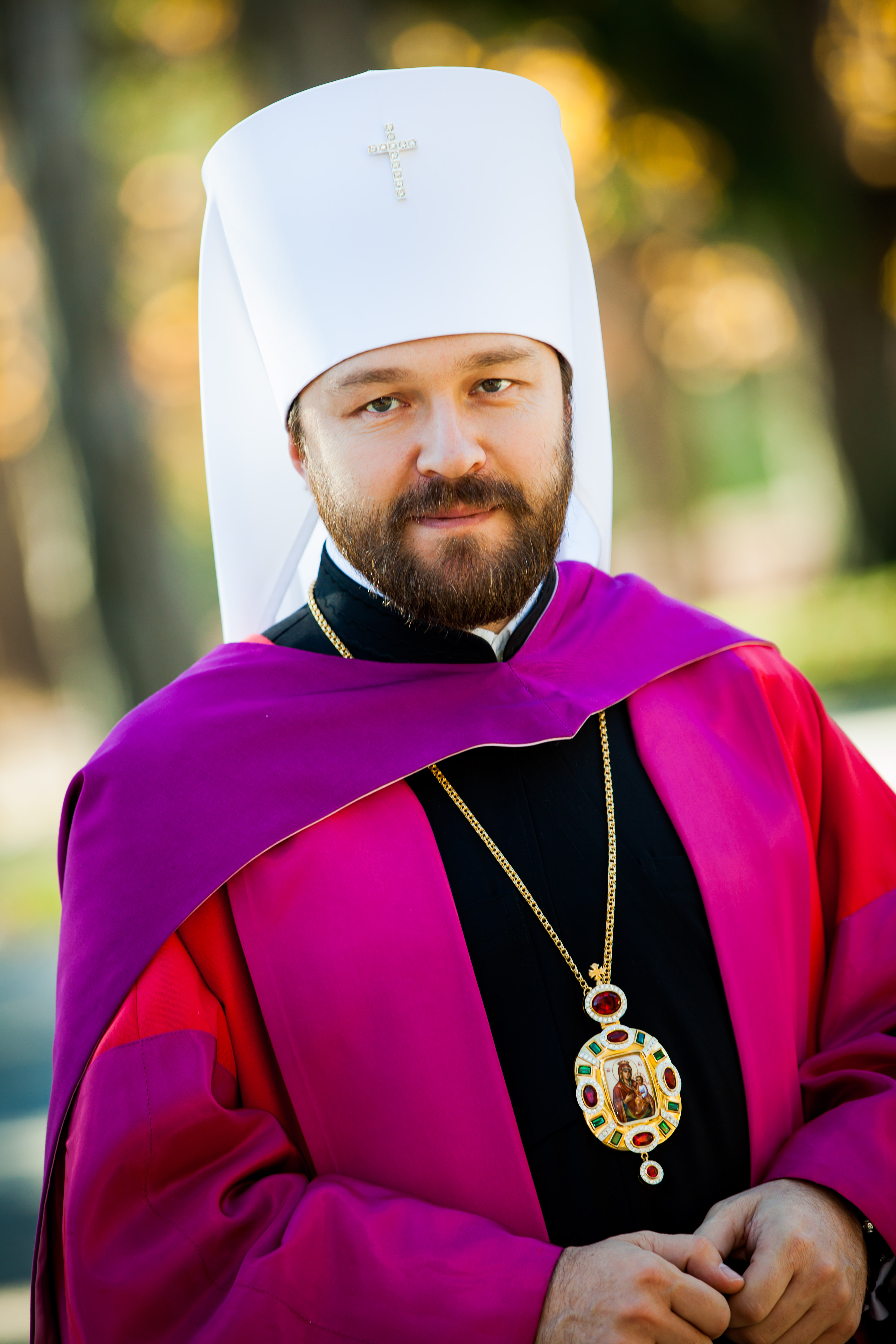
Posts tagged with: Metropolitan Hilarion Alfeyev

Metropolitan Hilarion (Alfeyev) of Volokoamsk

Metropolitan Hilarion (Alfeyev) of Volokolamsk

For Syria’s Christians, it’s a time of great peril and uncertainty. Over the Holy weekend, one Christian in Syria summed up the situation in The New York Times: “Either everything will be O.K. in one year, or there will be no Christians here.”

Read more on Religion & Liberty: Interview with Metropolitan Hilarion…

Russian Orthodox Metropolitan Hilarion of Volokolamsk, chairman of the Moscow Patriarchate’s Department for External Church Relations, met with Pope Benedict XVI at the Vatican on Oct. 16 after the session of the Synod of Bishops of the Roman Catholic Church.

In an interview for Acton’s Religion & Liberty quarterly, the Russian Orthodox bishop in charge of external affairs for the Moscow Patriarchate, Metropolitan Hilarion (Alfeyev) of Volokolamsk, warned that that the situation for the Christian population of Syria has deteriorated to an alarming degree. Hilarion compared the situation today, after almost two years of fighting in Syria, as analogous to Iraq, which saw a virtual depopulation of Christians following the U.S. invasion in 2003.

The Russian Orthodox Church has been among the most active witnesses against Christian persecution around the world, particularly in the Balkans, North Africa and the Middle East. In November 2011, Kirill, the Patriarch of Moscow and All Russia, visited Syria and Lebanon. In a meeting with Syrian President Bashar al-Assad, Kirill said that he shared a concern with Assad about the “spread of religious radicalism that threatens the integrity of the Arab world.”

That sentiment has been expressed widely in Christian communities in Syria — some of them dating to apostolic times — as civil war has progressively taken a heavy toll. Now almost two years on, as many as 30,000 people may have perished. Despite having few illusions about the nature of Assad’s autocratic rule, many Christians feared that the Islamist groups, involved in what the West initially viewed as another “Arab Spring” uprising, would eventually turn on them. Indeed this is what has happened. Entire Christian villages have been depopulated, churches desecrated, and many brutal killings have taken place at the hands of the “Arab Spring” insurgents. Most recently, Fr. Fadi Haddad, an Orthodox priest, was found murdered with brutal marks of torture on his remains. Car bomb attacks are now being waged against Christian neighborhoods. (See these backgrounders on the Syrian crisis from the Congressional Research Service and the Council on Foreign Relations). Read more on Russian Orthodox Bishop: Syrian Christians Facing ‘Extermination’…

With Europe’s traditional moral framework – Christianity – under increasing attack, the Roman Catholic and Russian Orthodox churches are drawing closer in order to combat the forces of secularism and “Christophobia.” Rev. Johannes L. Jacobse looks at efforts to set aside long held theological disputes and forge a unity of action on social questions. Subscribe to the free weekly ANC and other Acton publications here.

Read more on Commentary: Rome and Moscow Make Common Cause…

The miraculous post-Soviet revival of the Russian Orthodox Church, all but destroyed by the end of the Stalinist purges in the 1930s, is one of the great stories of 21st Century Christianity. This revival is now focused on the restoration of church life that saw its great institutions and spiritual treasures — churches, monasteries, seminaries, libraries — more or less obliterated by an aggressively atheist regime. Many of the Church’s best and brightest monks, clergy and theologians were martyred, imprisoned or forced into exile. Yet, plans are now underway to build 200 churches in the Moscow area alone.

Read more on Christian Unity and the Russian Orthodox Church…

John Couretas
posted by on Wednesday, September 22, 2010

This week’s Acton commentary from Research Director Samuel Gregg. Sign up for Acton News & Commentary here.

+++++++++

Benedict’s Creative Minority

By Samuel Gregg

In the wake of Benedict XVI’s recent trip to Britain, we have witnessed—yet again—most journalists’ inability to read this pontificate accurately. Whether it was Queen Elizabeth’s gracious welcoming address, Prime Minister David Cameron’s sensible reflections, or the tens of thousands of happy faces of all ages and colors who came to see Benedict in Scotland and England (utterly dwarfing the rather strange collection of angry Kafkaesque protestors), all these facts quickly disproved the usual suspects’ predictions of low-turnouts and massive anti-pope demonstrations.

Indeed, off-stage voices from Britain’s increasingly not-so-cultured elites—such as the celebrity atheist Richard Dawkins and others whom the English historian Michael Burleigh recently described as “sundry chasers of limelight” and products of a “self-satisfied provincialism”—were relegated to the sidelines. As David Cameron said, Benedict “challenged the whole country to sit up and think.”

Of course the success of Benedict’s visit doesn’t mean Britain is about to return to its Christian roots. In fact, it’s tempting to say present-day Britain represents one possible—and rather depressing—European future.

Pope Benedict XVI celebrates mass at Westminster Cathedral


In an article welcoming Benedict’s visit to Britain, the UK’s Chief Rabbi Jonathan Sachs observed, “Whether or not you accept the phrase ‘broken society,’ not all is well in contemporary Britain.” The facts cited by Sach were sobering. In 2008, 45 percent of British children were born outside marriage; 3.9 million children are living in poverty; 20 percent of deaths among young people aged from 15 to 24 are suicides; in 2009, 29.4 million antidepressants were dispensed, up 334 percent from 1985.

Such is the fruit of a deeply-secularized, über-utilitarian culture that tolerates Christians until they start questioning the coherence of societies which can’t speak of truth and error, good and evil, save in the feeble jargon of whatever passes for political correctness at a given moment.

But what few commentators have grasped is that Benedict has long foreseen that, for at least another generation, this may well be the reality confronting those European Catholics and other Christians who won’t bend the knee to political correctness or militant secularism. Accordingly, he’s preparing Catholicism for its future in Europe as what Benedict calls a “creative minority.” Read more on Samuel Gregg: Benedict’s Creative Minority…

Acton PowerBlog RSS

Google Plus

Twitter Feed

Facebook Fan Page

Support the Acton Institute

The Acton Institute is funded through the generous contributions of individuals such as yourself. Learn more about how you can advance the cause of freedom and virtue.