Posts tagged with: pope benedict xvi

National Public Radio did a roundup of views on what to expect from Pope Francis on economic issues. Reporter Jim Zarroli interviewed Acton Research Director Samuel Gregg and several commentators on the Catholic left. NPR host Audie Cornish introduced Zarroli’s report by observing that the new pope “comes from Argentina, where poverty and debt have long posed serious challenges. In the past, when thrust into debates about the country’s economic future, Francis had made strident comments about wealth, inequality and the markets. Now, some Catholics are hoping their new pope will play a similar role, giving voice to the poor and exerting influence on a global scale.” But Cornish cautioned that if “some say the idea that Pope Francis is some kind of economic liberal is to misread him and the church.”

Read more on Audio: On NPR, Samuel Gregg Discusses Pope Francis and Economics…

Sarah Stanley
posted by on Tuesday, March 19, 2013

Michael Severance, operations manager of the Istituto Acton in Rome, recently wrote an article for the World Catholic Report explaining why Pope Francis was a historic choice and examining  what we can expect from his papacy.

He points out that “this past week proved a historic week of firsts:”

We now have the first Jesuit pope. And the first pope named Francis. He is the first non-European pope since Gregory III, an eighth-century Syrian. And we now have the very first pope from the Americas.

We have also witnessed a pope who is shunning what some critics perceive as Vatican tinsel and niceties during these economic hard times.

Francis has refused to ride in the pope’s private car (preferring the shuttle bus) or to wear red shoes and a fur-lined cape, or mozzetta, opting for ordinary black shoes and a white cassock.

This is the first time in a very long while that we have listened to a pope who readily quips in public and frequently includes off-script interjections to prepared remarks—at his first Mass with his brother cardinals, then a second time during his first press conference with journalists on Saturday, then a third time during his Sunday sermon at the Vatican parish of St. Anne, and again only a few hours later at his noontime Angelus, when he preached from his apartment above St. Peter’s Square. Not even John Paul II was at such ease with humor and his own words so early on in his pontificate.

Since Cardinal Jorge Bergoglio was somewhat unknown before he was elected Pope, Severance has compiled a brief profile of Pope Francis, focusing the pope as a pastor, thinker, and advocate for the poor. Read more on What We Can Expect from Pope Francis…

Pope Francis

Pope Francis

Surprise was the reaction in Rome on hearing of the elevation of Cardinal Jorge Mario Bergoglio, Archbishop of Buenos Aires, to the Papacy. My colleagues in Rome told me that the Plaza was unusually quiet as the people tried to figure out what was going on.  I guess the Cardinals showed that they elect the pope on their own terms, and now everyone is wondering who Pope Francis is, how he will lead, and what will characterize his pontificate.

Intra and Extra: Challenges for the Pope in the Church and the World

The Pope’s main role is to preach the Gospel of Jesus Christ. In his first homily as Holy Father he asserted just this. “We can walk as much as we want,” he said  “we can build many things, but if we do not confess Jesus Christ, nothing will avail. We will become a compassionate NGO, but not the Church, the Bride of Christ.”  He also has a Church to govern—and he’ll face serious challenges on both fronts.  On the inside, the Church continues to reel from scandals and abuse. The curia needs to be reformed and the bureaucracy cleaned up. On the outside, Pope Francis faces a growing and hostile secularism, religious persecution from a number of fronts, dwindling number of believers in traditionally Catholic lands, including Latin America, and increasing ignorance of the basic tenets of Christianity. But there are also some real positives. The Church continues to grow in the Global South—especially in Africa and Asia. Belief is still high in Latin America, though many Catholics are leaving for the Pentecostals or evangelicals. Among U.S. Catholics, Hispanics are now the majority.  And while the Church in the West may be getting smaller, it is also more vibrant and serious. Younger Catholics are orthodox and evangelical, and dissenters like Hans Kung are aging and less influential each day. Pope Francis also has the advantage of following Blessed John Paul II and Benedict XVI, whose interpretation of Vatican II and whose intellectual and spiritual guidance set out a framework for the New Evangelization.

Francis brings several important things to his papacy. The most obvious are that he is a Latin American, and not a member of the Roman Curia. The Curia needs reform, and being an outsider with experience of diocesan dysfunction will serve him well. Further, as Archbishop of Buenos Aires he not only dealt with extreme poverty, corruption, lack of rule of law, and social and economic volatility that is common in the developing world, he also has had to contend with virulent and aggressive secularism that is common in the West.  He has been a fearless defender of human life and family, has called abortion the “death penalty for the unborn,” and has been unafraid to clash with political leaders over corruption, reminding them that social corruption is rooted in personal sin.

He also brings a long record of engagement with the poorest of the poor. Read more on Pope Francis: For the Church, the City, and the World…

New Delhi TV recently published a Agence Franch-Presse report describing the former pope’s “invisible presence at conclave:”

Retired pope Benedict XVI is gone but far from forgotten as cardinals begin voting for candidates to replace him, with his personal secretary Georg Gaenswein one of the last to leave the Sistine Chapel before the start of the conclave.

Rev. Robert Sirico addresses Benedict’s influence on the conclave:

Read more on Rev. Sirico: Don’t Underestimate Benedict’s Silent Influence…

Michael Matheson Miller
posted by on Monday, March 11, 2013

The conclave to elect the new pope is scheduled to begin tomorrow afternoon after the public Missa pro Eligendo Pontifice (Mass for the Election of the Roman Pontiff) which is scheduled at 10am Rome time.   It was at this mass in 2005 after the death of John Paul II that the then Cardinal Ratizinger famously spoke of the “dictatorship of relativism.”   At 4:30 pm Rome time, the cardinals wearing full choir dress will enter the Sistine Chapel singing the hymn Veni Creator Spiritus (Come Holy Spirit).  Cardinals will enter into conclave (from the Latin cum clave, meaning “with key”) and they will be locked away from the world with no access to television, newspapers, or mobile phones until they have elected the new pope.

As the Conclave gets underway and the world waits to see who will be the next pope, here are some helpful hints for making your way through the media storm that is already underway.

1. The papal election is not a U.S.- or European-style political event.

In our hyper politicized world where almost everything is reduced to politics it is hard for our imagination to process a public event like the election of a new pope outside of the structures of politics.  That’s not to say there’s no politics in the Church.  There’s too much of it.  Way too much. And it’s always a factor.  Nevertheless trying to understand the papal election if the light of the American political system or interest and lobbying groups will not be of much help. Read more on A Guide to the Conclave…

ROME — For all the ‘Vaticanisti’ (journalists specializing in the Vatican) sitting around Rome and interviewing one another for the last several weeks, the wholesale consumption of high blood pressure medication took a precipitous drop on the announcement Friday afternoon that the Conclave to elect the new pope would occur on Tuesday, March 12, one day later than I had predicted several weeks ago.  Now is the lull before the storm. A Mass praying for the election of the pope will be followed by the first voting session of the Conclave in the early evening.

With many media outlets waiting for that date to be announced, the remaining hotel rooms left in Rome will be gobbled up, and by Monday evening we can expect an influx of the rest of the 5000 journalists accredited to the Holy See to cover the event.

It is difficult not to compare the lead up to this Conclave to the last one I had the opportunity to witness eight years ago.  Then, of course, one of the monumental figures of the twentieth century had passed from the scene after a long and highly visible bout with Parkinson’s disease.  By the time I had arrived to provide commentary at the BBC location above St. Peter’s Square, the body of John Paul II was being translated (an elegant way of saying the body was ‘moved’) from the Apostolic Palace where the pope lived and died, to beneath the Bernini colonnades in the center of St. Peter’s Basilica. It was a slow, mournful and moving sight.  By the time the body of the Polish pope was laid in state at the foot of the papal altar lines, long line, began forming down boulevard leading to the basilica.  The crowds would grow in the following days to estimates ranging from three to four million pilgrims to pay the last respects the John Paul II. Read more on At the Vatican Conclave: The Lull before the Storm…

Acton president and co-founder, Rev. Robert Sirico, and Director of Research, Samuel Gregg, are currently in Rome for the upcoming papal conclave. Here’s a roundup of their observations, including thoughts on the legacy of Pope emeritus Benedict XVI.

Read more on Audio Roundup: Acton Vatican Experts on the Conclave…

John Couretas
posted by on Wednesday, March 6, 2013

Detroit News reporter Oralandar Brand-Williams interviewed Kishore Jayabalan, director of Acton’s Rome office, about preparations at the Vatican to elect a successor to Pope Benedict XVI. A date for the conclave, the assembly of cardinals that will elect the next pope, has not yet been set. Jayabalan said that there is no cause for concern. “They need to wait for all the voting cardinals to arrive before deciding on the date,” he told The News. “There’s a sense it’s better to take some time rather than rush it.”

Read more on Jayabalan: No Rush on Papal Conclave…

On the website of Crisis Magazine, Acton Research Director Samuel Gregg looks at the “tsunami of unsolicited advice from pop atheists, incoherent playwrights, angry ex-priests, and celebrity theologians that has erupted since Benedict XVI’s abdication.” Then there’s Hans Küng’s article in the New York Times:

Read more on Samuel Gregg: Catholicism, True Reform and the Next Pope…

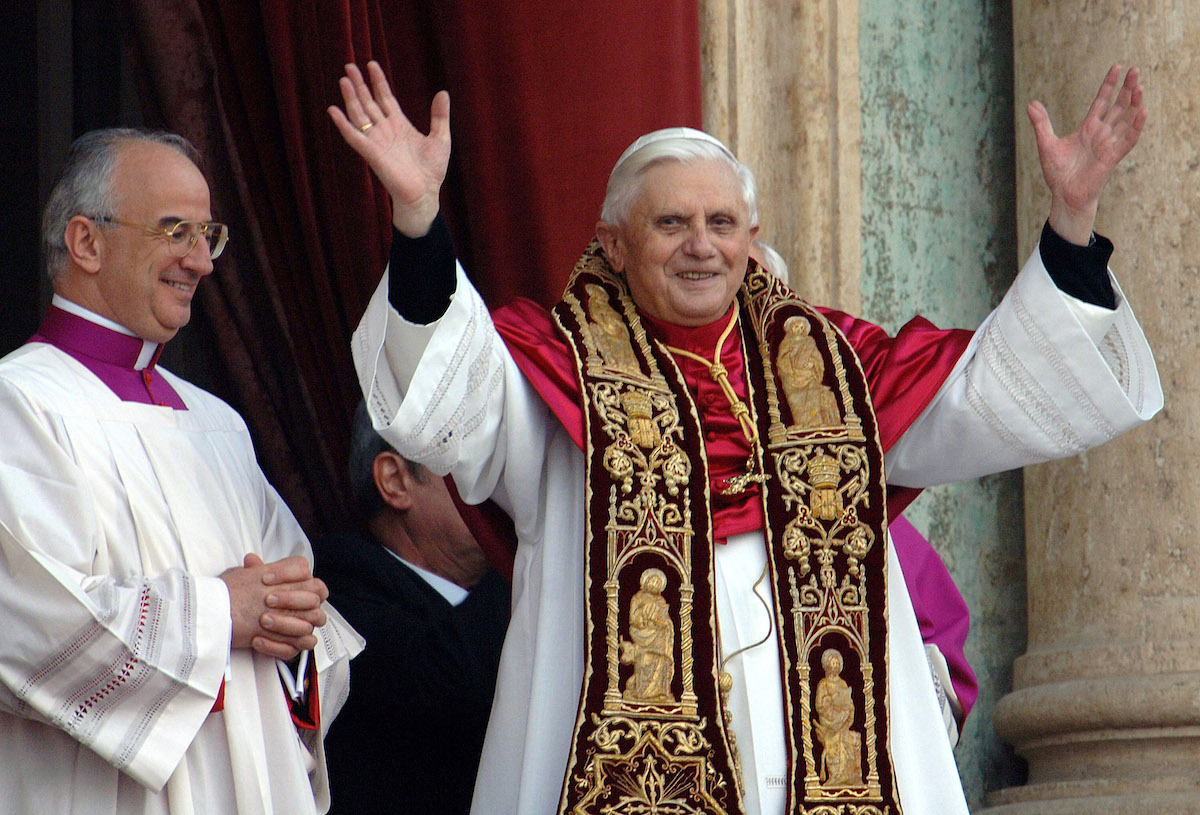
Benedict XVI Rome 2005 © Michael Matheson Miller Yesterday in front of a crowd of about 150,000 Pope Benedict XVI gave his final general audience. He steps down this evening at 8pm Rome time and will fly to Castel Gandolfo until his new residence within the Vatican is ready. He expressed his deep gratitude to the people for their prayers and confidence that God would continue to guide the Church.

Read more on Pope Benedict models his future after St. Benedict…

Acton PowerBlog RSS

Google Plus

Twitter Feed

Facebook Fan Page

Support the Acton Institute

The Acton Institute is funded through the generous contributions of individuals such as yourself. Learn more about how you can advance the cause of freedom and virtue.