Posts tagged with: religion

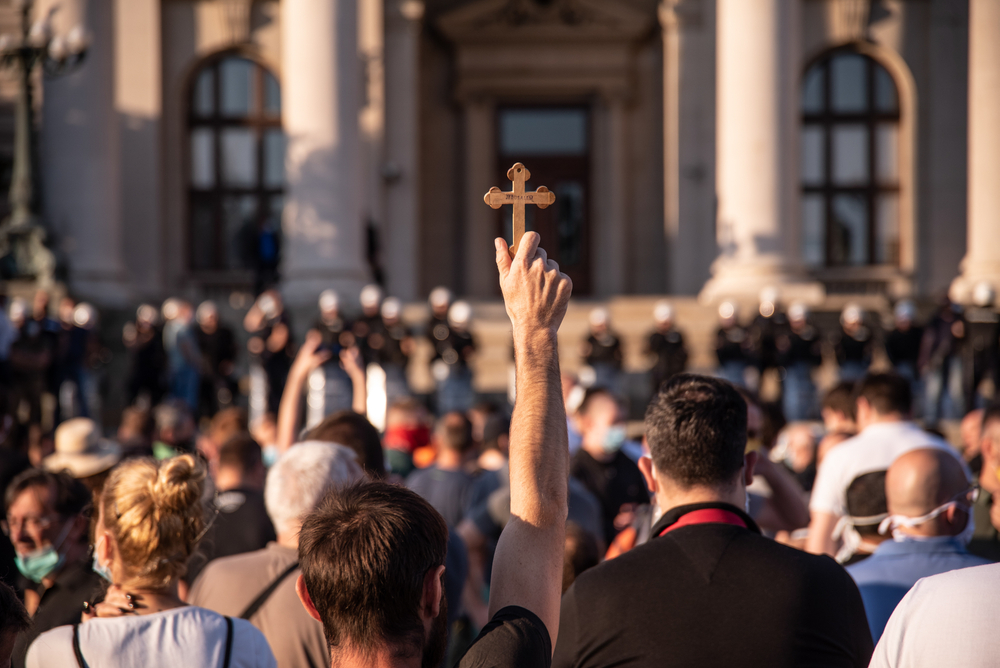
As part of the United States Conference of Catholic Bishops (USCCB) “Fortnight For Freedom” campaign, the USCCB has enumerated a number of threats to Americans’ religious liberty. Besides the on-going battle with the Obama Administration regarding the HHS mandate and the gutting of funding to Catholic programs that fight human trafficking, the bishops want us to be aware of these perils to religious liberty:church-state[1]

Read more on America: Current Threats To Your Religious Liberty…

Emperor Theodosius Forbidden by St Ambrose To Enter Milan Cathedral (Anthony van Dyck, 1620)

In the latest issue of Renewing Minds, a journal of Christian thought published by Union University, I examine two different visions of religious liberty. They are roughly analogous to the two versions of the “empty shrines” of secularism described by Michael Novak and George Weigel, respectively, as well as to the visions of the American and the French Revolution. One has to do with the freedom of the church from state control, and the other has to do with freeing the public square from religion.

Read more on Neuhaus’ Law and Religious Liberty…

dad-baby-bjorn1With the expansion of economic freedom and the resulting material prosperity, we’ve reached an unprecedented position of personal reflection and vocation-seeking. This is a welcome development, to be sure, but as I’ve written recently, it also has its risks. Unless we continue to seek God first and neighbor second, such reflection can quickly descend into self-absorbed and unproductive naval-gazing.

Thus far, I’ve limited my discussion to the ways in which privilege and prosperity can impact our views about work outside of the home, but we needn’t forget the side effects that modernity might foster in an area that often consumes the rest of our daily lives: the family.

Just as most of our ancestors had few choices about where they glorified God in business (toiling for the feudal landowner), they also had few choices when it came to raising families (who they married, how many children they had, etc.). Whether due to lack of contraception, more practical material/financial concerns, or any number of other factors, for most families, children were simply a given.

Today, much like in our approaches to job-seeking, child-bearing has come to involve a significant degree of choice, and the overriding choice of the day seems definitive. As Jonathan Last points out in his book, What to Expect When No One’s Expecting: America’s Coming Demographic Disaster, birthrates in the Western world are in a free fall, with more and more adults opting for fewer and fewer kids, if any at all. Last offers plenty of nuances as to why this is happening, pointing to a “complex constellation of factors, operating independently, with both foreseeable and unintended consequences.” But on the whole, he concludes that “there is something about modernity itself that tends toward fewer children.” Read more on Family and Vocation in a Culture of Choice…

Philip at the Solovki monastery

In the most recent issue of Religion & Liberty, the “In the Liberal Tradition” section profiles Metropolitan St. Philip II of Moscow for his defense of faith and freedom in the face of the tyranny of Tsar Ivan IV, known to history as “Ivan the Terrible.” In contrast to Ivan, who used his power to oppress his own people, Philip taught, “He alone can in truth call himself sovereign who is master of himself, who is not subject to his passions and conquers by charity.” Among the many spiritual disciplines of the Orthodox Christian spiritual tradition geared towards freeing a person from being “subject to his passions,” we can see Philip’s love of labor in his many projects at the Solovki monastery in the years before he was made Metropolitan of Moscow. Read more on Philip II of Moscow: A Model of Christian Enterprise…

Duccio di Buoninsegna 029Today is Maundy Thursday in the Western church. One account of the origin of the unique name for this day is that comes from the Latin word mandatum, which means “command.” The command referred to here is that contained in John 13:34, “A new command I give you: Love one another. As I have loved you, so you must love one another.”

Read more on Covenant, Community, and the New Commandment…

In a new video from Biola University, Dallas Willard explains how “business is a primary arrangement, on God’s part, for people to love one another and serve one another.” (HT)

Willard goes on to explain how God does not wait for Christians to use business as a means for serving the needs of the world:

If God wasn’t in business it wouldn’t even be there. It has this natural tendency to reach out to the neighbor and the neighbor and the neighbor and the neighbor all around the world. That’s in the nature of business…It’s like most of God’s operations, they are running beyond the conscious motives of the people who are doing it.

Business is a primary moving force of the love of God in human history, and it doesn’t wait until Christians get a bright idea about it…It’s just there. That’s God. That’s the kingdom of God at work…We have to recognize that God is always out front of the church and he’s working in many ways.

Yet even though God doesn’t wait for us to perform his work, this needn’t lead us to throw up our hands. Rather, such truth should inspire us to be more active and discerning in the larger economy. Through the work he’s already doing, God is openly inviting us to participate.  Read more on Dallas Willard: Business Is a ‘Moving Force of the Love of God’…

molechWe are now witnessing how some make the tie between human tragedy and federal spending. Just yesterday, Senate Majority Leader Harry Reid shamelessly implied that the accident that killed seven Marines in Nevada is tied to spending cuts from sequester. Hollywood actor Harrison Ford lamented that “accidents are going to happen” in aviation because of sequester. It’s almost if more government spending is needed to appease the wrath of the Divine State. If not appeased, wrath will reign down on humanity and nature if not given due alms. We know from Exodus that the Lord our God is a jealous God, but is the federal government a jealous god too? Slowing the rate of growth of this god stirs up anger.

Read more on Is The Divinization of Federal Government Complete?…

Michael Matheson Miller, Acton’s Director of Media and PovertyCure, joined host Hugh Hewitt on the Hugh Hewitt Show this afternoon to discuss the election of Pope Francis, and how his experiences in Argentina may influence his actions as Pope in addressing issues of poverty. He notes that Pope Francis is not a proponent of Liberation Theology, and quotes the new Pope’s earlier writings:

Read more on Audio: Michael Matheson Miller on Pope Francis and PovertyCure…

As Joe noted last week, over at Think Christian, H. David Schuringa highlights the primacy of the church’s ministry to prisoners and their families. He points to efforts both great and small:

Read more on Chuck Colson, Compassion, and Criminals…

The Emperor Constantine with his mother Helen, both traditionally commemorated as saints.

The Emperor Constantine with his mother Helen, both traditionally commemorated as saints of the Church.

This month marks the 1,700th anniversary of the Edict of Milan. While much debate surrounds the relationship of Church and state in Christian Rome, even key figures like the Emperor Constantine (traditionally considered a saint by both East and West), the Edict of Milan is something that anyone who values liberty, religious liberty in particular, ought to commemorate as a monumental achievement. While a previous edict in 311 had offered some toleration to Christians, who spent almost their first 300 years having to fear for their lives any one of many local outbreaks of persecution that periodically plagued Pagan Rome, the Edict of Milan for the first time granted the Church the same status, including property rights, as other religions. It did not establish Christianity as the state religion (that would not happen until the end of the fourth century). Even then, the history, like all history, is messy. Often different emperors had widely different practical perspectives toward their role (or lack thereof) in religion. As Lord Acton has stated, liberty is the “delicate fruit of a mature civilization,” and that includes religious liberty and Christian Rome. In all cases, it was not a total separation of Church and state, but it was an achievement, a maturation if only for a time, that marked the end of centuries of martyrdom for Christians in the Roman (now Byzantine) empire. Read more on The Edict of Milan in the History of Liberty…

Acton PowerBlog RSS

Google Plus

Twitter Feed

Facebook Fan Page

Support the Acton Institute

The Acton Institute is funded through the generous contributions of individuals such as yourself. Learn more about how you can advance the cause of freedom and virtue.