Posts tagged with: Tyler Cowen

Joseph Sunde
posted by on Friday, March 22, 2013

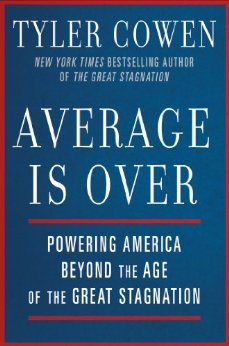
Tyler Cowen has an interesting column in last Sunday’s New York Times, arguing that despite run-of-the-mill objections to “cold” and “heartless” economic analysis, economics is, as a science, “egalitarian at its core”:

Economic analysis is itself value-free, but in practice it encourages a cosmopolitan interest in natural equality. Many economic models, of course, assume that all individuals are motivated by rational self-interest or some variant thereof; even the so-called behavioral theories tweak only the fringes of a basically common, rational understanding of people. The crucial implication is this: If you treat all individuals as fundamentally the same in your theoretical constructs, it would be odd to insist that the law should suddenly start treating them differently.

James Poulos offers an healthy response, reminding us that “no matter how solid the economic foundation for moral egalitarianism, there’s a thing or two of great moral significance that’s missing.”

Indeed, in attempting to avoid the cliché of cold-heartedness, Cowen risks perpetuating a different one: that economists ignore the mystery and spiritual significance of humanity and human behavior. The instilling of egalitarian sensibilities when it comes to seeing people as people is one thing, but part of this reorientation needs to include a recognition of the features that make each us different. Leveling things is helpful when the earth is rocky, but the bigger problem for the modern economist seems to be his propensity to create craters in the pretty green grass. Read more on What Economics Can’t Explain…

Jordan J. Ballor
posted by on Wednesday, September 19, 2012

Tyler Cowen fielded an interesting topic on his blog last week, focusing on economists who are (or were) clergy.

There’s an interesting list, including notables like the Salamancans, Paul Heyne, and Heinrich Pesch. I didn’t realize that Kirzner is a rabbi. Malthus is named first, but as the initial comment on Cowen’s post notes, anytime you mention Malthus you should mention Anders Chydenius in the following breath.

Read more on Economists and Clergy…

Rev. Gregory Jensen
posted by on Friday, March 19, 2010

obedience1On his blog, Marginal Revolution, Tyler Cowan links to an article about game show, The Game Of Death, that was recently broadcast on French television. According to the article (“Torture ‘Game Show’ Draws Nazi Comparison“) the program, “had all the trappings of a traditional television quiz show, with a roaring crowd and a glamorous and well-known hostess.”

For all that it appeared to be a typical game show, what “contestants . . . did not realise [was that] they were taking part in an experiment to find out whether television could push them to outrageous lengths.” As describe by SkyNews:

The game involved contestants posing questions to another “player”, who was actually an actor, and punishing him with 460 volts of electricity when he answered incorrectly.

Eventually the man’s cries of “Let me go” fell silent, and he appeared to have died.

Not knowing that their screaming victim was an actor, the apparently reluctant contestants followed the orders of the presenter, as well as chants of “Punishment” from a studio audience who also believed the game was real.

According to the article, some “80% of contestants went all the way, shocking the victim with the maximum 460 volts until he appeared to die” with “just 16 refus[ing] to shock the victim and walk[ing] out.”

Putting aside the morality of the project, the program parallels the study done in the 1960′s by Yale psychologist Stanley Milgram. Milgram’s “experiment measured the willingness of study participants to obey an authority figure who instructed them to perform acts that conflicted with their personal conscience.” As with the television program, Milgram found that the majority of participants in his study (A Peer Administers Shocks), 25 out of 40, were willing to follow orders and administer a fatal electric shock (and again, as with the TV program, in Milgram’s experiment, the “victim” was a confederate of the researcher and did not actually suffer any harm much less die).

As Milgram wrote in a 1974 article for Harper’s Magazine (“The Perils of Obedience“) based on his experiment: Read more on The Perils of Obedience…

Acton PowerBlog RSS

Google Plus

Twitter Feed

Facebook Fan Page

Support the Acton Institute

The Acton Institute is funded through the generous contributions of individuals such as yourself. Learn more about how you can advance the cause of freedom and virtue.