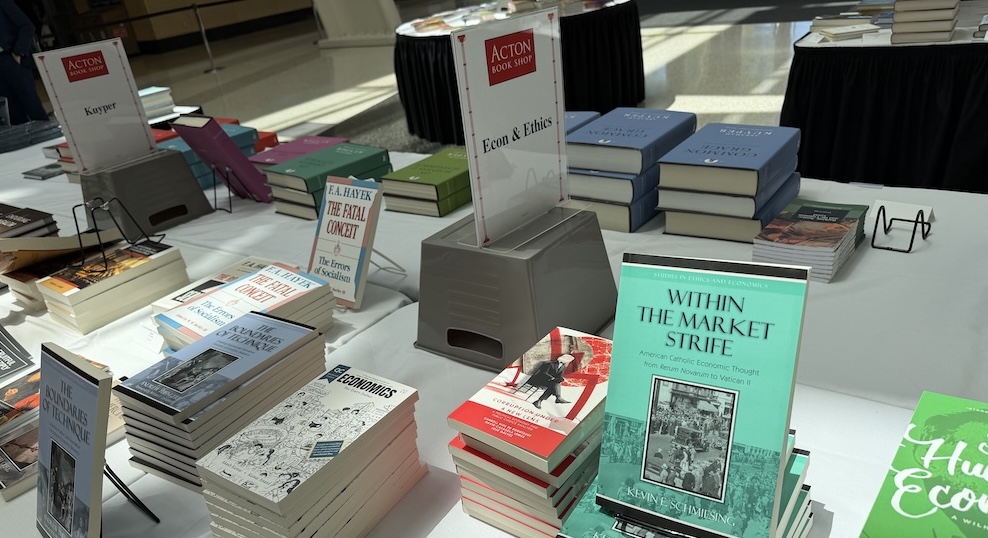
It’s that time of year again: Acton University is in full swing with long summer days and short summer nights. It’s the perfect time to add to your reading collection, so if you’re attending AU, swing by the bookstore, which carries many of these reads. If you can’t be here in person, you can have these gems delivered to your door with just a few clicks on Amazon. Even though summer is a great time to slow down, sit by the pool, and catch up on your daydreaming, policymakers are busy, and these books can provide much-needed economic insight into what works. So grab a lemonade and start with which volume catches your fancy.
- Orthodox Christian Social Thought: The Kingdom of God and the Common Good by Dylan Pahman, research fellow at the Acton Institute and founder and president of the Nicholas Cabasilas Institute, presents a comprehensive and accessible study of Orthodox social teaching. Pahman traces this tradition throughout millennia of church history, right up to modern Christian social thought and biblical theology. He expertly sets political economy upon these theological foundations, emphasizing both economic efficiency and the virtuous institutions that foster neighborly love. Covering wealth, poverty, work, and innovation, the book explores how commercial, political, and social relations function within the Orthodox tradition. Written in short, engaging chapters punctuated by lively pop-culture references, each section concludes with thought-provoking discussion questions, making it a perfect selection for church groups, classrooms, and book clubs.
- Need some reading for the kids? Make sure to pick up one or more of the Tuttle Twins series by Connor Boyak. It is never too early to begin teaching our children the economic way of thinking, and Boyak does just that in an innovative and captivating manner by bringing these realities to life through relatable stories. This is a great way for parents to start early, engaging their children in the power of economics, which allows them to thoughtfully engage with important ideas, driving home the power of entrepreneurship, human creativity, and innovation through markets buttressed by the rule of law. Check out the many titles available, including Food Truck Fiasco, Creature from Jekyll Island, and The Miraculous Pencil. Pick up a few and get reading with your kids!
- I would be remiss if I did not recommend that this year we should all return to the work of Adam Smith, the father of modern economics and author of An Inquiry into the Nature and Causes of the Wealth of Nations. Published 250 years ago, on March 9, 1776, now is an excellent time to revisit this masterpiece. Smith, a moral philosopher, can be understood as the world’s first development economist. He argues that everyone possesses human creativity but that we need appropriate institutions to unleash it in a manner that allows us to serve strangers through wealth creation. Markets allow us to extend our sympathies and seek justice in society by coordinating people peacefully through the division of labor and the productive powers of specialization. There is something for everyone in this book—and it’s one you can read and reread slowly over time.
- This title is hot off the presses and so new that it’s only available online: A History of Christian Political Economy: From the Patristics to the Present by Jordan Ballor and Erik Matson, which can be paired with the companion book, Sources in Christian Political Economy: A Reader, which features 49 texts from the early church all the way through to the modern era. Ballor and Matson present a comprehensive historical and theological account of how Christians have understood wealth, markets, and the institutions that promote the common good, spanning from Clement of Alexandria to Michael Novak. They argue that political economy must be rooted in a proper understanding of our anthropology, recognizing that people are both good and fallen, finite and interdependent, yet endowed with inherent dignity. Economics, in this view, is fundamentally about stewardship, with individual choice and responsibility at its core. The book offers both historical depth and analytical insight, emphasizing that a properly ordered Christian political economy acknowledges the essential role of market systems in promoting human flourishing and the broader common good.
- Mere Economics: Lessons for and from the Ordinary Business of Life by Art Carden and Caleb S. Fuller. Have you ever wondered where your hamburger came from? Borrowing a framework from C.S. Lewis, Carden and Fuller remind us that, just as there are no ordinary people, there are no ordinary hamburgers; in fact, the modern market makes them nearly miraculous. I’ve recommended this book before, but it’s worth highlighting again because its core message is so vital. Mere Economics makes a masterful Christian case for commerce, illustrating how foundational economic principles apply to both the minor details of daily life and the grand scale of public policy. The authors show that economic thinking isn’t just about numbers; it’s a tool to help us navigate a complex world and deploy our God-given talents for human flourishing. Accessible to beginners yet deeply rewarding for economists, this book is an absolute must-read. Grab a copy and maybe order a burger to enjoy alongside it.
Wherever your summer travels take you, there’s always time to make room for more books in your stack. Happy summer and happy reading!