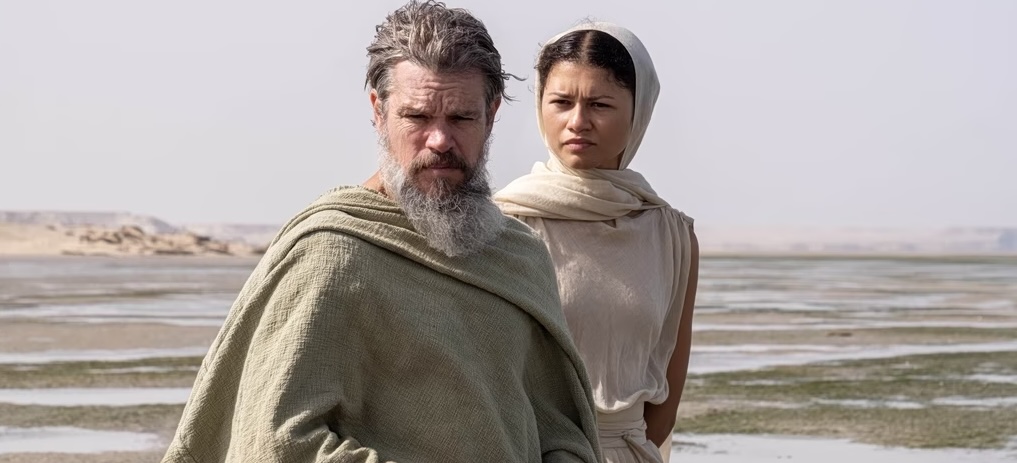
“Loved the book, didn’t care for the movie.” A truly good book is not easily compressed into a two- or three-hour format. Difficult choices must be made concerning what parts of the narrative to include, how to present the characters, how to construct the dialogue, and what details need highlighting. We typically judge such efforts by their fidelity to the source material: Can any person watching this movie have an accurate idea of what’s in the book? If not, has the filmmaker at least captured the spirit or the essence of the thing?
I generally admire Christopher Nolan’s films. I thought Memento was fresh, interesting, and sophisticated. The Batman trilogy was terrific. Oppenheimer got a plus rating from me, even if I thought it wasn’t great. I didn’t care much for Inception but I did like The Prestige. Nolan’s films have much originality, an often disjointed narrative structure, and remarkable cinematography.
Any person, having not read The Odyssey, who walks away from Nolan’s new movie thinking he knows the story would be sorely mistaken. Learning Odysseus from Nolan is a little like learning Hamlet from Disney. Nolan’s movie, however, should not be evaluated simply on how faithfully it replicates the book, in no small part because I don’t think Nolan concerned himself with fidelity. Although he studiously replicated terrain and, to some extent, dress and timeframe, he freely updated the classic in terms of dialogue and demography. I’ll confess to having little interest in the controversy surrounding his casting choices: Opposing the choice of actor because she’s black or transgendered is just as stupid as celebrating that choice for the same reasons.
Even though the credits claim the movie is based on the work by Homer, it nonetheless borrows the title and characters, raising some expectation that the move will re-present the novel. Nolan gets some things rights, and many things wrong. I think the movie is better viewed as a palimpsest than an adaptation; still, I would hope that the filmmaker gets some of the big things “right.”
At which Nolan fails. The gods, with the exception of Athena, are notably absent. Nolan completely desexualizes Odysseus’s relationships with both Calypso and Circe, in the former instance denuding the Calypso story of its central significance to the overall narrative and in the process diminishing the importance of Penelope . One consequence of this is a flattening of Odysseus’s personality, which I suppose makes some sense of Matt Damon playing Odysseus with hardly any affect. The essential elements of Homer’s Odysseus—the cunning, guile, deception, viciousness, and so forth—are largely bypassed. Instead we have an Odysseus psychically tortured and burdened by guilt, which becomes the central theme of Nolan’s rendering. The result is, ironically enough, a less human Odysseus. Homer’s Odysseus faces all the great human temptations: the desire for glory and riches (he’s a plunderer, after all), immortality (as offered by Calypso), and to know everything by yielding to the Siren’s song. None of that really plays a role in Nolan’s version.
Nolan’s reshaping of the Siren’s song is telling: rather than being tempted by the desire to know all that which the gods alone can know, to transcend human limits, Nolan has the Sirens remind Odysseus of his failings and concomitant guilt: “It [the song] told you what you most want is what you most can’t have, and what you most can’t have is what you already had and lost. . . . It was the song of all the promises I’ve failed to keep.” Rather than being tempted by omniscience, Odysseus is haunted by failure.
Nolan offers the Greek guest-friend ethic (xenia) as the code that connects Homer’s time to our own. Ancient Greeks believed that any stranger could be a god in disguise and required that the homeowner treat that person accordingly, showering him with food and drink and gifts. The guest also had reciprocal obligations not to abuse that hospitality, to be gracious and nonthreatening. This ethic operated as a strict moral code, the violation of which invited chaos. Throughout the movie, Nolan refers to this as “Zeus’s law,” which is universal, so no one whom Odysseus encounters on his 10-year journey is without excuse.
Themis was the goddess of right, justice, and good order. As an abstract noun, themis is similar to what we mean by “natural law.” We have an intuitive sense of “what is right,” and when that order is broken we experience an impending chaos. We violate it at our own peril and its abandonment signifies civilizational collapse. Even as individuals, once we sense the suspension of themis we enter an anomic state where we believe our actions have no consequences and we have no accountability.
Nolan takes “Zeus’s law” (the guest-friend imperative) and themis to be identical. We see the violation immediately in the book and movie in the behavior of the suitors occupying Odysseus’s household, wantonly consuming not only his food and wine but also trying to take his wife. Their abuse of Penelope’s hospitality clearly irritates both her and Telemachus, Odysseus’s son.
Nolan’s rendering of the story with the Cyclops contains some interesting elisions on this score. Most importantly, Nolan bypasses the fact that Odysseus and his men, having already plundered other places, entered the Cyclops’s lair uninvited and immediately began eating his food. The Cyclops surely violates themis by devouring his guests, but only after, according to Homer, Odysseus and his men did so. Nolan also ignores the famous scene where Odysseus tells the Cyclops his name is “nobody,” thus effacing the cunning and deceit that are essential parts of Odysseus’s character.
Homer’s Odysseus seems no more troubled by these serious character flaws than he does by his infidelities to the ever-faithful Penelope. (Homer has them, after they “reunite,” in bed telling each other the full story of what happened all those years Odysseus was gone. One suspects that Odysseus was not quite as forthcoming on all the details as was Penelope.) That said, Nolan adds an introspective depth to Odysseus that is missing in Homer’s original. The ancient Greeks knew little about guilt, particularly given the god’s unending complicity in everything that went wrong. “Guilt” as a concept emerges out of the Hebrew and Christian scriptures. I don’t know enough about Nolan to know how those texts shaped his narrative, but we do have some clues.
When Odysseus returns to the palace dressed as a beggar, he immediately captures the attention of Telemachus and Penelope, both of whom welcome him under the guest-friend rule. Telemachus, seeing the dying dog Argos wag his tail upon his master’s return, correctly intuits that the beggar is actually Odysseus. Penelope has no such divination, but since she is told that the beggar knew her husband she wants to have a conversation with him, and this is the key scene in Nolan’s film. She is sitting behind a screen, the same screen that allowed her to both tempt and deceive the suitors by making it possible for them to see her profile but also the tapestry she was weaving (and then undoing every night). She sits behind the screen, waiting to hear from the beggar who has Athena, the goddess of cunning and wile, at his side.
Odysseus takes his seat on the other side of the screen with his back toward her. The scene represents a confessional, a perception reinforced by Nolan’s set directions in the original screenplay. Earlier in the movie Telemachus approaches Penelope as she sits behind the screen, and according to the screenplay “Telemachus mounts the stairs, sidles up to the screen like a confessional, speaking softly.” Telemachus later tells Penelope what he has learned from his trips abroad. “Everybody in Sparta’s talking about a coming catastrophe, an age of darkness brought on by people from the sea violating Zeus’s law.” PENELOPE: “So the stories are true. Our civilization is collapsing.”
Now at the end of the movie Odysseus enters the confessional, talking to Penelope but looking at Athena while he makes his confession. This is not the first confession he makes to Athena. We forget that Odysseus was in many ways a very bad leader, making a series of catastrophic decisions that led directly to his men’s death. Homer’s Odysseus might feel sadness over the death of his men, but not guilt; Nolan’s Odysseus feels the full weight of guilt.
ATHENA: When you watch your men die do you see chance? Or do you see consequence?
(Odysseus turns on her)
ODYSSEUS: I see consequence. I see my failure.
ATHENA: What if their deaths aren’t your failing but theirs?
ODYSSEUS: I lead them. I led them here.
ATHENA: And who led you? Why do you put yourself above the Gods? Why do you claim responsibility? Why don’t you want to go home?
Athena’s assurances concerning his errors of leadership do not fully exculpate his guilt, because his biggest crime was not his failure but his successes, and his greatest success was also his greatest moral failing: the Trojan Horse. Homer presents the story as completely consistent with Odysseus’s gift for deception, but having downplayed that aspect of Odysseus’s character Nolan changes Odysseus’s role. As the Greeks storm and destroy the city, Odysseus walks through the city almost passively, dismayed by what he witnesses. One of the innocents slaughtered by the soldiers, a young woman decapitated in front of Odysseus, looks at him pleadingly before the sword falls. The screenplay underlines this scene: “It is the person we have seen as Athena.” (Both played by Zendaya.) Now, as he makes his confession, he realizes that the gift of the horse was the complete undoing of the guest-friend ethic, the only source of order in the world. “To burn the walls of Troy,” he confesses in the third person, “was to burn the world entire. Including his home.”
How could order be restored or guilt expelled? “What if he knew exactly what he’d done?” Penelope, seeking to absolve him, “What all of you had done.” His guilt cannot be so easily exculpated. “One man’s idea. One man’s trick to break Zeus’s law forever.” Odysseus speaks in the third person because Penelope does not yet realize it’s him. He continues: “The breaking of Zeus’s law is spreading like cancer. Our age of bronze is collapsing. And maybe he couldn’t bear to see the ruins of what he’d done, anywhere. Least of all his home.”
The suitors had already fully violated Zeus’s law not only in their abuse of Penelope’s hospitality but also in the way they treated the beggar Odysseus. Is there any way order could be restored? Both Homer and Nolan address this in part by having Odysseus slaughter the suitors. Homer, however, concludes that with a beautiful reunion of Odysseus and Penelope, their home having been restored as a prelude to a kind of cosmic restoration that occurs when, while Odysseus and Telemachus visit Laertes (Odysseus’s father), they fight the revenge-seeking families of the suitors. Finally the gods step in and bring an end to the conflict, establishing peace. Zeus has restored Zeus’s law, but only after Odysseus prepares to leave Penelope once again in order to make a sacrifice to Poseidon and to honor the dead.
Nolan’s film ends very differently. After he slaughters the suitors, the wounded Odysseus stumbles toward Penelope, the scene having none of the intimacy or beauty of the reunion as Homer presents it. In the movie she holds him, wiping the blood from his face. “My love,” she whispers, “you came back.” One would expect him to respond with some sort of complementary endearment, but reuniting with Penelope was never really his goal. Confessing guilt so that, as king, he could restore order was the point. “At last. At the end . . . to see my beloved Ithaca one last time.”
Nolan exiles Odysseus for his crime against the suitors, that one last, though justified, violation of Zeus’s law. And this is a theme in Nolan’s films: There must be retribution and violence to achieve order, but there must be a price to be paid for its use. Having returned home to Ithaca, he must now leave it, but he leaves it with Penelope at his side. “Telemachus will be king. And we’ll head into the unknown west to honour my men. Together.” We now understand Odysseus’s (failed) effort to keep Telemachus’s hands completely clean in the battle with the suitors. Only a man free of guilt could rule well. Odysseus rather than Zeus has restored order, but in the process gave up the right to rule to his blameless son. This is how we might uphold Zeus’s law without a Zeus.
“Civilization will rise again,” Penelope assures him. He replies, with some ambiguity: “A new dawn will break over the darkened world … and our mistakes will once again be forgotten,” which I take to mean that they will likely be repeated. But perhaps the cycle can be broken by every age and civilization remembering anew, and I think that’s Nolan’s best hope. His movie is a call to remember.
Nolan has given us a very un-Greek reading of The Odyssey, but I don’t regard the movie as a failure. It may be lousy Homer, but it’s pretty good Nolan. He’s arguing that the renewal of the Greek hospitality ethic is a tonic for the poison that’s destroying the West. This explains his casting choices as well. And let’s face it: It’s a compelling ethic, particularly when one considers the reciprocal duties of host and guest. But can that ethic alone do the work he aspires for it? He’s trying to get us to realize that the maintenance of our civilization, during a time of immigration crises and tribal warfares, requires some kind of hospitality to those we regard as enemies. It is an almost-Christian ethic he offers: not quite the golden rule, but almost. Not quite a story of guilt and forgiveness and redemption, but almost. Not quite a vision of peace and good order, but almost. Not quite a story about love, but almost. Homer’s Sirens sing the truth in full; Nolan’s only in part.
Nolan finds himself drawn to the use of Christian symbols to remind a secular age about the consequences of playing with nihilism. I don’t think he thinks Christianity is the answer—his use of the guest-friend relationship seems like some sort of warmed-over progressivism that draws its moral heat from the smoldering ashes of Christianity. I think his central insight holds, however: There is a universal law concerning how we treat others, the violation of which destroys civilizational order. Using force to uphold that law is, at best, morally compromising and requires both confession and penance. A truly just order requires leaders who don’t have blood on their hands. Being an American no more exempts you from that than being the King of Ithaca absolved Odysseus.